World of Warcraft: Wrath of the Lich King • Page 2

On an Arctic roll.

Flying out to Blizzard's California headquarters this week to see the second World of Warcraft expansion, we felt neither apprehension nor any great excitement. After the reinvention and reinvigoration that was first expansion The Burning Crusade, Wrath of the Lich King seemed a more workmanlike sequel: ten more levels, a new continent, a new profession, a new class, a new battleground, all as expected, little of it pulse-raising. Fine; Blizzard had earned the trust that it would get it right, and the right to stop driving itself so hard.

We should know better. A lot more detail and a little more time on Lich King remind us that laurels - and Lord knows there must be a mountain of them stored somewhere in this clean white campus - don't get rested on at Blizzard. A stunningly brave revamp of raiding is the big surprise; every raid dungeon in the expansion will be playable with either 10 or 25 players, opening the full sweep of the game to far more people.

Then there is the new vehicle combat technology. And the fact that the Death Knight, the new hero class, will grant a 55-level head start on any server. And a raid encounter which changes over time.

And the deft handling of its grand narrative (the war against the Scourge and its Lich King, the former hero Arthas). And the further leap in the quality, variety, detail, and entertainment value of the quest design. And the seamless blend of dramatic high adventure with the lyrical and humorous tone of the early levels of the original game. And the sheer, electrifying beauty and scale of it all.

Scale is the first thing that hits you. Northrend is considerably larger than The Burning Crusade's Outland, and is composed of nine immense zones. Dragonblight, situated between the two starting areas - Borean Tundra in the west and Howling Fjord in the east - is the largest zone the WOW team has ever built.

Don't expect the desolate expanses of the bigger areas of the original game, though. Setting off on a cross-continental hike, we discover a far richer variety within single zones than you can find anywhere in the existing game. A greater sense of spectacle and a more evocative sense of place, too, which is no mean feat. Blizzard's world-builders remain in a class of their own.

1

Grizzly Hills: the green bit.

Howling Fjord, familiar from last year's BlizzCon unveiling, is a wooded plateau above towering cliffs, peopled by angry ten-foot Vikings (the Vrykul). It's connected by boat to Borean Tundra, a vast, otherworldly wilderness with rolling dunes and a haunted shoreline plunged into an eerie, grey, flickering half-light. Here, we help out the Tuskar walrus-men and join D.E.H.T.A. - Druids for the Ethical and Humane Treatment of Animals - in their campaign against the rapacious dwarf hunter Hemet Nesingwary, eventually riding a mammoth into battle and deploying its devastating charge, trample and bellow attacks.

This is also where you'll find The Nexus, a new instance with level 70, level 80 and raid wings. This airborne spiral of ice, crackling with lightning, is home to the evil Blue Dragonflight, and one of its wings will use the vehicle combat system to allow whole parties of players to fly drakes through it, bombarding the enemy. As with The Burning Crusade, the aim is for 5-man "levelling" dungeon wings to take a lunch break-friendly hour or less to complete. Blizzard is working on providing more context for them too, leading toward them with strong questing storylines, as it did with the low-level Deadmines dungeon in the original game.

Borean Tundra: the blue bit.

As admirable as all this is, you have to feel that the re-use of a couple of "classic" dungeons is a little cheeky. Stratholme returns as a new Caverns of Time instance, replaying events from Warcraft III, while Naxxramas has been transformed from the hardest raid in the original game to the easiest raid in Lich King, for all those who didn't catch it first time around.

Many more will, thanks to the new raiding structure. Following the huge popularity of the 10-man dungeons in Burning Crusade, all raids in Lich King are available for 10 or 25 players. These two tracks work similarly to Burning Crusade's Normal and Heroic modes for 5-man dungeons (which also return); they both offer a full progression in difficulty, but 25-man raids will find better loot, and more of it. It's a brave move, and a brilliant one, granting admission to the greatest challenges and narrative climaxes in WOW to more than just a committed hardcore.

Moving deeper into Northrend, Dragonblight is a snowbound region of icy forests and cracked mountains, punctuated by the grandiose shrines of the five Dragonflights and Wyrmrest Temple, where the Chamber of Aspects will offer a series of different single-encounter short raids with dragon bosses. You'll also come up against Arthas for the first time here - the final encounter with him won't be until the final patch of the Lich King cycle, some time after release - and be reunited (violently) with the insane Scarlet Crusade.

Next door, Grizzly Hills provides a pure hit of early-level nostalgia, a flashback to classic WOW. Special guests include the endearing, troublesome Furbolg and Kobolds, human characters that hark all the way back to low-level Westfall, the exploitative Venture Company, the Worgen werewolves led by a resurrected Arugal, and a shattered, evil sister city to the Alliance capital, Ironforge.

We're also shown two never-before-seen zones: Zul'Drak and Sholazar Basin. Zul'Drak is a single, giant ziggurat, the broken civilisation of the ice trolls, who've gone mad after sacrificing their animal gods in an attempt to fight off the Scourge. There's another stunning dungeon here, Drak'Theron Keep, where improbable dinosaurs roam and Scourge necromancers overwhelm players with waves of resurrected Trolls. The Argent Dawn faction returns in Zul'Drak.

Finally, there's Sholazar Basin, a lush tropical oasis in the midst of Arctic wastes, reminiscent of the original game's Un'Goro Crater. Here you'll take part in a faction-reputation war between the Wolvar (sentient wolves) and Oracles ("the next evolution of the Murlocs" - a worrying thought). A much lighter take on reputation gaming is promised here, with players actively encouraged to defect to the other side at will.

Of the remaining three zones, all we really know are the names: Crystal Song Forest, The Storm Peaks, and Icecrown Glacier, where the final dungeon, Icecrown Citadel, will appear after launch. Northrend is rounded out by the flying wizard capital, Dalaran, and open-world player-versus-player zone, Lake Wintergrasp.
3

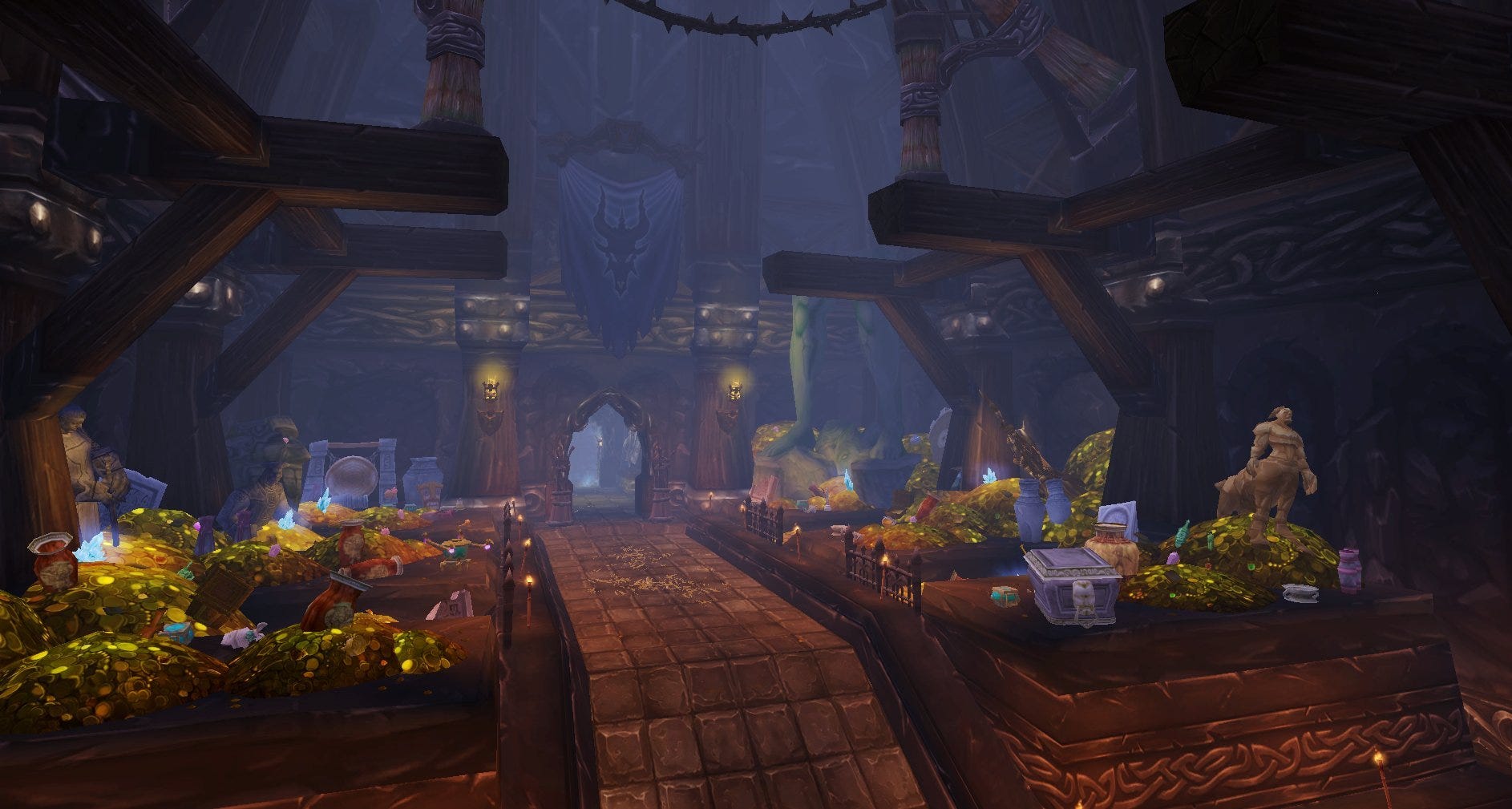
Utgarde Pinnacle: the loot bit.

If Blizzard does still have something to prove, it's in PVP. As popular as the game's battlegrounds and arenas are, there isn't much about them that's massive - they mostly play host to fairly standard, if enjoyable, tactical/twitch gaming archetypes on a small to medium scale. Burning Crusade's efforts to revive open-world warfare were its only major failure. We can't say for sure whether Lich King will succeed here, as Lake Wintergrasp and the new battleground weren't shown, but we can shed a little more light on them.

Wintergrasp is home to a valuable mine, guarded by a keep, which Alliance and Horde are fighting over. One side defends and the other attacks according to a set, rolling schedule; the attackers attempt to bring down the destructible defences with siege engines, and both sides fight over outlying towers and siege workshops. Successful attackers will defend in the next event, while failed attackers will be granted more resources for another go, as a balancing device. The unnamed battleground, meanwhile, is an island located off the southern coast, and described as a "D-day invasion scenario".

Zul'Drak: the troll bit.

Wintergrasp is a kitchen-sink attempt to create a single, intense focus for world PVP, with more involved gameplay and set event times to galvanise players into fighting. Both it and the battleground will also show off the new vehicle technology, which introduces physics and handling characteristics - including inertia, turning circle, grip and suspension bounce - to land and airborne vehicles and special mounts. It also allows for up to eight passengers per vehicle, and brings up bespoke action bars and skills for vehicle and turret operators. It was intended to be used solely for PVP siege weapons - Dwarven steam tanks, Forsaken plague spreaders and Orc demolishers.

Quest designers, however, got carried away with other ideas, introducing crazy vehicle quests that are an exponential evolution of Burning Crusade's bombing runs - throwing flaming oil at Worgen from horseback, airlifting supplies in a gyrocoptor, and yes, mammoth wrangling. We also see tanks and parachutes, and there's even talk of allowing players to take a passenger on regular ground or flying mounts. All of which is conventional stuff in regular gaming, but a huge dose of wish-fulfilment in an MMO, and all the more impressive for being retro-fitted into an older game engine.

Disappointingly, we don't see any destructibility first-hand. Something else we don't see - but do talk about - is the new profession, Inscription. Inscribers will create glyphs that allow players to modify their spells and abilities. Going by the first recipe, which requires Peacebloom, they'll rely on the herbalist gathering profession. Every player will get a new spell book page to which they can add six glyphs - currently, four major and two minor.

Major glyphs will be effective in combat - adding damage over time or stun to a physical attack, for example - while minor glyphs will give convenient or cosmetic improvements, removing the need for some spell reagents. Like jewels and enchants, they'll be useful to every player; unlike enchants, they can be sold on the auction house, and indeed plans are afoot to allow enchanters to use auctions to sell their wares as well.

One rather important new feature of Lich King remains to discuss: the first new character class since WOW launched, and the first Hero class, the Death Knight. This plate-armoured undead warrior will specialise either in dealing damage or taking it (tanking), and is available to every race. We didn't get to play it for ourselves, but we did see it in action and hear more about it, and were frankly amazed. Show-stopping, inventive, and designed for fun before balance, this is WOW class design at its best.

Contrary to initial plans, the only requirement for creating a Death Knight, which starts at level 55, is another character at 55 or above. But they don't need to be on the same server, making the Death Knight a sensationally welcome fast-track to the later levels if you want to join new friends. Another barrier lifted. The Death Knight has its own starting zone and quest line, gets a Death Charger mount as a quest reward, and has an accelerated learning curve - you start with six skills and gain two every level for the first few levels at least.

5

Howling Fjord: the Viking bit.

Its twin resource mechanic of runes (in a customisable combination of six, used to cast spells) and runic power (built up over time to unleash finishing moves) is a fair bit more involved than anything else in the game - not for novices, but with fascinating potential. There are three "presences", aligned with three talent trees: Blood, Unholy and Frost. Frost deals damage, Blood is for tanking - caster tanking especially - and Unholy has a PVP focus, with increased movement and attack speeds.

Notable skills include the abilities to heal undead characters, convert magical damage into runic power, perform pulls and knock-backs, and summon powerful Ghoul minions which can leap, stun and be sacrificed for health. The Death Knight can even resurrect other players as Ghouls, with a temporary set of bespoke Ghoul abilities. The Tauren Death Knight we saw in action was a rampaging force of nature, much more showy and reckless than a Warrior, and we can't wait to get our hands on one.

Like so much of Wrath of the Lich King, the Death Knight is a bold, grand gesture; in both its design, and the way it's made available, it changes big things about WOW, and does so for good. Expected it might have been, but conservative it isn't, and what's more, it has a perfect thematic link to the new geographical and story elements of the expansion.

Vehicle combat: the best bit.

But it's that geography, and that story, that look like being Lich King's greatest achievements. Everything about this expansion has a momentous, epic sweep to it; the music is spine-tingling, the environmental art is breathtaking, the zones lead smoothly into each other. Even the shortest, most throwaway quest lines seem to take you somewhere interesting; while the pervasive main plot inspires a sense of grand adventure, of common purpose, that should finally bring WOW's disparate players together, and respond to the new benchmark in MMO storytelling set by Lord of the Rings Online.

If Burning Crusade was a wild explosion of ideas, then Lich King is shaping up to be a smoothly orchestrated crescendo of them. It brings to mind the elegance, coherence and sense of direction of the Blood Elf starting areas - perhaps the jewel in Burning Crusade's crown - only achieved across an entire continent.

"Northrend's been kind of a coming home," lead designer Jeff Kaplan told us. Despite the fact that Blizzard has been working on WOW non-stop for some eight years now, he maintains that his team is currently "in love with it". As surprising as that it is, we don't doubt it for a second. In every aspect of Wrath of the Lich King, it shows.

Comments (50)

Comments for this article are now closed, but please feel free to continue chatting on the forum!

  • Loading...hold tight!