Version tested: Wii
MaBoShi: The Three Shape Arcade
- Developer: Mindware
- Wii Points: 800
- In Real Money: GBP 6 / EUR 8 (approx)
It's always nice to be surprised (unless the surprise involves a clown shining a torch in your face in the middle of the night) and MaBoShi is a very surprising game. It's a quiet, unassuming little thing, sitting there on the Wii Shop shelf and doing very little to alert you to the evil genius lurking behind its obscure title.
It's a compound word, you see, made up of the abbreviated Japanese words for Ball (maru), Stick (bou) and Square (shikaku), and these are the geometric shapes around which the three mini-games within revolve. Often literally. As the suffix suggests, this is a game made up of three parts - one game for each shape, all using minimal controls. The Ball game involves a constantly rotating sphere trapped in a wooden circle. Pressing the A button reverses the direction of the rotation, and you must use this basic Newtonian concept to manoeuvre the ball around the play area, hitting tiny enemies before they can escape.
The Stick game uses concepts of movement familiar from the hammer event in countless track and field games. There's a constantly spinning stick, with a vulnerable "core" at one end. This core is the centre of the stick's rotation, and pressing and holding A launches the stick using the momentum of its swing. Destroying blocks and enemies is the goal, but only the stick can strike these objects. If the core takes a hit, it's game over.
Finally, the Square game is a little like Snake, or the light-cycles from Tron, but with a twist. You move a tiny square around a vertical grid using the d-pad, leaving a trail of fire in your wake. However, the screen only scrolls every time you move. Green blocks can be destroyed by touching them with your fiery trail, but all blocks must be burned up by the time they reach the bottom of the screen.
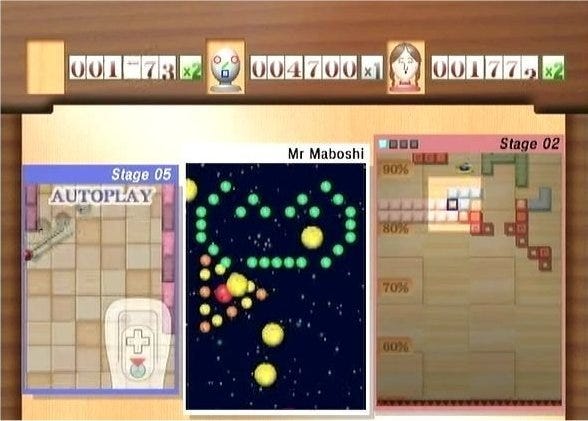
That's just the basics, but already you've got a fantastic trio of physics-based arcade puzzle games. MaBoShi goes one further though. You play your chosen game in one of three parallel windows. After a short time, AI players will start playing in the other windows - or human players can join in and do the same. Here's where it crosses over into the realms of genius: although the playfields are separate, they can affect each other. Swing the Stick off the edge of its box, and it can destroy blocks in the Square game or wallop the Ball. Destroyed enemies from Ball will arc across the three boards, as will burning blocks from Square.
It's a multi-tiered gameplay system that demands not only fast reactions, but also mind-bogglingly complex mental agility to take account of all the factors in play. Your actions can help, or hinder, the other players, by accident or design. It's deceptively simple, yet incredibly rich the more you think about it. A million points is your goal, as dictated by the sporadic appearances of Mr MaBoShi, but with only one life per game it's a goal you'll really have to work at.
Judged purely on its ideas and gameplay, MaBoShi comes highly recommended to anyone with a taste for Japan's oddball puzzle games. And yet there's still more to unearth through dedicated play, including replays of your best runs that you can send to your Wii Friends, as well as the ability to download a smaller version of the game to your DS - completely free. And all this for just 800 Points. Such thought and generosity puts most of the WiiWare line-up to shame.
9/10
Critter Roundup
- Developer: Epicenter
- Wii Points: 1000
- In Real Money: GBP 7.00 / EUR 10.00 (approx)
Speaking of shameful WiiWare releases, here's another one to help put MaBoShi's quirky wonders into perspective. It's a remake of Qix, the arcade game in which you use a cursor to fill in a large arena by drawing lines to form self-contained sections, and was served up to American gamers back when WiiWare launched.
You're a farmer, and must build fences across paddocks to keep your different animals apart. You're also a really crap farmer, since the slightest contact with your livestock kills you stone dead. Power-ups occasionally drop into play, allowing you to move faster, attract animals to a certain spot or shoo them around with a squirty thing. You can jump over fences, or smash them with a remote waggle.
There's nothing terribly wrong with all this in theory, but the game's shocking lack of polish makes even this rudimentary gameplay a real chore to get through. Most immediately obvious is the sluggish pace, with your character feeling like he's moving through custard. The controls are also unresponsive, with the fence-smashing in particular proving to be a right old fiddle. The gameplay really doesn't evolve as you play, so the option to have up to four players all running around and avoiding pigs is of dubious value. The same goes for the small brace of tepid mini-games that you can unlock.
With its lumpy graphics and stiff gameplay, Critter Roundup was already guaranteed a swift kicking, but the fact that it joins the troubling list of games to have plumped for the 1000-Point price-tag despite offering precious little entertainment ensures it a special place in the WiiWare Hall of Horrors.
3/10
Bio Miracle Bokutte Upa
- Platform: NES
- Wii Points: 600
- In Real Money: GBP 4.20 / EUR 6 (approx)
Sometimes referred to as Baby Mario because of a hastily rebranded pirate cartridge, this oddball little platform game really doesn't deserve to be mentioned in the same breath as Miyamoto's genre-defining series, but that's not to say it doesn't have some charm.
You play as a crawling baby - he's a prince out to stop an evil monster, if you give a toss about the story - and must use your rattle to clobber the various monsters patrolling the platforms ahead. Once struck, the bad guys inflate and start to float off, at which point you can jump on them and use their drifting corpses to reach new areas. Or you can clobber them again, and send their balloon forms ricocheting around the screen, damaging other enemies - and potentially yourself.
It has the sort of "what the hell?" appeal that you want from a previously unseen Japanese game, but it also comes with several throwbacks to its 1988 vintage that make it less than desirable. Linear scrolling, for one thing. Once the screen has rolled forwards, there's no going back. Also, it's one of those games where losing a life to the boss means reappearing at the start of the level. Often frustrating and rather basic, there are better ways to spend 600 Wii Points.
5/10
Dig Dug
- Platform: NES
- Wii Points: 600
- In Real Money: GBP 4.20 / EUR 6 (approx)
And so the last, and strangest, addition to the Hanabi Festival. While it's technically true that the NES version of Dig Dug never made it to European shelves, that hardly makes the game a rare obscurity. It's Dig Dug, an arcade game that was commonly found in provincial arcades across our continent, and one that has been well represented in various home versions for other formats. Heck, when Xbox Live Arcade has already got a version with online leaderboards and other modern trimmings, the justification for charging an extra 100 Point "import fee" is severely diminished. It's not even a particularly good emulation, with lots of sprite flicker to distract you.
Having said that Dig Dug is still a fine little game, if not quite the sort of timeless classic that can still be used to demonstrate how exquisitely simple great game design can be. You run around underground, you pump up monsters and squish them with rocks. It's cute and fun, and deserves to be remembered, but it's not something you'll keep returning to. It's no Bubble Bobble, put it that way.
6/10
