Version tested: Wii
There has already been plenty of debate about Wii Music. Some say it's another bold move by Nintendo to explore the wider uses of console technology and expand the gaming demographic. Some say it's another sign Nintendo is abandoning its hardcore fanbase in order to pursue a more lucrative agenda. Others say fcuk u in ur stupid ass Nintendo Wii Music sux ballz i want teh realz next gen.
But most of the debate has been about what Wii Music actually is. Is it a videogame? Is it a toy? Is it a creative tool? Is it a learning device? The answer is, it's attempting to be all of those things. The bad news is, it's not very good at being any of them.
Let's start with the basics. Wii Music features more than 60 virtual instruments, ranging from the obvious (drums, guitars, pianos, string instruments etc.) to the more obscure (sitars, banjos, DJ turntables) and the downright silly (dog and cat noises).
Each instrument is played using one of four control systems. The Piano method involves waving the remote and nunchuk up and down as if banging away on a keyboard. To play Guitar-style instruments you hold the nunchuk as if it were the neck, and make a strumming motion with the remote. The nunchuk also represents the neck when using the Violin method, and the remote is used as a bow.
In Trumpet mode, you hold the remote as if it were a wind instrument and press the 1 and 2 buttons to make sounds, raising or lowering the controller to increase or decrease the volume. You can also press buttons while using the other playing styles to produce different effects such as tremelo, glissando and arpeggio, but this isn't obligatory.
In fact, nothing in Wii Music is obligatory - you don't even have to worry about playing the right notes or keeping to the rhythm. Songs will sound better if you bang away in time, but there's no scoring system so no penalties. You even get to award yourself points after each song according to how well you think you did.
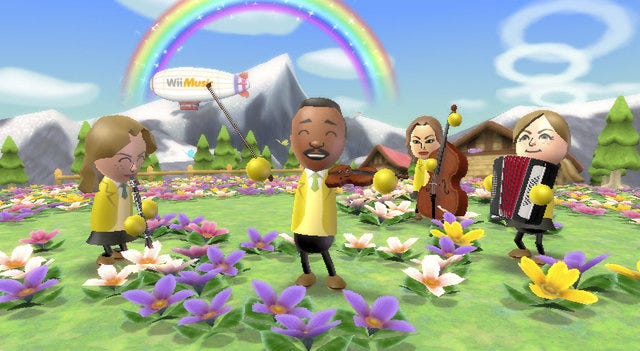
It's unlikely Nintendo is trying to attract Gears of War fans with this title.
In this respect, Wii Music is very different to traditional videogames. But while there are no penalties, there is a reward system; new tracks, environments and instruments are unlocked by completing lessons and recording videos.
Game modes include 'Quick Jam', where a song, part and instrument are chosen for you, or a 'Custom Jam'. Here you can choose whether to play the melody, harmony, chord, bass or percussion parts. There are 50 songs to unlock, including classical pieces (Ode to Joy, Four Seasons), nursery rhymes (Twinkle Twinkle Little Star, My Grandfather's Clock), "as made famous by" pop hits (Every Breath You Take, Wake Me Up Before You Go-Go) and Nintendo theme tunes (F-Zero, Zelda, Super Mario Bros.).
There is some fun to be had with picking your song and instrument, changing the tempo and trying out different musical styles. I enjoyed beatboxing over a super-fast classical version of Material Girl, for example. For about three minutes. If you're really dedicated you can play through the song again and again, recording each part yourself. But this takes time and frankly, the novelty doesn't last that long.
It's this aspect of Wii Music, the ability to play with different instruments and experiment with combinations, that makes it feel like a toy. But does it have any value as a musical tool? To help answer that question I got some help from a couple of people who know about this sort of thing. First up was Clarissa, who has a degree in music and plays the cello in a band. After a few hours of play, she said, "Wii Music teaches you about rhythm, because you need to play the right rhythm for the tune to come out as you need to hear it.
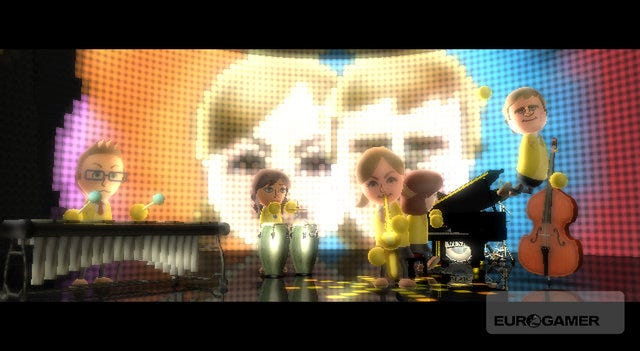
Girls Aloud in weight gain shocker. Wait, can't be them, they're playing instruments.
"It encourages creativity and improvisation, in that you can just decide to play in the way you want to. It doesn't tell you you're doing it wrong, which is where other musical games, like Guitar Hero and SingStar, are lacking. But you're not ever really making your own tunes up, it's pre-set."
To get a second opinion I enlisted the help of Jake, a professional composer and occasional contributor to Eurogamer. He agreed that there are serious constraints when it comes to exploring your own creativity. "There's freedom of expression, but it's not your expression," he said. "It's an expression of the music algorithm that's been programmed into the thing... It's quite primitive."
To understand what he's on about, it's important to understand how Wii Music works. As Jake explained it to me, whenever you decide to play a note, the Wii works out something that will sound okay. So if you're playing in the chord of C, and decide to throw in an extra note, it'll pick one of the notes that make up the chord (C, E or G, in this instance), and play it. That way, even if you're banging away to any old rhythm, songs might sound wonky but they'll still sound familiar.
"The problem with this is there are going to be no happy accidents, and most of music writing is happy accidents," said Jake, wearing his best composer hat. "It comes from noodling about on a keyboard and finding something that makes you go, 'Ooh, what was that?' That's never going to happen here because they're trying to make it sound nice, not like someone punching a piano. So there will be nothing new, nothing creative. It's just about doing something pretty and meaningless."
Oh dear. Perhaps, I thought, the Instrument Improv mode might cheer him up. Here, you pick an instrument and start playing whatever you like. After a little while other characters, known as Tutes, will appear on-screen and start "jamming" along with you, or so the theory goes. Surely this offers real scope for creativity?
Not really, because as we discovered, you end up following the Tutes' lead whether you want to or not. Jake tried playing a tune in 3/4 time rather than 4/4 - "Which is the timing everything in this game seems to be in" - but the Tutes just chimed in with their pre-set 4/4 pattern. Nor would they follow different tempos.
"It lets you waggle about a bit and think you're doing something by yourself. Then it just creeps in with the pre-set backing pattern and you will inevitably fall into that," said Jake. "Which is quite fun - I sort of enjoyed it, briefly. But to call it improvisation is pretty laboured. It's no better than the auto-accompaniment from a keyboard. In 1983."
It doesn't help that all the audio in Wii Music - the instruments, the backing tracks, the menu music - sounds like it is emanating from a keyboard in 1983. Clarissa agreed: "The music is really awful, and the sounds are terrible.
Flower power! It's just like Woodstock! Without all the sex.
"I do have a personal hatred of that whole midi sound. I think timbre's a really important thing in encouraging people to like and enjoy music. The problem with this is the sound isn't nice; it's plasticky and fake, and a lot of the arrangements are really cheesy. So it doesn't inspire an appreciation of quality music."
Indeed, you can't help feeling they should have called it Wii Muzak, particularly when it comes to the horrendous renditions of classical pieces. The excerpt from Swan Lake, the on-screen text informs us, is "incredibly moving". Not when it's being played by midi castanets and accordion, it isn't.
However, reckoned Jake, the developers had little choice but to take the midi option. In a game like Guitar Hero, when you hit a note you hear a sample of recorded audio. That's quite a big chunk of data, but you either get it right or wrong. In Wii Music, many more permutations must be covered - which instrument you're playing, when you might hit a note and for how long.
"You'd need thousands of samples just for Twinkle Twinkle Little Star. Using midi data is an economic way of doing it," he said. "Bearing in mind the constraints of the disc, how much RAM there is and how much processing power the Wii has, they've probably done they best job they could." Even though it sounds rubbish? "Yes. Beethoven would kill himself. Except he couldn't hear it anyway."
Up to four players can form a band, with the other parts played by NPCs.
So perhaps it isn't fair to criticise Wii Music for the audio quality. And besides, perhaps we're taking this all far too seriously - do kids really care about 3/4 time and proper violin sounds and musical algorithms? No, but they do care about being entertained, and they don't have the longest of attention spans.
I doubt most kids would enjoy banging away on Wii Music for longer than an hour or two. I doubt many of them would be that bothered about playing through a song six times, just to record all the parts themselves. And I seriously doubt they would want to complete all the lessons.
These are incredibly laboured. They ask you to grasp musical concepts which can be quite complex, without really explaining them. Each lesson requires you to play each part of a song, which means playing the song six times. Plus getting through the practice bit before you're allowed to play the proper song - so that's a dozen times. You can't even complete a couple of parts, then come back later to finish the lesson off; you'd have to start all over again. In other words, the lessons in Wii Music are as boring as most real music lessons.
There are always the mini-games to keep you entertained. But not for long, as there are only three of them. Mii Maestro involves waving the remote around to conduct a virtual orchestra - or in practice, to choose the speed they play at. Clarissa found it to be "a bit clunky" and "still just about rhythm, not about conducting". Jake liked it, and saw potential for a useful composing tool ("If I could record a piece of music, then control the tempo intuitively by waving my arms about, that could be genuinely useful.") I thought it was dull and rubbish.
Handbell Harmony is the closest Wii Music ever gets to being a videogame, and the most fun thing in it. Different coloured bells scroll across the screen, and you wave the appropriate controller when your colours reach the marker. It's Guitar Hero for simpletons and small children, in other words, and it's surprisingly enjoyable - especially with two or more players. Unfortunately there's only a handful of tunes to play through.
Pitch Perfect is the most educational of the mini-games. You're given tasks like picking two Miis playing the same note from a group of four, or determining which Mii is playing the wrong note. Some of these tasks are tediously easy while others are tricky even for grown-ups, and they seem to be bundled together in any-old order.
According to Clarissa there's some value here when it comes to learning about how music works, but once again, there are limitations. "This could be a good way to get thinking about high and low pitches and their relationships," she said. "But there's a strange incongruity where it uses musical jargon - words like pitch and harmony - without explaining what they mean. So a kid couldn't just play by themselves and suddenly have an understanding of those things."
Jake added, "It's quite advanced music theory, in a way - you're learning about pitch, intervals, chords, notes and stuff. What would it cost to put up a bit of blurb at the end of each task, explaining what you've just learned?"
Shame you can't customise the backgrounds. They'd probably charge another fiver though.
Not very much, is the answer. Which brings us to one of the most fundamental problems with Wii Music: value for money. The full RRP is GBP 34.99. Yes, you can already find it online for GBP 29.99, but even that's pushing it.
There's an awful lot of fluff and polish here. The visuals are stylised, cute and occasionally charming in that Nintendo way (although the Tutes are a total rip-off of the Muppets). You can design your own album covers using your Miis and a limited selection of templates. You can share music videos over the internet. You can play with just remotes if you don't have enough nunchuks, and use the Balance Board as a drum pedal.
But these are all throwaway extras. They don't make up for the fact you've got a pretty limited selection of songs to choose from, many of them rubbish, and no promise of downloadable tracks in the future. Nor for the fact there are only three mini-games, and only one of them is any good. Nor for the fact that while Wii Music makes some pretense of teaching musical theory, it doesn't do so very well. In short, the novelty of banging away on different virtual instruments wears off quickly, and when it does there's not much left at the core.
It's almost as good as Guitar Hero. In no way.
It's not only unclear what Wii Music is, but who it's aimed at. It's certainly not for Nintendo's platforming hardcore, though that's not a reason to condemn it. It's not challenging or sophisticated enough to appeal to adults who want to improve their musical skills. Meanwhile, some of the lessons, mini-games and concepts presented are too complex for younger children, and too tedious for older ones. So who is Wii Music for?
Perhaps Jake had the answer. "It's for middle-class parents," he argued. "It's so they can say, 'Well, we got a Wii, because at least they're moving about a bit, and we got Wii Music, because at least they're learning some musical skills.' It's misguided, and it's pointless. 'Darling, darling, why don't you play Wii Music?' 'No, because I'd rather drive a car around. Or shoot things.'" He and I are both the children of middle-class parents, and as he pointed out, aged 9, we'd probably have played Wii Music for an hour, then gone back to Super Mario Kart.
Not all videogames have to be about cars or guns, and I don't believe every piece of console software should have to be a videogame. I do think software should be entertaining, or educational, or preferably both. Wii Music isn't very entertaining and it's not very educational. There aren't enough goals for it to work as a game, and there's not enough musicality for it to work as a toy. It's not clear what it is or who it's for. One thing's for sure: it's not worth forty quid.
5 / 10
