What Did I Do To Deserve This, My Lord!? 2 Review

Dig for victory.

Version tested: PSP

Hurrah for Nippon Ichi. Not only do they tirelessly serve the needs of niche enthusiasts with games like Disgaea, but they understand the cathartic value of letting you play the bad guys once in a while. Much like the Disgaea series, in fact, both "What Did I Do To Deserve This, My Lord!? 2" and its Batman-rankling predecessor put you in the shoes of a divine evil - sallying forth against the sickeningly puritanical forces of goodness and light, turning the traditional RPG hit-tables with a healthy splash of comedy villainy.

We'll be calling them the "Lord" games, by the way, for obvious reasons.

In both Lord games, players take the role of the God of Destruction, via the medium of a disembodied pickaxe. Summoned by the camply comedic dungeon master Badman, it's your job to mine an evil lair from the magical loam and bedrock below a typical fantasy JRPG kingdom, constructing a labyrinth of sufficient terror and complexity to confound the aims of the occasional visiting hero.

It's not a new concept - games like Dungeon Keeper and Evil Genius have dipped their toes in this sort of criminal housing project before. But whereas those games gave you direct control of what went where and how it should behave, Lord scales back the interaction to that single pickaxe - cutting away squares of earth to craft the rooms and corridors of your lair, but leaving monsters to their own devices.

Of course, it's not as simple as all that. Monsters aren't purchased or placed, instead they're encouraged to settle and multiply through the manipulation of an increasingly complex food chain, beginning with basic resource-grazers and terminating in dragons and powerful beasts summoned from the gates of the netherworld.
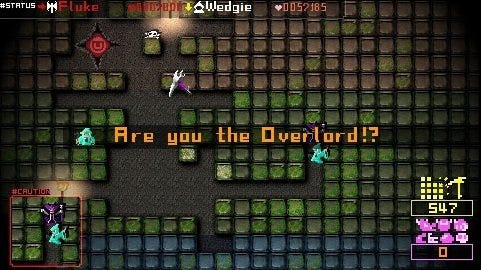
1

Tickertape messages keep you appraised of events, whilst an in-screen picture focuses on highlights.

The conveniently squared areas of dungeon real estate contain nutrients, released as creatures when the blocks are destroyed with your pickaxe. The basic level of nutrients will give rise to a slimemoss, a mindless and weak blob that will blindly absorb nutrients from the surrounding area and redistribute them, if correctly herded, into more concentrated patches.

Because they're simple beasts, they only take turns when presented with a dead end, so they can be easily contained in T, O or H-shaped areas, gradually sucking up monster fuel and depositing it again. When their constantly-depleting vitality wanes, they'll take root in the form of a flower, gaining new properties and sucking up nutrients from a wider area before giving birth to a litter of new mosses when they die. Thusly do the lowly orders multiply, and left to their own devices they continue to do so.
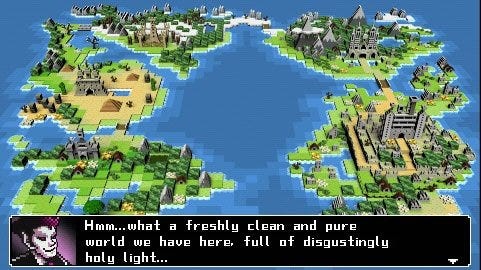
2

There aren't many areas, but challenge rooms pad the experience out a bit.

Once these lowly ruminants have done their job, the whole process begins to open out a little. As the concentration of nutrients builds, new and more powerful creatures emerge from broken rocks, feeding on the creatures beneath them. They won't do any of the nutrient-hauling monkey-work, however, so you'll need to maintain a balance between the slimemosses and the higher-ups.

Once the third tier of creatures is introduced, balancing becomes harder. Introduce magical nutriments, giving rise to a whole new tree of monsters, and you start to see what a balancing act it can become, especially when you consider that you have precious few minutes to prepare your dungeon before the heroes come knocking.

These born-from-the-soil creatures are far from the whole story. Under certain conditions, usually the manner in which their fellows die, creatures mutate into new breeds, specialising or becoming more powerful. Forcing them to do so means paying close attention to their behaviour and surroundings or encouraging their environment in particular directions. Once you've mutated a new strain, all creatures of that type will take that form from thereon in.

It's a nice system, pleasantly in-depth and sufficiently complex to keep you guessing and interested. Sadly though, like the rest of the mechanics, it suffers from the lack of direct control you have over anything other than the digging, especially when it's compounded by the almost total lack of feedback when you fail.

For a start, persuading slimemosses to deposit nutrients in a concentrated fashion is a tricky task. Not impossible, but it takes a fair bit of micro-management, something for which the game's fast pace leaves you very little time.

Things do get a little easier once you've established a basic ecosystem, providing you can keep the food chain balanced, but this means culling over-zealous breeds by hand. Evolving things on purpose is almost impossible, requiring big risks in the management of monster numbers and environments along with almost all of your attention.

3

It's much more complex than that, actually.

Happily, mutations happen quite a lot by accident, with a handy ticker at the bottom of the screen warning you when it's happening and giving you a chance to cancel it. There's also a gauge showing the relative numbers of each monster type, helping you to maintain balance. New to the sequel is a practice chamber where you can perfect your tunnelling and mutation skills, although planning is often a moot point in the chaotic tumult of actual gameplay.

This is more of a polish than a true sequel, in fact. There are more monsters, heroes and areas, and important improvements have been made to usability and ease of access, but this is the same game with some nice new bells and whistles.

This also seems to undermine Nippon Ichi's decision to include the first game as an unlockable on the UMD to differentiate it from the cheaper PSN version, but that's certainly nothing to complain about. However, if you enjoyed the first game, you probably won't need many of the new tutorials or hand-holding which are on offer here anyway, making it a much less tempting prospect.

4

Presumably some new foreign policy is in the offing.

As we said of the first Lord, there's a good game hiding in here somewhere, and a breezily satirical script and quick restarts after failure give it a 'one more go' quality. Useful, because even the rare victories feel more like luck than judgement.

If you liked the look of the first game but never got around to it, and fancy a challenging, unique and often quite entertaining game where you get to plot against smug goody two-shoes, then you may find this clicks with you. Like most games from the Nippon Ichi stable, though, it's not one for the majority - obscured as it is by obtuse mechanics and a sometimes-vicious difficulty level. Hurrah for them all the same.

6 / 10

Read the Eurogamer.net scoring policy

Comments (22)

Comments for this article are now closed, but please feel free to continue chatting on the forum!

  • Loading...hold tight!