Wario Land: The Shake Dimension Review

Not stirred.

Version tested: Wii

What a relief. It makes a change to play a 2D platformer these days, rather than a 3D action-adventure set in a post-apocalyptic American city. There are no crumbling skyscrapers and fallen telephone poles here, just pyramids and pirate ships. Everything's pink and yellow, not grey and brown, and when you attack enemies they don't explode, they just get dizzy. The plot isn't about government conspiracies or science experiments gone wrong; it's about the kidnapping of some giggly pixies and a magic bag that never runs out of coins. It's a good, old fashioned run-and-jump-em-up, just like your Miyamoto used to make.

Well, not quite. Wario Land: The Shake Dimension is different from classic Nintendo platformers in several respects, one of them being it isn't as good. Another relates to the control system. As you'd expect Wario can run, jump, disappear down pipes, smash blocks, perform belly flops and crawl through gaps, and all that's done using the D-pad plus buttons 1 and 2. However, some moves can only be performed by shaking or tilting the Wii remote.

That includes emptying the bags full of coins littered around every level. It's highly satisfying to watch the treasure spilling out as you shake away, and this is the best use of the remote's motion sensor in the game. It's also fun to give the remote a short, sharp shake to make Wario punch the ground. This causes the whole environment to shudder, dislodging specially marked and precariously placed blocks, and setting off any bombs lying about.
1

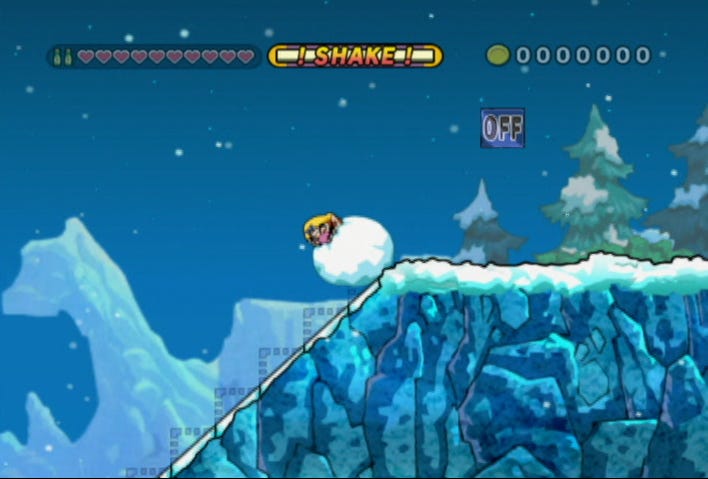
Yes, there is a lava level too.

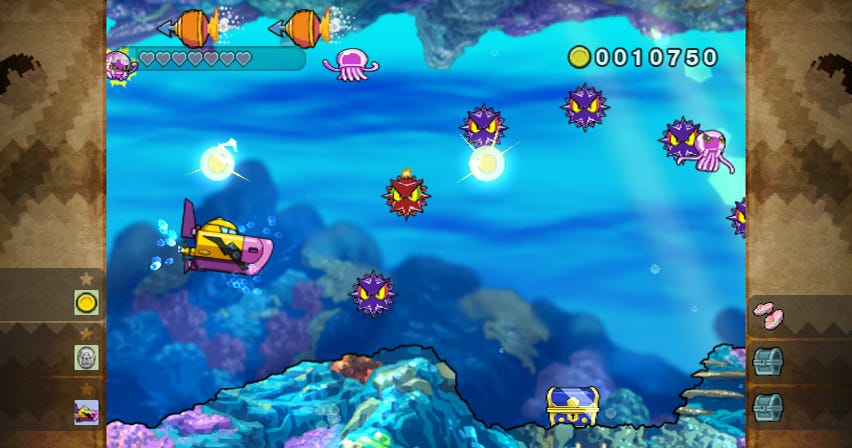
They should probably have left it there, though. Tilting the remote to aim throws is fiddly; waggling it to spin round poles is tiresome, especially when you've got a dozen poles in a row to deal with. The tilt mechanism is also used to control vehicles, including a submarine and a mine cart. This works better as the level of sensitivity has been perfectly tuned. But on the whole the motion-sensing elements don't add much to the experience, and in some instances having to waggle the remote about is a chore.

It's a good thing, then, that the levels are well-designed enough to make you push on through - especially when you throw in the fact each one must be navigated twice. The first time round it's traditional platforming stuff; you must collect coins and kill enemies, and work out which of Wario's moves are required to open up new pathways. It's rare to find yourself stuck for a solution, but sometimes it'll take serious precision control and several repeat attempts before you're able to progress.
2

We all live in etc.

This can make the game feel unbalanced at times; having bounded through the first two-thirds of a level effortlessly, it's frustrating to find yourself repeating the same series of pole swings again and again because you keep missing that tricky last leap. But when you finally pull it off, there's a great sense of relief and reward. It's the same story with the boss levels. They're built to a familiar formula, forcing you to work out an attack method through trial and error, then perfect its execution with practice. Just like in the good old days.

So what of the second time round? At the end of each level there's a metal cage containing one of the kidnapped pixies. Shaking it will free the pixie, but also set off an alarm. An on-screen clock starts ticking and Wario has to make his escape before it hits zero - which involves racing all the way back to the start of the level.

This isn't as tedious as it might have been, thanks to some clever design decisions. The pixie you've just freed floats alongside Wario, carrying an arrow sign which always points towards the correct path - so you don't end up backtracking in the wrong direction. In some levels, there's a machine for super-charging Wario near the pixie's cage. This means that with decent reflexes and an eye for when to jump, you can race back through the the whole level at top speed - effortlessly barging through enemies and obstacles as you go. Which is fun, obviously.

Another plus point is that you don't follow the same route back through levels; new pathways open up and there are different obstacles to overcome. This creates a problem for completists, however. If you're the type who likes to seek out hidden booty (and there's plenty here), you can spend ages trying to work out how to access a particular area or break a certain block - before realising it's only possible on the return journey.

Perhaps you're not a completist, and just want to run through levels at a quick-smart pace without worrying about secret treasure chests and hard-to-reach bags of coins. In which case, you will also end up with a problem. Accessing new sets of levels isn't simply a matter of completing the preceding ones; you must buy a map for each area before you can visit it, and you can only buy maps if you've collected enough coins.

3

Count Duckula's put on a bit of weight since he's been out of the public eye.

The first one's cheap, and you'll have earned the asking price just by racing around, but later on they get more expensive. You may have finished five levels and beaten the boss, but unless you also made a bit of effort to find hidden goodies, it's a question of repeating levels again to get more coins. Considering you've already been through each of them at least twice, this isn't much fun.

Issues like this prevent Wario Land: The Shake Dimension from crossing the line between good and brilliant. It feels as though the game has been designed to please both hardcore and casual players, but it fails to satisfy the needs of either group.

Fans of classic platformers will find most of the game too easy. Nintendo has tried to make up for this by sticking tons of bonuses in the most fiendish of hiding places, but the dual pathways can lead to confusion. This won't be a problem for those who like a lower difficulty level and faster pace, but they'll likely end up frustrated by the trickier spots and enforced repetition.

4

Nintendo now has its own magic bag that never runs out of coins, as the last financial report confirmed.

It's a shame, particularly because The Shake Dimension could have been the 2D platformer the Wii's been waiting for. The shake mechanism works well, at least in some instances. The production values are extremely high; the visuals look hand-painted, the animations are superb and the music is great, in a nineties way. There are flashes of retro brilliance such as the Egyptian and submarine missions, clearly inspired by classic Game Boy title Super Mario Land. But they are only flashes.

Does Nintendo still care about hardcore gamers? This title could be used as evidence for the defence; it's a 2D platformer, with hard bits and boss battles and rewards for extra effort. But, as the prosecution might point out, even here there are indications of an attempt to appeal to a wider market. The result is a game which is good, but not great, and certainly not up to the standard of Nintendo's best 2D platformers. They don't make 'em like they used to, that's for sure. Still - at least they make 'em.

7 / 10

Read the Eurogamer.net scoring policy

Comments (44)

Comments for this article are now closed, but please feel free to continue chatting on the forum!

  • Loading...hold tight!