Real-time strategy is getting too niche, reckons Relic. It's hard to think of a recent RTS game that didn't start out with this very same mission statement; a preview of one that didn't contain promises to scrap the genre's hang-ups, start afresh and bring it to a new audience (with the exception of the stubborn StarCraft II, Blizzard presumably being happy with its "niche" of hundreds of thousands of crazed fans).
World In Conflict, Supreme Commander, Relic's own Company of Heroes: they all made some important strides, they are all excellent games. Yet still the RTS fanbase refuses to grow, and here we are, sat in THQ's E3 suite, hearing it all over again - applied this time to the sequel to the successful Warhammer 40K-licensed Dawn of War. Relic says it's going to steer clear of the genre's weaknesses, make it more accessible, more involving, more rewarding.
The thing is, this time, we believe it.
RTS games aren't the easiest to demonstrate, but Relic's showing leaves us impressed with Dawn of War II's immediacy, and itching to try it hands-on. It's the most confident and exciting showing of a PC-exclusive game since Blizzard debuted Diablo III last month, and yes, that does include BioWare's slick Dragon Age presentation at E3. It all just makes such perfect sense.
The robust, colourful bleakness and violence of the Warhammer 40,000 licence - dark fantasy hurled into the far future, to become even darker sci-fi - is the piece of this neatly completed puzzle that needs no introduction. It was beautifully applied in the first Dawn of War and - with somewhat diminishing returns - across its three expansions. As you would expect, the same is true again. We watch thunderous fire-fights and brutal physical confrontations, as Space Marine squads take on Ork battalions in a dense and dilapidated jungle setting.
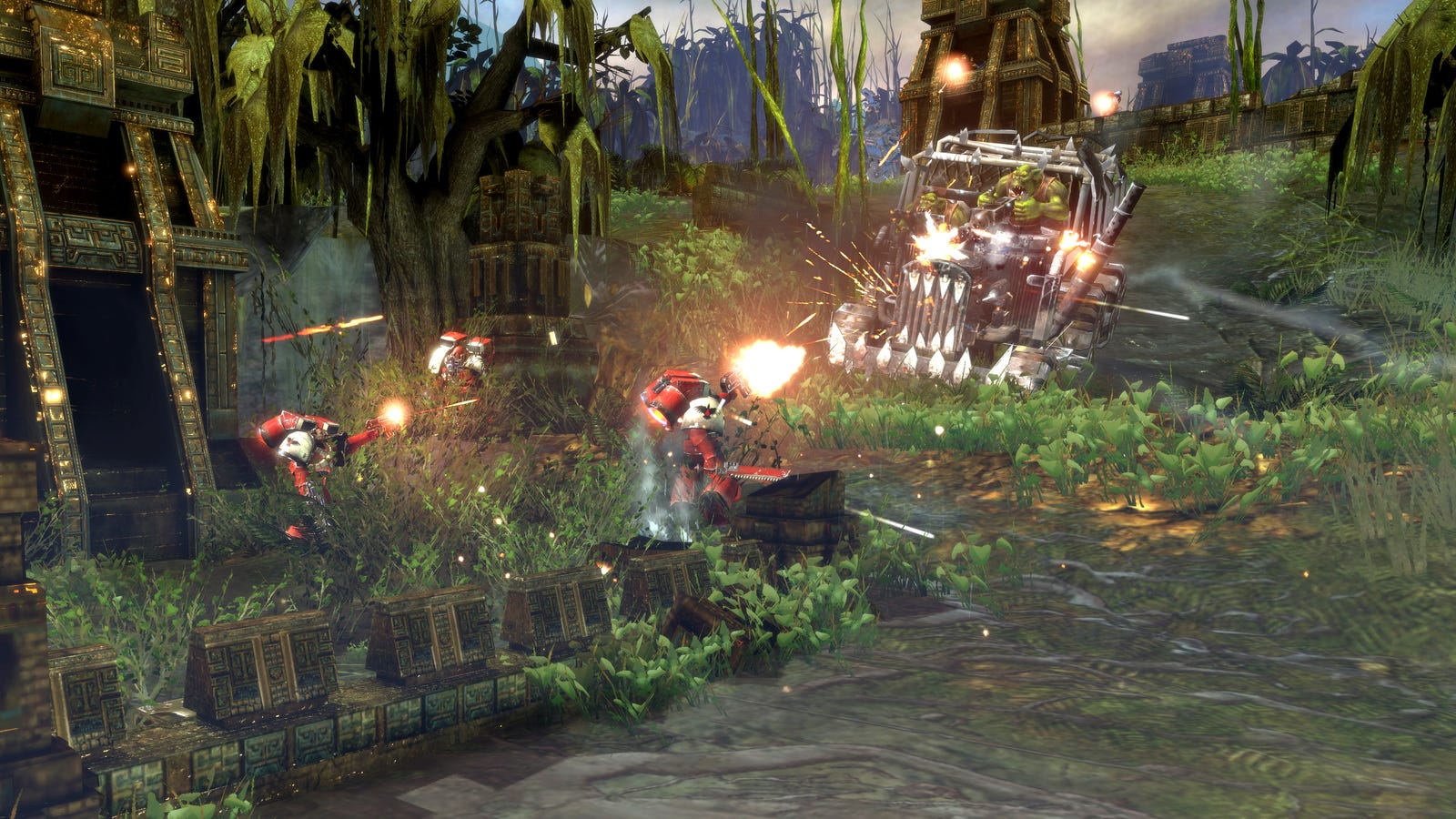
Not going to end well.
Dawn of War II inherits plenty from critical darling Company of Heroes, Relic's up-close-and-personal take on World War II combat. The environment is heavily destructible; terrain, cover and lines of sight are of critical importance; there's a definite sense of physical connection to combat. There's a strong emphasis on active and credible AI for the units, and an effort to give those units some personality, something for the player to grow attached to.
Relic has gone even further in uncompromisingly axing the resource-management and base-building side of real-time strategy this time around. Dawn of War II simply doesn't have that side. "No more starting over" is the developer's motto. No bases, no resource gathering, no building units, no dithering over force composition. Instead, there's a continuous sense of progression from the RPG-like levelling of squad commanders, and tactical choices come in the form of customising your skill-set before starting a mission.
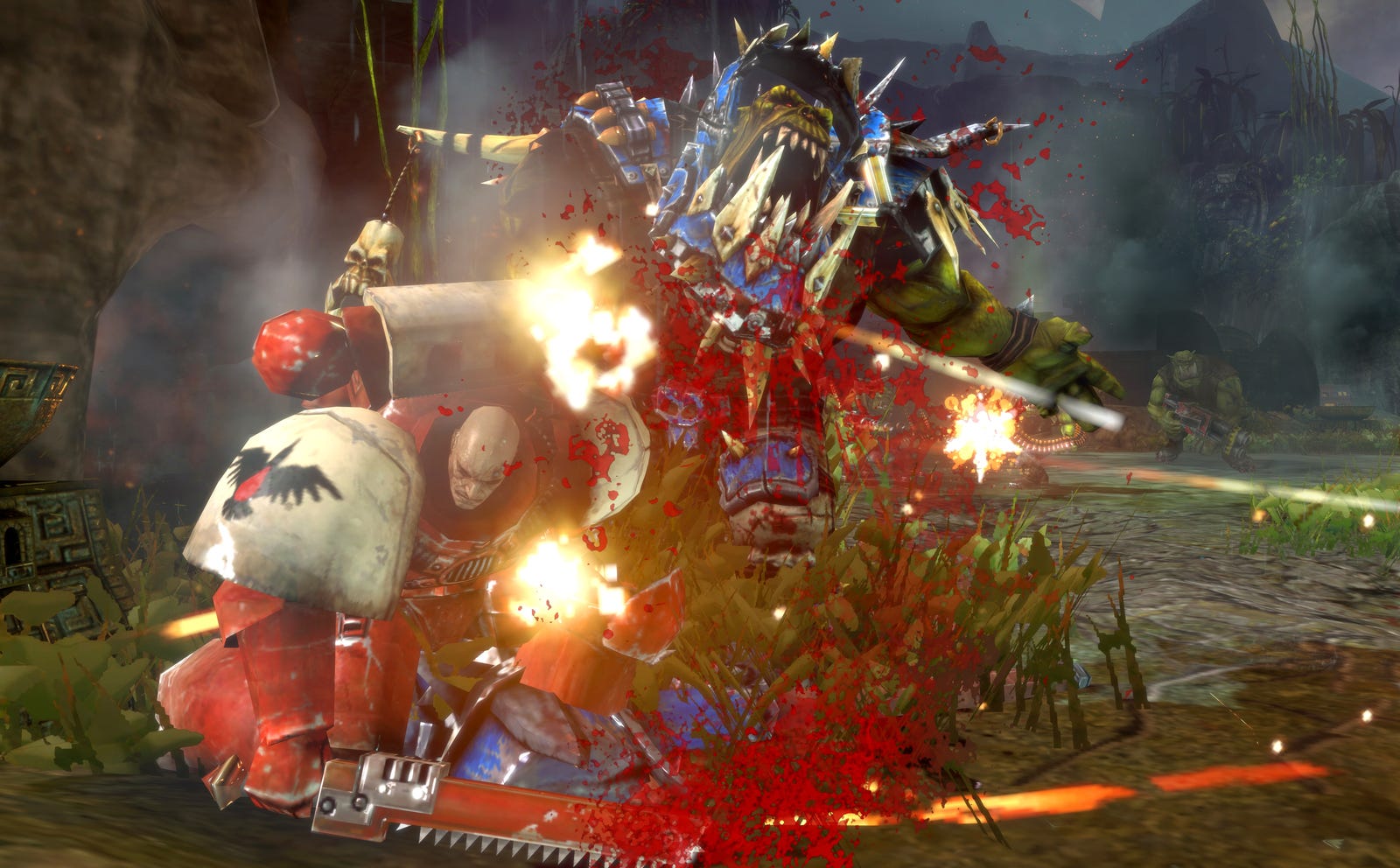
Bonesmasha buys it.
These per-session skills are called Accessories and actually drop as loot, alongside War Gear. A rare example might be an orbital bombardment beacon that can be used to annihilate a tricky outpost, leaving just the cleaning up to your squads. ("Cleaning up" isn't really the right phrase, since Dawn of War II's combat only ever seems to make more glorious mess.) You can collect a pool of Accessories, but only equip a very limited number; you can swap them out between missions depending on preference and availability. This sounds like an excellent, compelling system for tactical variety (and limited get-out-of-jail cards), without forcing you to work your way through a tree of force-composition choices at the start of every map.
Squad leaders level up, too, granting you an attribute point each time to spend; you might choose to improve his "taunt" (read: tanking), or double his range and damage with a "focused fire" skill. It's pure action-RPG: with almost every map, your force will become more powerful, more efficient, more spectacular. If traditional single-player RTS gaming is a series of crescendos, then the Dawn of War II campaign will be one single, extended one.
Maps seem fairly linear - the one we see, anyway, which is a push through a tangle of jungle to a mechanoid Ork boss called Bonesmasha, whose area-of-effect and line-damage attacks need to be juggled carefully between squads while you shower him in grenades. Diversions will exist in the form of territory-capturing side objectives, earning you recovery and reinforcements at some risk - the Shrine capture we witness requires a sustained and bloody fight. These also feed into a meta-game that tracks morale across entire sectors, giving you long-term squad benefits, and once captured they remain so - all maps are persistent.
The campaign, Relic promises, will be less linear. Relic's only talking about the Space Marine campaign at the moment, refusing to confirm whether or not there will be others in the shipping game. It involves an attempt to protect three planets from a massive invasion, but there will always be a choice of several missions, of several fronts to drive the story forward on. Fantastically, the entire thing will be available to play in two-player co-op. Relic isn't talking about competitive multiplayer yet, however.
We're shown four squad Sergeants in action - the Force Commander, Assault Marines, Devastator Marines and Scout Marines. Scouts sneak behind enemy lines to outflank and lay traps, Devastators are weapons specialists who lay down heavy gunfire, but the most spectacular have to be the Assault Marines, who use jetpacks to leap from behind cover and land instantaneous surprise attacks right in the heart of the enemy force. There's a tremendous and gratifying impact to this commander ability, so much so that it actually deforms the ground where they land - enough for it to provide light cover.
Now with added arson.
Although units are expendable, if a squad commander falls, he can always be revived after the fight - Relic say that, if it wants to make RTS gaming more accessible, it should almost always be possible to recover from a mistake. Squad mates have to be replaced by reinforcements from a drop pod, which naturally makes a lot of noise and mess with its arrival. Relic wants the environment to be "a big player" in the game, and isn't afraid to put it on the player's side - there's no fog of war, so lines of sight are only a problem for the enemy. All the better for ambushes from behind walls, or even from within the protection provided by buildings.
If we had one complaint - and at this stage, coming up with complaints about Dawn of War II is not that easy - it's that destructibility and terrain deformation look a little crude and unconvincing when held up against the best current technologies. But even this can't damage the strong and satisfying physicality of the game, engendered by the excellent animation, potent effects and sound, and bright, characterful art. More than any other - even than Company of Heroes - this looks like being an RTS where you really feel the action on the ground.
The Assault Marine's squad jump in action.
Add an almost total lack of barriers or chores between the player and the action, and a mouth-watering advancement system that should drip-feed depth while keeping the game supremely accessible (and indulging in a bit of collectible loot fever to boot), and Dawn of War II looks hugely enjoyable, like it might be the RTS that could finally break the barrier. Let's hope so - we really don't want to be writing that introduction again this time next year.
