Viva Piņata: Trouble in Paradise

Refilled with fun.

We loved Viva Piņata! But much as we loved Viva Piņata (and as much as we assaulted you with that love day after day for months afterwards), it's no secret it sold pretty badly. Over a million copies is decent going, but not quite the return you want after four years of hard slog. Certainly not if you're Rare, Microsoft's most expensive acquisition since the light - and everything else - went green on the Xbox project. So, we ask, beached on a futon in the bowels of Rare's idyllic countryside lair opposite two of the game's most senior developers, why do a sequel?

"We didn't have anything immediately to do," says lead designer Justin Cook, taking us back to November 2006 shortly after the game had shipped. "And I think it's natural certainly for programmers to start looking at things they've just done, tightening the screws, tweaking and doing that kind of thing." Lead programmer Will Bryan agrees. "There's always the things we'd thought about for the first game but hadn't done. But then there's also...you go on forums and things and people say, 'Can you do this?' and you go, 'No...you can't. That's a really good idea! Why didn't we think of that!' But then we've done so much that we never intended to for the sequel. People ask, 'Is it a genuine sequel?' and you think, 'Well, it's a genuine sequel and then some.'"

Viva Piņata: Trouble in Paradise is an easy game to sum up: more of the same, stuffed with better sweets. As before, it's about turning a neglected plot of land into a flourishing garden by laying grass, trees and flowerbeds - and most importantly it's about creating a home fit for the dozens of paper-skinned piņata animals lurking outside the borders, and balancing their needs and habits as you unlock better tools and more advanced decorations, which in turn attract more exotic species. It's the circle of life with horticulture and experience points.
1

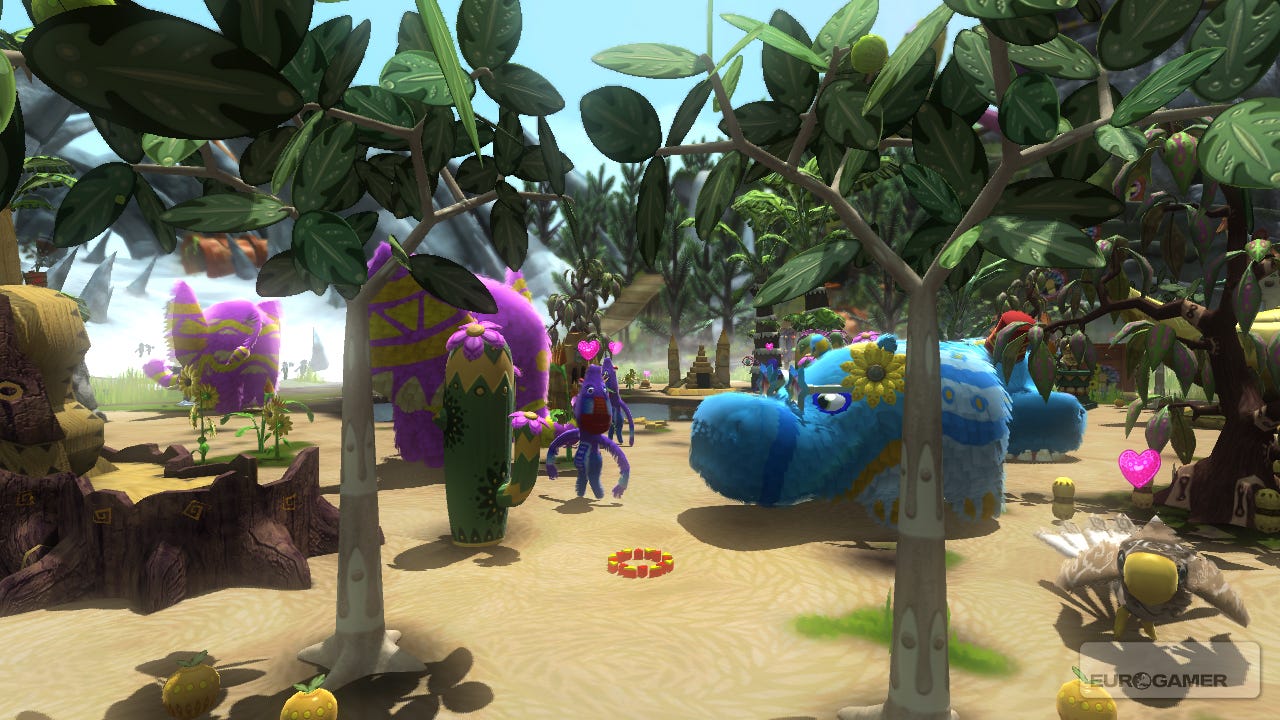
You can't spend much time in the desert or arctic, but you can lay sand or snow to make your garden feel like home for imports.

The Trouble in Paradise interface is largely unchanged, but there are new arctic and desert regions to visit and trap piņata (and the option to lay sand or snow atop the soil in your main garden rather than grass alone), new elements like the Trick Stick and the Just for Fun mode (a less demanding sandbox, where you aren't so harried), and a host of new things to do with your piņata, including talent shows and even a racing mini-game. There's a Photo mode, too ("replacing the dodgy mobile phone pictures posted on forums", Bryan points out). And of course there are dozen of new piņatas - around 30 in total, from the desert-dwelling Camellos, Sweetles and Geckies, and the arctic Jelis, Robeans and Walrusks, to the new first animal, the Bispotti, and others like the Sarsgorilla, Hoghurt and Custacean. All beautiful.

The ability to refine rather than start again is arguably why Trouble in Paradise happened at all. "We basically had a running game, so instead of having to build it from scratch we could turn it around a lot faster," Cook explains. Some of this refinement is very focused, like a three-step tutorial to improve on the first game's cluttered opening, support for a larger number of simultaneous objects in the world, the option to plant multiple seeds without having to run back to the shop, and the ability to reach outside the borders of your garden, so you can check out a piņata's requirements without having to stand poised for when your elusive visitor trips within its borders.
2

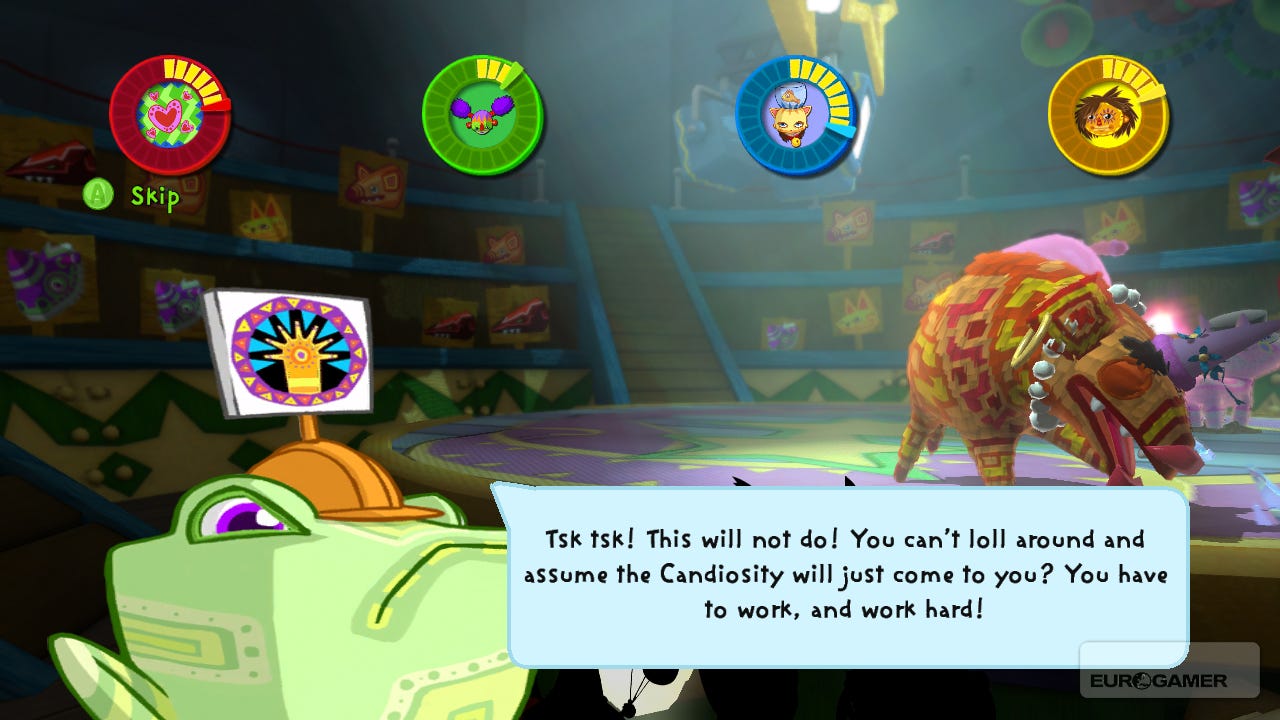
The P Factor makes no bones about telling you you're worthless and you'll die alone in a caravan. On fire.

These changes have blossomed into other new features and improvements. Being able to reach outside the garden border had several knock-on effects, for instance. "It allowed us to put things out there and take them off the menu, so again it was a more user-friendly experience," Cook explains. Just For Fun mode had hidden benefits too. Envisaged as a way of lowering the bar for kids, the addition of local two-player co-op suddenly meant it was ideal for kids to play while a parent or second player, who doesn't have to be logged in with a separate profile, stood by with a second pad to help out. "We've given them a new special ability," Cook reveals, "where if they do good things for your garden they gain magic power and it fills up their cursor with rainbow colours, and then you can use that power to make piņatas happy, or you can cure the sick piņatas, or you can tinker items. For me and one of my kids it's fantastic."

It's on Xbox Live, too, with support for up to four players. Once they're in, you can see their cursors moving around, donate money to them and boot them out if they get annoying. "We got to the stage where we couldn't fit it into the first game in the time," Cook says of the four-player online mode, but that preliminary work means it's fully featured for Trouble in Paradise, allowing you and up to three friends to play collaboratively through the entire game, or just drop in and out. You can set their levels of interactivity, so if you have a stranger visiting they can't tear up your hard work. "It's great if you've got a more experienced person coming to visit your garden because the garden uses their experience level rather than the host's," Cook says, "so you'll see things you wouldn't normally see until later in the game. New things will open up. And it has that cool thing: you've built a disco in one corner and a beach at the other end, and you just want to show people and let them have a wander around."

And whereas the first game was very much a slog at times for the developer, this was more fun for the small Rare team given 18 months to figure it out. "It was a very different experience having a game that would run consistently from the day we started to the day we finished," says Bryan. It enabled Rare to doss about. Hence the talent show ("P Factor"), accessible from the X-button radial menu, where a panel of judges made up of the game's humanish characters rate your piņata based on the things they like: fancy accessories, a history of victories in the racing mini-games, and so on. Elements like the talent show also allowed the team to make use of leftover assets from the original game's extensive development. "We were going to have experts for each type of animal - lizards, mammals, etc. - and all the characters were done for those," says Cook, "so we used them."

3

The arctic and desert regions allow you to trap exotic piņata.

The Trick Stick, another X-button menu tool like the shovel or watering can, is another add-on born of fun and frolics. Each animal has two tricks that they will perform when they eat a certain item, and if you tap them with the Trick Stick as they're doing it, they learn the trick and can then perform it whenever you tap them thereafter. Achievements, too, are geared towards fun. "You can hit the sweets with the shovel and play a little golf game. They go in the holes and you get a little cheer and coins come out. There's an Achievement for doing that. Achievements are a great way of pointing people to things they might not have noticed," says Cook.

Plus of course there's the vaunted Xbox Live Vision USB camera link-up. "That was Will's invention," says Cook. "He literally came to us and he said, 'Right, I've got this code, here's the camera, it'll do this - do you think we can use it?' and it's like, 'Of course!'" Rare's not exactly sure how the cards will be distributed yet, but we get to play with them anyway. They're the size of playing cards, and when you hold them up to the camera a little video window pops in from the right side of the screen, focuses and then a second later the animal encrypted into each card's unique code materialises in the game world, complete with a specific name and accessories. "So much of that stuff, like the disco paving was just like, 'We've got this paving - why don't we make it change colour like a disco floor?'" says Bryan.

4

You'll be able to share pictures using the internet.

It's all good for fans, then, but the big question is whether this can make up for the original game's flaws: a lot of dead time, a fiddly interface, and the odd repetitive mechanic. Otherwise genuine crossover appeal will remain elusive. According to Bryan, the problem last time was simple. "We'd be looking at a specific feature for a specific period of time, and therefore the actual fact that you might have to do that a hundred times before you finish the game is completely irrelevant to somebody who's developing it - up to the point they're at home playing it and the wife says, 'This is really annoying.'" Much as it pains us to say it, there are signs of that happening again in the early stages of the main game: frilly menus and flashing prompts and lights all over the place, lots of screens to work with, and the potential to get lost before you find the fun.

Rare's confident though. "I think it's...I actually enjoy playing it a lot more than the first game," says Cook. "And I'm hoping that other people find that too."

Viva Piņata: Trouble in Paradise is due out on 5th September. Look out for our review very soon.

Comments (35)

Comments for this article are now closed, but please feel free to continue chatting on the forum!

  • Loading...hold tight!