Virtua Tennis 2009 Review

Motion granted.

Version tested: Wii

This is an amended version of a review first published last week, then withdrawn by the editor due to errors affecting our previous review of its main competitor, Grand Slam Tennis. Please see the Editor's blog for an explanation.

Thanks to the release of the Wii MotionPlus, tennis games suddenly find themselves the centre of attention as gamers try to establish the merits of Nintendo's new controller add-on. EA Sports' Grand Slam Tennis got the ball rolling, and now it's SEGA's turn to get us leaping around the living room in the name of science.

As you'll recall, Virtua Tennis 2009 was released a few weeks back on PS3 and Xbox 360, and proved to be a solid update to the series with an improved online mode. On the downside, the wearily unchallenging World Tour mode was a little disappointing, as were the curious player progression mechanics and generally lacklustre visuals. Bolting on motion controls might help inject some life into the series - or could just derail it entirely.

As will be the case for many MotionPlus-enabled games, there are essentially two contrasting ways to play. The non-WMP version works on the basis of timing your Wii remote strokes with an on-screen shot gauge, which appears above the player whenever the ball is served or returned to you. Depending on your player's court position, the white vertical line will sweep quickly from either the right or left to represent a forehand or backhand shot.

Similar to the system used in Grand Slam Tennis, shot placement depends on how early or late you return the ball, and the shot gauge provides a handy illustration, sweeping from right to left for a forehand shot and left to right for a backhand, similar to Gears of War's Active Reload system, oddly. To place the shot to the right of the court, you would aim to connect with the ball with the indicator over at the right side of the bar, and vice versa. If you swing too early or too late you'll either miss the shot or hit the ball out. Running, meanwhile, can either be left up to the AI to determine, or you can plug in a nunchuk and try and combine motion control with a control stick tethered - not the most elegant operation as it turns out.
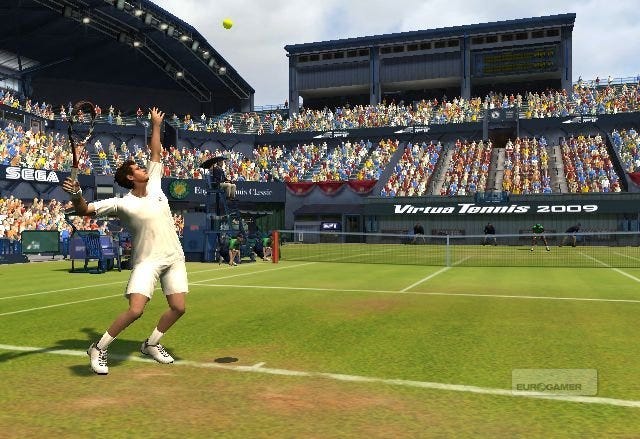
1

While lacking in a few pixels, the slick visual sheen makes a seamless transition to Wii.

In terms of pulling off specific types of shot, it's a mixture of timing, the angle of the controller and the force you apply. For example, drop shots and slices can be pulled off by tilting the remote upward and swinging in a downward motion with varying degrees of force, while smashing appropriately involves whacking the Wii remote downwards when the opportunity arises - usually near the net. Finally, lob shots can be pulled off by swinging the Wii remote upwards while holding down the A button.

Compared with the standard joypad controls featured on the original versions, the motion-enabled controls take a fair bit of getting used to. Judging when to begin your swing is all-important, as is sussing out how much force to apply on the shot. Fortunately, unlike Grand Slam Tennis, a thorough tutorial mode gives you a run through all manner of shots, from beginner to intermediate and advanced, and leaves you reasonably well-prepared.
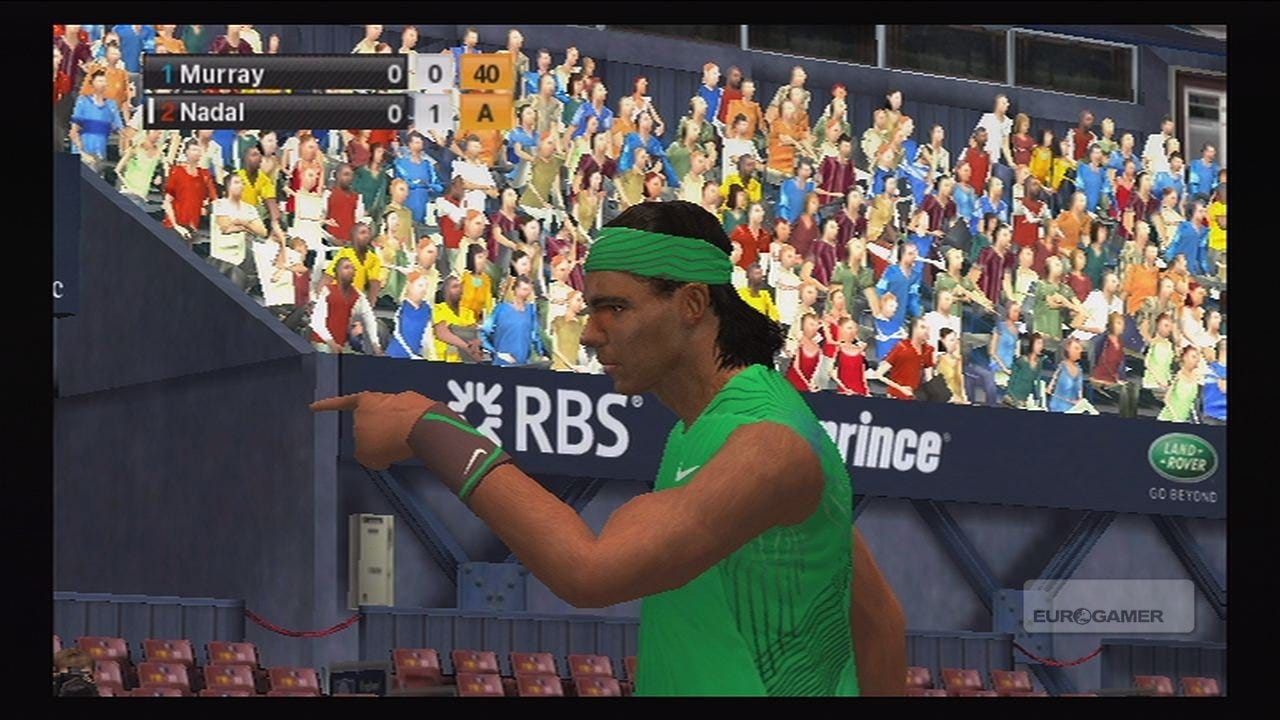
2

What the hell happened to your arm, Rafa?

Nevertheless, the relative ease of the coaching session contrasts markedly with real matches, with even the lowest-ranked players in World Tour mode seemingly capable of blasting the ball back at velocities which give you a small window within which to get your return in. While the standard joypad controls would allow you a fair margin to return even the most violent shots, trying to respond to a fast shot with Wii motion controls is a comparatively tough task, mainly due to the relative speed with which the shot gauge can move.

As in real life, the faster the ball is coming towards you, the less time you have to react, and while this feels like a perfectly fair reflection of the real game, it's a surprisingly steep learning curve for a new control system. The main problem, of course, is that it's hard to know exactly when to wind up your shot - especially when the game can misread your hand movements at crucial moments. In general, while the addition of motion control is a fun way to play an old favourite, the lack of precision turns an intuitive, flowing game into an unnecessarily frustrating affair that makes you hanker after a control pad before long.

Not so with the Wii MotionPlus add-on plugged in, however. As with Grand Slam Tennis, WMP in Virtua Tennis 2009 offers a tangible extra layer of precision which returns a great deal of the flowing intuitiveness that any tennis game requires. That said, coaxing the game into letting you play with WMP controls involves an unnecessary amount of nannying. Despite having a global settings option in main menu, the game still forces you to instruct it to utilise WMP controls at the start of every single game, when it also checks whether you're a lefty. Not only that, you're then instructed to point the Wii remote at your player at the start of every single point, presumably so the game can ensure the calibration is correct before the point gets underway. Whatever the reason, you'll soon get heartily tired of having to go through this flow-breaking rigmarole.

Once again, getting used to the controls isn't instant, but again it's something the useful tutorial goes some way to remedying. The most obvious difference between the systems initially is the removal of the shot gauge, which means you have to instantly rely much more on your own judgement rather than focusing on the varying speed of a white line travelling from one side of a horizontal bar to the other. Removing this visual aid generally makes the game feel more immersive, and it's apparent that real-life racquet motions are being replicated on-screen in real-time. Although it's by no-means foolproof, the general direction and velocity of any given shot is replicated convincingly, if not quite as intuitively as in Grand Slam.

But just as with GST, the business of running is still a problematic issue. By default, you can simply leave it up to the AI to position your player for you - an option which obviously strips away a significant amount of the strategy. Worse still, the timing of your wind-up and swing can have an influence on where the AI decides to run to, often resulting in shots where the ball will miraculously reappear, despite having evidently flown beyond your despairing racquet. With the nunchuk plugged in you can take complete control, but at the cost of tethered interference. With practice you'll perhaps get used to a wired controller being plugged in, but it's never the most graceful pairing.

3

Moments before doing the splits.

In all other senses, the game is almost identical to the PS3 and 360 versions, featuring the exact same World Tour mode, online options, and roster of male and female professionals. Visually the game obviously can't compete with the HD versions, but still manages to boast the flowing animation that has been VT's trademark for almost a decade - at least when the odd juddering slowdown doesn't intervene.

As with the PS3 and 360 versions, the player customisation options are pretty poor, and while the likenesses are great for the real-life pros, the game suffers when you're playing the generic unknowns. Somehow Sumo has managed to make this side of the game proportionally worse than previous VTs, and it's hard to understand how it managed to break something that didn't need fixing. Likewise, the rejigged World Tour mode is a chore to play through, and the new court games fail to engage. Online play also suffers on the Wii thanks to the relative paucity of matches and the ongoing friends code shenanigans, but it would be harsh to put the blame on Sumo for that.

4

Murray to win Wimbledon? That's where my money's heading.

On the whole, Virtua Tennis 2009 is another clear indication of the potential of the Wii MotionPlus add-on. While the game struggles to provide intuitive accuracy with default motion controls, the addition of Nintendo's little dongle transforms the accuracy of the strokeplay in a manner which will be warmly received by both old-school Virtua Tennis fans, and casual admirers of the sport at large. A few residual issues with the running mechanic aside, VT2009 is a great tennis game, especially in multiplayer. It might lack some of the charm and fluidity of EA’s offering, but Sumo deserves much credit nevertheless. With two strong tennis titles on the market, Wii owners suddenly find themselves spoilt for choice.

7 / 10

Read the Eurogamer.net scoring policy

Comments (54)

Comments for this article are now closed, but please feel free to continue chatting on the forum!

  • Loading...hold tight!