Version tested: Xbox 360
Opening up gaming to the masses is one hell of a double-edged sword. Sure, make games more approachable, with intuitive controls and a steady learning curve. By all means introduce rechargeable health systems and automatically save progress as you go along. Hell, respawn the player into the action if it's feasible in the context of the storyline. Some of our favourite games of recent times have managed all of the above without making us cry. But Viking? It makes us want to swing sharp implements of death around with scant regard.
It takes accessibility to a ludicrous, self-defeating extreme, where playing the game on its hardest difficulty level still allows you to beat most of the enemies simply by stabbing a single button in anger. After a few hours of doing the exact same thing over and over, you'd prefer that the stabbing and anger were directed at the normally reliable Creative Assembly. Instead of lending its strategic prowess to the increasingly crowded hackandslash genre, any semblance of tactical nous is thrown out of the window quicker than you can dismember one of the game's many clueless drones.
It all starts off promisingly enough, with a reasonably engaging yarn with Brian Blessed's excellent contribution ensuring that you won't skip every cut-scene. For the record, it centres around a tussle for Asgard, the realm of the Norse Gods, with goddess Hel none-too-happy about being kicked out for defying Odin. Essentially, the battle has spilled over into the mortal world of Midgard, and Freya, the goddess of love and war, takes it upon herself to make young warrior Skarin her champion. Blessed with immortality, he must save the future of mankind, blah.
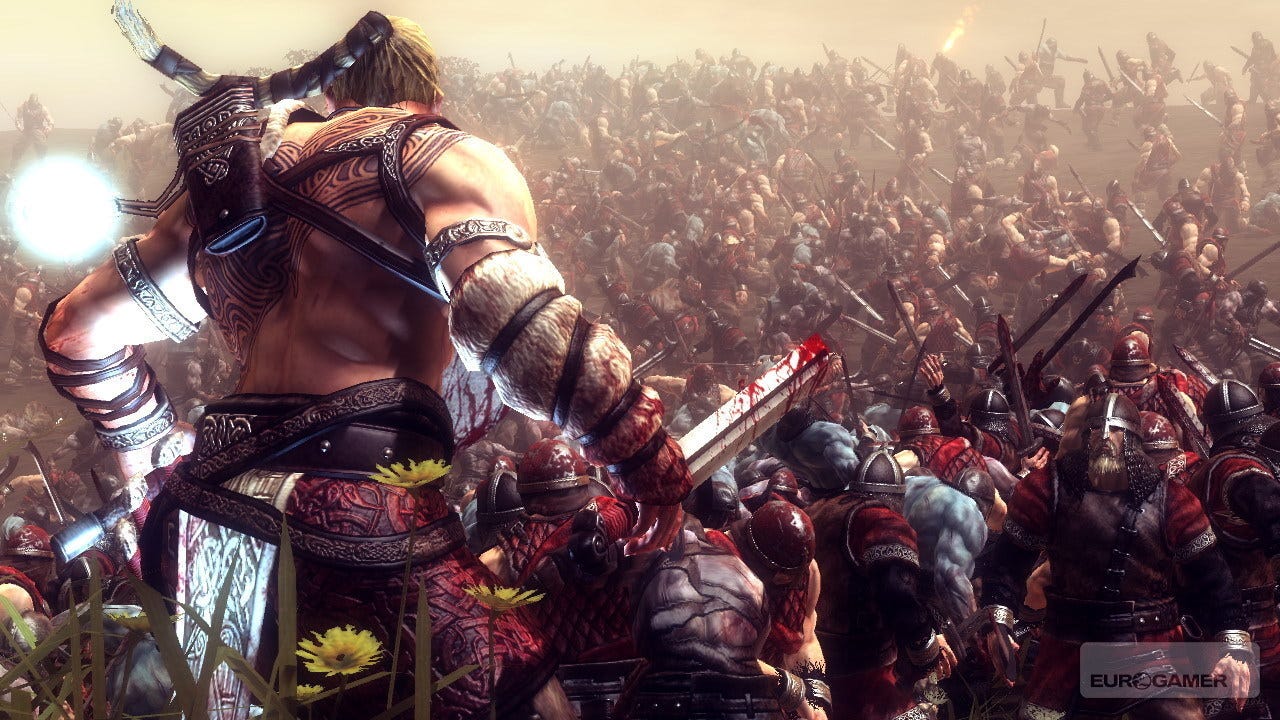
There's no doubting Creative Assembly's ability to render crowds. Shame it's all for show.
Without further ado, you're off trudging around hugely detailed rustic environments, chatting to locals and getting your bearings. Looking for all the world like a Fable-esque re-imagining of Gears of War, there's no denying that Creative Assembly has conjured up a hugely atmospheric, extremely detailed and frequently gorgeous game world, packed with incidental action and vibrant ambience - not to mention rendering insane numbers of characters on screen at once. When it gets into its stride, there's a sense of chaotic battle better than almost any other, as scenes are packed with delicious violence. Gloriously vicious slow-motion dismemberment and buckets of claret are standard-issue throughout, and, given the excellent animation, you can't help but admire the carnage. If that's possible.
Equally encouraging is the openworld approach, which draws initial comparisons with Crackdown for the way it allows players to pick and choose which area you want to liberate next, and how you fancy going about your assault (full frontal or sneak in around the side, for example). With most of the map open to you from the word go, you simply charge off in whatever direction you want, stumble across a village in peril and set about chopping up everyone in sight. If you die, the fact that you're immortal gives you an excuse to simply respawn at one of the nearby Leystones, which are basically portals which also allow you to traverse the island quickly. Once the coast is clear, you free the captives, mop up any stragglers and move on to another point of interest.
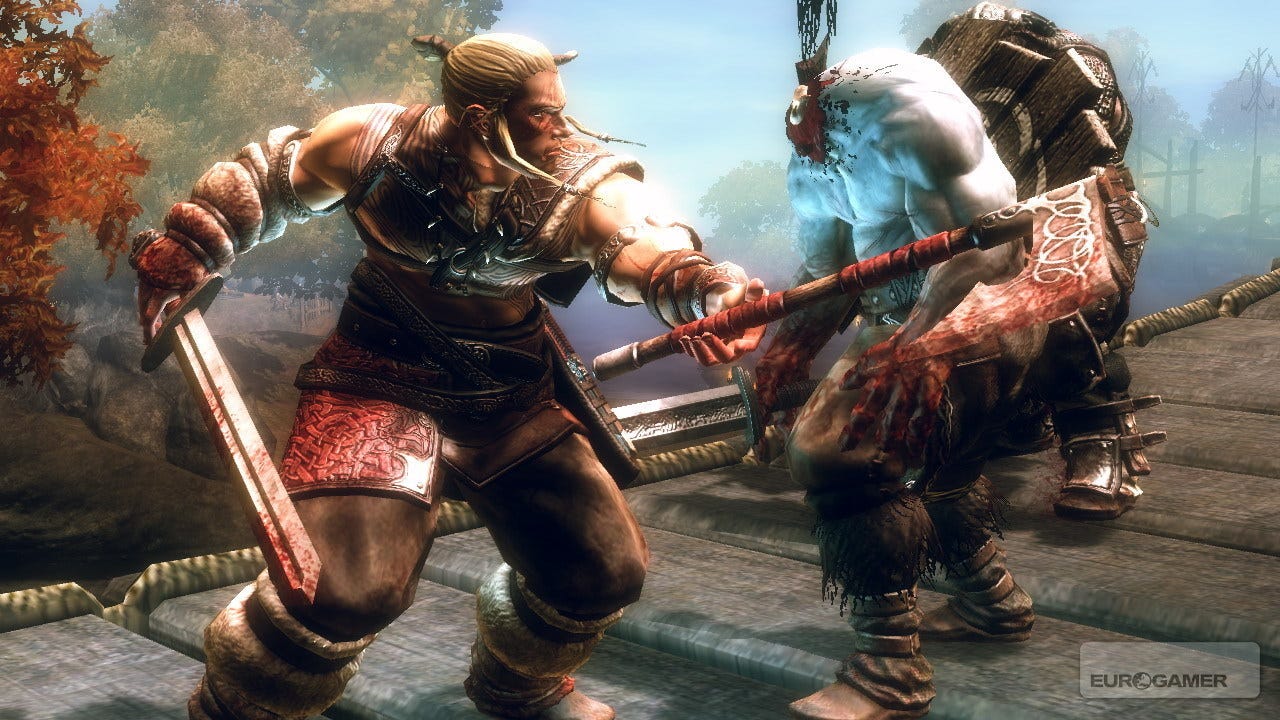
That's a shame. Dismemberment is part and parcel of Viking, but the novelty value soon wears off.
The whole point of liberating each area is to ultimately persuade all the various clans to get behind you for a climactic assault on the map's stronghold. Getting them onside, though, isn't simply a case of freeing them from captivity, but almost always also involves fetch-quests before they'll commit to helping you out. Ungrateful sods that they are, they'll demand you toddle off and find their grindstones and whatnot, which is just one of many ways the game appears to delight in wasting your time.
Fetch-quests we can handle now and then. They help change the pace a little, and give the game a chance to build up the narrative and encourage interaction with the cast. What we can't forgive so easily is how depressingly mundane the combat is, and how little it actually progresses from the early encounters. On the surface, Viking apes the industry-standard light/heavy attack combo system favoured in every game from Onimusha onwards, through Devil May Cry, Ninja Gaiden, God of War and Genji. Scratching the surface, you'll note how few attack combos there really are, and how much success you get from merely mashing the heavy attack button.
You'll also realise that CA has rejected the standard RPG-style upgrade system, even though downed enemies still spew the red orbs we see emerging from dead creatures in every game in the genre. In Viking, these red orbs top up your magic meter, and you have the option to supplement your standard attacks with some fire, lightning or ice if you hold down the right trigger and press the corresponding face button. In terms of upgrading your abilities, that, for whatever reason, comes about by accumulating all the gold that lies inexplicably discarded in all parts of the game world. When you eventually find the battle arena, you're then given the option of buying extra combo moves - providing you can demonstrate your ability to pull them off. Curiously, improving your magic abilities is simply a financial transaction at your local market.
Being kind, you could argue that stripping things out makes the game more accessible to newcomers not schooled in the arcane ways of XP and levelling up. But if anything, forcing players to trudge around buying upgrades rather than earning them feels even more convoluted; it merely rewards players who take time to tediously scoop up discarded gold, and then makes you go to a specific part of the map to do it all.
Putting the abysmal upgrade system to one side, the real Achilles heel of the gameplay is how simplistic the combat is, with almost no substance to the move-set, which relies on simple, one-button or one-two moves sufficient to take down everyone from the most clueless grunt to the game's towering giants. Rule of thumb? Hammer the heavy attack button until they go away - the chances are, the enemy AI will be so dumb, and the collision detection so wayward, that you'll win the day almost by default. The game has a knack of making all this crazed button-mashing look very, very good, so it almost fools you into believing you're a badass, while in reality you're hardly having to do anything involving real skill. That the game lets you get away with this kind of thing on hard mode is unforgivable. Very late on in the game, you do find yourself using the dodge move a little more, but by then you'll have already long since ceased to care.
Spectacular sights and sounds are the norm - but where's the game?
Elsewhere, the way CA handles the map endgame is curious to say the least, requiring neither combat skill nor any semblance of strategic nous. Having gone to considerable effort amassing an army and summoning a dragon to fight alongside you, you realise that the battles are harder to screw up than they are to win. This foregone conclusion involves little more than beating up one or more brainless giants (via Quick Time Events that a four-year-old would have trouble failing), running though a gaggle of enemies, and then smashing up one or more shaman. While your massed army goes about their business looking useful, you can effectively leave the dirty work to them and head straight for the strange-looking chap without a face surrounded by glowing red pillars. To send him back to wherever he came from, you have to quickly smash up these pillars, while respawning monsters try to carve you to little chunks.
But, as with the rest of the game, so long as you hammer the heavy attack button, the chances are you'll be fine - and if not, no worries, you'll respawn nearby anyway. To make it even less taxing, killing giants and shaman earns you Dragon Runes, which you can spend on sending fiery death on one of your targets. Once you've cleared the area completely, you'll eventually be able to summon your own shaman at a designated spot and bring blue skies and sunshine back to the world. Hurrah. You'd perhaps hope for some sense of achievement, but the more you play, the more you realise that you're just doing the same boring things over and over again across three increasingly large maps. Eventually, after about 16 or so hours, Creative Assembly decides that, yes, the world has been cleared of all evil, you can go now.
After that? Well, you'll be several hundred Gamerscore points richer, for what that's worth, but you're left feeling empty with zero incentive to go back and replay the game, and no multiplayer mode. You'll have hammered your way through hours of mindless, grinding hackandslash, and probably wondered why you bothered at all. The best thing you can say about the game is that it's technically impressive, and the openworld structure is a good idea - but that's it. The game's central purpose seems to be to make dismemberment as easy to pull off as possible, but as soon as that novelty has worn off you're left with a hollow, repetitive experience which quickly loses its initial appeal. With Devil May Cry 4 content to stand still, and Viking failing to build on its initial promise, it's all eyes on Tecmo and Ninja Gaiden 2 to inject some life into the hackandslash genre . For now, save your money.
5 / 10
