The last time Jeff Strain founded a new company and made a new game the world ended up with ArenaNet and Guild Wars. But even before then Strain was a name to be reckoned with, having been a lead programmer on World of Warcraft and instrumental in StarCraft's and Diablo's development at Blizzard. He's what can be described as MMO royalty, and he has ripped off his NCsoft suit to reveal his spandex developer costume once more and flown off to found Undead Labs. Better still, he's decided to make a console MMO about zombies. Zombies.
And so far that's all we know, or all we knew until we pounced on Strain and forced him to tell us more.
Eurogamer: Jeff Strain, you are a very successful man. Why? [Wow. "Hardball." -Ed]
Jeff Strain: I've been very fortunate. Whatever my own skills and qualifications are, I've been very fortunate to be surrounded by incredibly talented people. There's a lot of industry royalty out there - luminaries - who have great ideas and strong vision but these projects are too large to be the product of any one person's skill or talent. First and foremost that has to be said. But, you know, your ability to attract high-quality people is absolutely pivotal to how successful you can be.
I really do think it's a willingness to do things differently. Some companies make a success of taking existing formulas and polishing them to a bright sheen and that's a great model. That hasn't been the path that I've taken. I've always believed in innovation and been willing to live that and stand by it. And hopefully this new endeavour that I'm about to launch is just another example of that.
Eurogamer: Are Blizzard one of those that "polish to a bright sheen"?
Jeff Strain: Well, I certainly think they are a great example of a company who makes their business doing that, yeah.
Eurogamer: You mentioned surrounding yourself with a strong team. Who have you dragged along to Undead Labs? Why should we trust that you will make something special? You must know some big names.
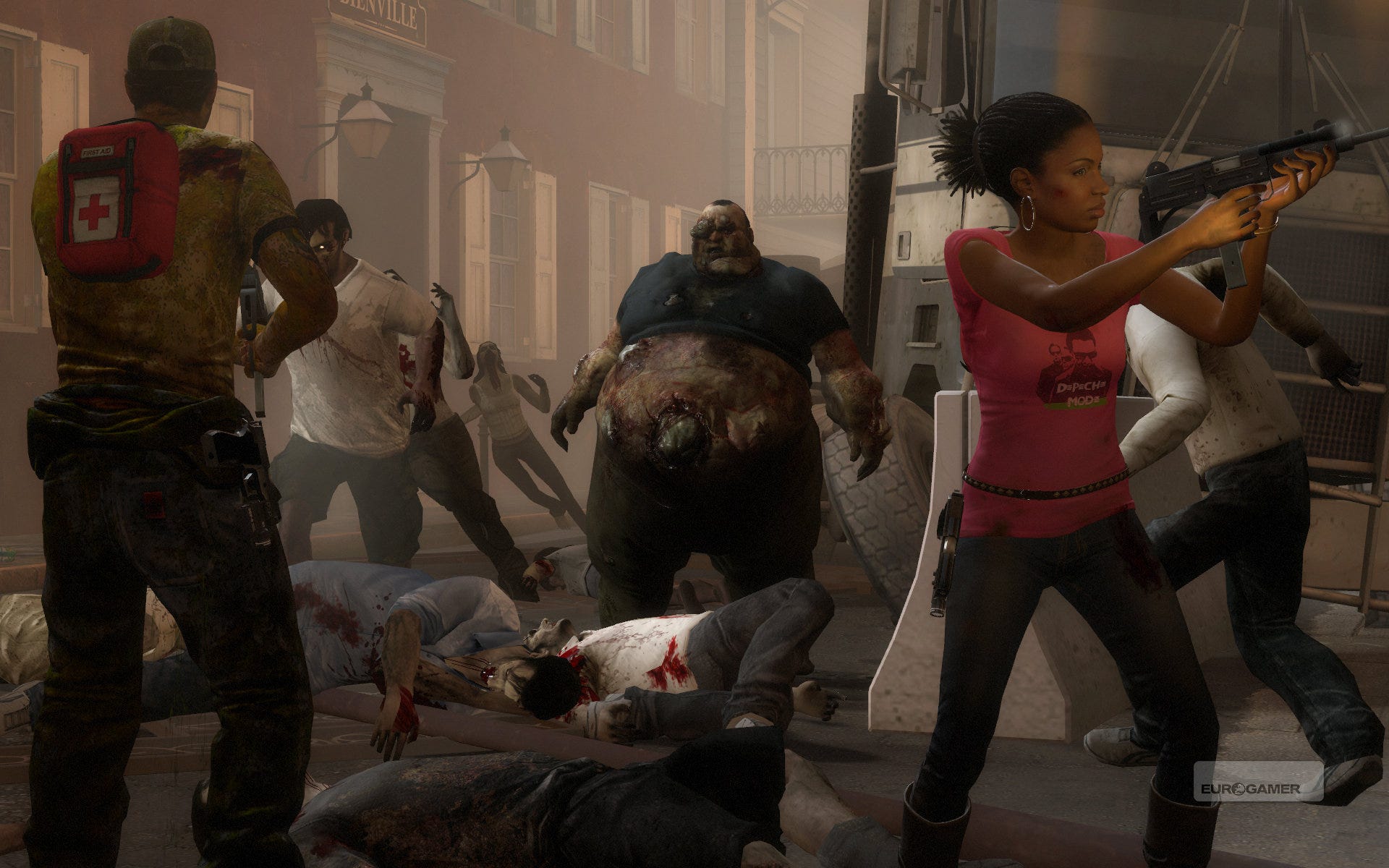
Left 4 Dead 2 has fast, scary zombies.
Jeff Strain: Ha ha. Well I can't mention any names at this point but you can expect to see announcements about that following shortly.
What's going to make Undead Labs special? That's very easy for me to answer, because what makes it special for me is the focus on making a zombie MMO. There are lots of zombies fans out there. I think it transcends your run-of-the-mill fantasy interest. People are passionate about zombies - and this is, to tell you the truth, the reason why I'm even talking about it at this point, about what kind of game I'm going to make, because normally when you start a studio you're very tight-lipped about that. The reason I'm talking about it is because I want zombie fans. I want the best developers in the industry that love zombies to want to work here and be part of this, because it is exciting, it is innovative and it's going to be something special and new. That, more than anything else, is what's going to make Undead Labs a special place to work: that focus and that culture.
Eurogamer: Are zombie fans the right audience for an MMO - don't they simply want to run around blowing limbs off?
Jeff Strain: If you think about MMO in terms of a traditional template, which is largely defined by its genesis and existence on the PC side of the wall, then I think that's a very legitimate concern. But when you say "making a console MMO", to take that template and just port it over is exactly the wrong thing to do for exactly the reason you point out. It's not so much a function of zombie fans as it is console gamers. Console gamers have expectations about how they can play the game. If I'm playing any kind of zombie game on a console, I don't care what the genre, I certainly expect to be able to pick up a golf club and start swinging it, there's no question about it. That has to be there. I'm not going to deny the essential nature of console games in the zombie genre.
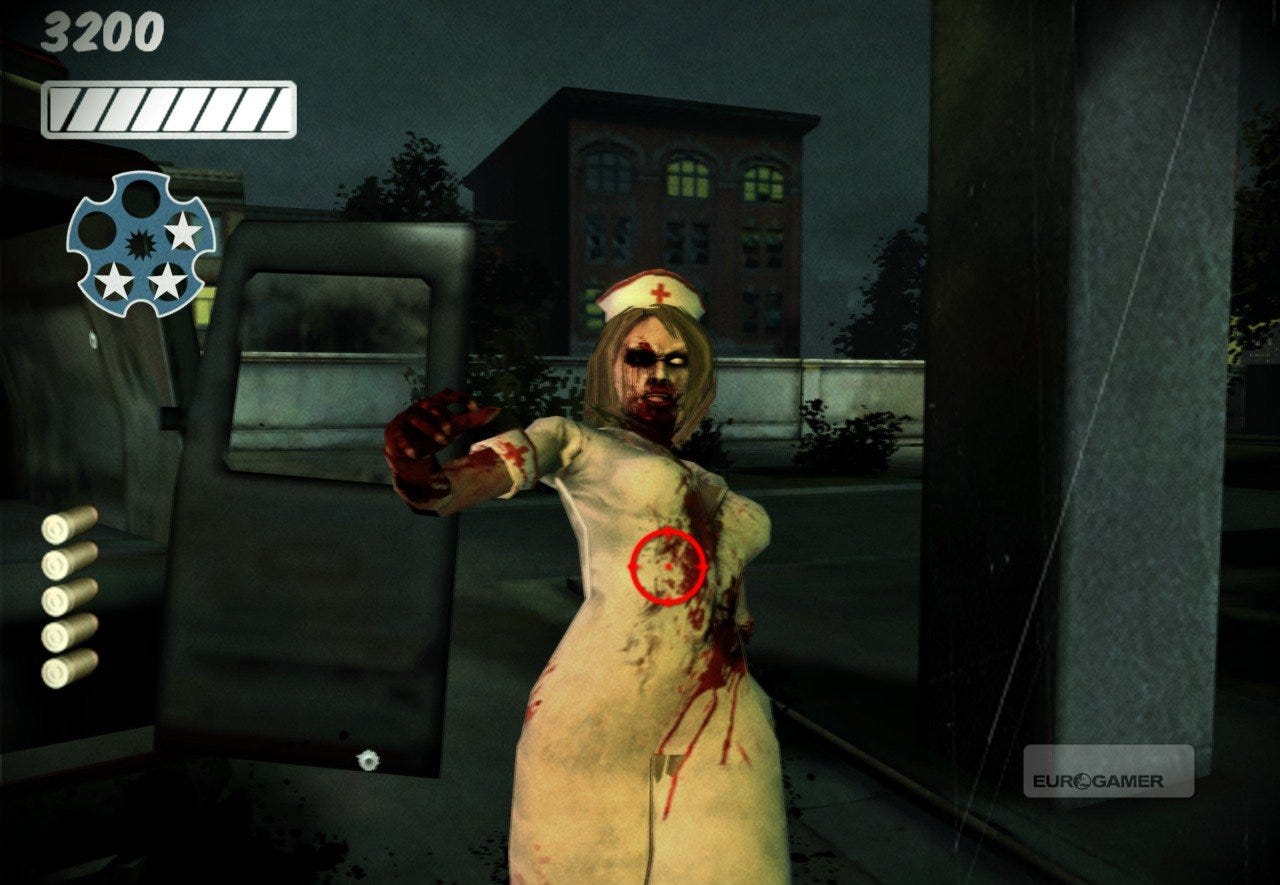
House of the Dead: Overkill has healthcare zombies.
But what you can wrap around it that really makes it compelling as an MMO universe is more this notion of post-societal collapse: the whole world is now your playground and your mission is inherently to work with other surviving humans to rebuild society, to retake your home town and hold it from the zombies and try to recapture what was good about the world. That's something that you don't normally get in your classic zombie corridor shooter, even though those can be fun - that social element is missing.
Eurogamer: Why are zombies more popular than elves?
Jeff Strain: Ha. I wouldn't say I believe zombies are more popular than elves. Zombies have a larger penetration in society but there's no question that fantasy has been an enduring and very powerful genre. My concern about making a fantasy game at this point is that it's been done; it's been done a hundred times. We've told those stories, we've explored those universes, we've spun variations off of core Tolkien canon so many times. What's happening is that the more we try to come up with new fantasy universes, the more we're having to be esoteric about how they work and what the mechanics are. The great thing about the zombie universe for an MMO is that it's largely unexplored territory.
The reason zombies are so powerful and transcend fantasy is because right now they are the modern, societal guilt-free meat-puppet. We've been through the Nazi phase, we've been through the communist phase, we've been through the terrorist phase. Those were all at various times in history fair game in the gaming culture. Right now zombies are fulfilling that need for us. That no-rules, no-guilt mentality is something that people really resonate with.
Eurogamer: Would you kill a zombie in real life then?
Jeff Strain: Well you have to! That's what's beautiful about it, right - because if you don't he's going to eat your brains and so there's absolutely no guilt! Ha.
Eurogamer: Of course you can always have two together and make Nazi zombies a la Call of Duty: World at War.
Jeff Strain: Which was a brilliant masterstroke, I have to say.
Eurogamer: It looks like some other people also like zombies and have made games about them, notably Dead Rising and the immense Left 4 Dead. How does your vision compare to theirs?
Jeff Strain: First of all, MMOs are just a different beast. Those games are both very high-quality games and I personally love both of them. They fulfil a need as far as your basic shooter goes that makes a very fun game. An MMO, though, wraps the societal and communal element around that. If you look at a modern zombie movie like Zombieland, the whole point of that is not about killing zombies: the whole point of that is, "What would the world look like in this post-zombie apocalypse world - what are your motivations at this point, how do you interact with other people, what are you trying to do?" The motivation that you get with an in-depth MMO you just don't get with a corridor shooter.
Eurogamer: When you sat at a table with your team and outlined the road ahead, what were the main mission statements for your game - can you share those with us?
Jeff Strain: Beyond the general outline, no. We're very early in the process and not really talking about a lot of game details. Beyond the genre and these core concepts of going beyond zombie shooting and zombie killing and into restarting society and recapturing your home town and working with your fellow surviving humans - that's the flavour we're trying to accomplish.
Dead Rising has lots of comedy zombies.
Eurogamer: The two unique selling points so far are it being a zombie MMO and it being made by Jeff Strain. I'm not convinced zombies are enough - what can your game do that no-one else's can?
Jeff Strain: The third big point is that this is a game that is breaking with tradition in terms of the platform it's on. This is a game that's designed from the ground up for console gamers. It's not a game that's being designed for PC and console or a game that's being designed for PC and being ported to console. Every MMO developer out there is dipping their toes in that water and finding it to be very, very chilly water, because console gamers have a very different set of expectations for how a game plays and how they interact with a game.
One of the things we'll have going for us is that we're going to be the first company, to my knowledge, that's really trying to define what a console MMO is. The analogy I use is what Bungie and Rare did with the first-person shooter: they were the first ones to really go out there and say, "Look, first-person shooter is a PC genre, that's where all the players are, but we believe we can make a fantastic first-person shooter for console gamers and essentially define what that genre looks like." And they did that. They did not saddle themselves with trying to make a hybrid game. The MMO genre is ready for that. The console gamers are ready for that. I don't want a game that's taking all the template mechanics from what we expect in PC MMOs and trying to somehow graft that onto consoles, I want an MMO that takes all the cool stuff about MMOs and really puts it in a console-specific experience that the gamers are going to resonate with. That is going to be one of the larger selling points.
Eurogamer: One of the reasons we've not seen many console MMOs is red tape caused by Microsoft's and Sony's online services. Has that been a problem for you?
Resident Evil 4 has fast and slow zombies. Tricksy.
Jeff Strain: That's right, and we're concentrating left, right and centre on that whole issue. I've been sitting in rooms with Sony and Microsoft for years and years and years talking about bringing MMOs to console. The reason you have not seen it yet... It's a little bit misleading to say that there's too much red tape. You have to look at it from the viewpoint of... every MMO developer out there by definition is a PC developer. That's where their business is and that's where their customers are. If you contemplate taking your business onto console you have to do it from a standpoint from, "How do I make a console version of my game and still maintain my PC user-base and the structure I built around that?" That's what makes it complicated.
We're fundamentally in this mindset where we've created this entire infrastructure around how we interact with our customers and how the game mechanics work and how we expect the backend of a structure to work. If you just scrap all that and say, "Look I'm going to sit down with Microsoft and Sony and I'm going to roll up my sleeves and tell them right-up I'm making a console MMO and we can jettison 50 per cent of all this business red tape that we've been struggling with for years and years," then I really think we're going to get tremendous traction with that.
Eurogamer: I'm assuming PS3 and 360 are the platforms you're targeting even if you can't confirm that here today. Have you sat down with Microsoft and Sony already and told them that?
Jeff Strain: Unfortunately I can't make any comments about that. I'm sorry.
Eurogamer: What's your game called, by the way?
Jeff Strain: That's something [where] normally I would tell you that I'm not talking about the name because I didn't have one this early, but I'm not talking about the name because I'm just not ready to announce it yet. Ha.
Eurogamer: The MMO genre is always changing, even in the games themselves. What's exciting to you about the industry today?
Jeff Strain: The real new frontier for MMOs - and this is something you'll hear from almost any MMO developer - is true impact on the world, a truly dynamic world. Everybody has their own spin on how that's going to work, but if you're going to move beyond level grinding and if you're going to move beyond the grafted-on mechanics to keep players coming back based on some kind of need to see a number go up - to really keep them coming back because they're excited about what they're going to do next and they're having a good time. The only way we're really going to accomplish that is by building worlds that truly and honestly dynamically adapt to what the players are doing. You have to feel like you matter. You have to feel like you're making a difference. That's where we absolutely have to go. And certainly with this game that is rule number one and absolutely central to the design.
Eurogamer: Are you moving beyond level grinding?
Jeff Strain: I'm not going into details about the game right now. Philosophically, levels do serve a purpose. They give you a visual and mathematical indication of your progress through the game. As a goal in and of itself - if you find yourself building a game where all of the mechanics and all of the reward structures are designed around increasing your level - that is ultimately shallow, and a bad way to design.
Eurogamer: Are you making scary zombies or comedy zombies?
Jeff Strain: There's an inherent humour in zombies. Some games get this right and I see some skew off towards more horror or Gothic-creepy. For an MMO in particular that's not the direction I want to go. It is a fine line; it is a fine line between horror and slapstick. Zombies are not slapstick, and if you make them slapstick then people are going to lose connection with the world, lose their sense of purpose - it has to be a credible and meaningful threat.
But - and we were talking earlier about this guilt-free meat-puppet - there is a guilty pleasure, a guilty humour, in the way you interact with the zombies. If I find myself spending a little bit of extra time to construct a trap for the zombies that are going to be invading my town that night, so that not only do they fall under but the pit catches on fire and then there's a truck that falls on top of them - then that's funny, right? I can see myself as a player, even though it doesn't really buy me anything, I can see myself going for the style points there.
Call of Duty: World at War has Nazi zombies - a "masterstroke", says Strain.
Eurogamer: Can I be a zombie in your game, Jeff Strain?
Jeff Strain: Ah! Again not talking about specific mechanics but I will tell you that as a player I would sure love the opportunity to play as a zombie from time to time. I wouldn't be at all surprised if we included that in the game.
Eurogamer: And will you then be accused of influencing children to go outside and eat people?
Jeff Strain: Oh! That's a whole big ball of wax that we'll tackle when we have to. Look, it is going to be an M-rated game, we're not going to sanitise it and make it something for your eight-year-old. There's always issues when you do that. But boy, this is a zombie game, you know? You don't go to see a zombie movie and expect it to be rated G and the same thing could be said for this. We have to be true to the genre.
Eurogamer: Are you going to be class-based?
Jeff Strain: That's a level of detail I'm not going to talk about at this point.
Eurogamer: There must be PVP in your game! How does it work?
Jeff Strain: Ha ha. Without going into specifics, I'm not sure there will be, other than if there are times when players can be zombies - there may be some PVP there. The fundamental conflict in this world is humans versus zombies, and I don't see us violating that in any way.
Eurogamer: "Times when players can be zombies"! That sounds like Left 4 Dead, where players take turns as different types of Infected and they play against the Survivors. Are you doing that - am I on the right track?
Jeff Strain: You're thinking about it the right way.
Eurogamer: And when you mentioned rebuilding towns and rebuilding society, were you explaining the craft and trade side to the game?
Jeff Strain: Absolutely. Rebuilding towns and holding them against the zombie menace will be an essential part of both the economic backbone of the game and the character progression portion of the game.
Eurogamer: I assume guilds will feature, one way or another. Will they be able to control whole towns or cities?
Jeff Strain: Yeah that's a level of detail I'm not prepared to talk about.
Zombies Ate My Neighbours has zombies from 1993.
Eurogamer: How long has Undead Labs been working on this game?
Jeff Strain: Ha ha. Unofficially or officially?
Eurogamer: Unofficially!
Jeff Strain: I personally have been working on the core concept and core design spine and all this since shortly after I left NCsoft.
Eurogamer: How does it compare to Guild Wars - were you dreaming of that a long time before you left Blizzard to found ArenaNet?
Jeff Strain: A large part of the reason I left NCsoft was because I needed to return to my developer roots. Certainly the notion of a console-only MMO, and the notion of some genre other than fantasy (leaning towards the zombie genre because that's something I'm personally fascinated about) had been kicking around my head at the prototype stage for a long time.
Eurogamer: What sort of development cycle are you looking at for your zombie MMO?
Jeff Strain: MMOs take a long time and they take a lot of resources. Just to manage everybody's expectations: this isn't something you're going to see next Christmas or the Christmas after. Beyond that though it starts to get a little fuzzy, and I won't be any more specific than that.
Eurogamer: And, er, who's bankrolling the game?
Jeff Strain: That's not announced at this time.
