Trinity Universe Review

Dood, where's my star?

Version tested: PlayStation 3

"That man has ten arms!"

"He's a cosplayer."

I've played enough idiosyncratic games of Japanese origin recently that the above exchange - one of many in Trinity Universe that poke fun at games and gaming culture - barely raised an eyebrow. This isn't the weirdest game I've reviewed this year, though with its effective skewering of anime stereotypes (there's a neat recurring gag about one character's silly hairstyle) it might just win the prize for the wittiest.

Trinity Universe is a hefty slab of pure JRPG whimsy which half-inches characters from the Disgaea and Atelier series and sprinkles them among a cast of originals led by a half-man, half-dog, understandably reluctant to fulfil his destiny of bringing harmony to the universe by transforming into a "dinky gemstone".

Demon Dog King Kanata is an idealistic young pup looking for adventure, rescued from being prematurely bejewelled by Tsubaki, his softly-spoken aide who may or may not have an ulterior motive for saving him. Here in the Netheruniverse, outer space is filled with detritus, from soft toys to traffic cones, rubber ducks to castles, and you're tasked with eliminating all these drifting objects to prevent them colliding with your home world of Empyria.
1

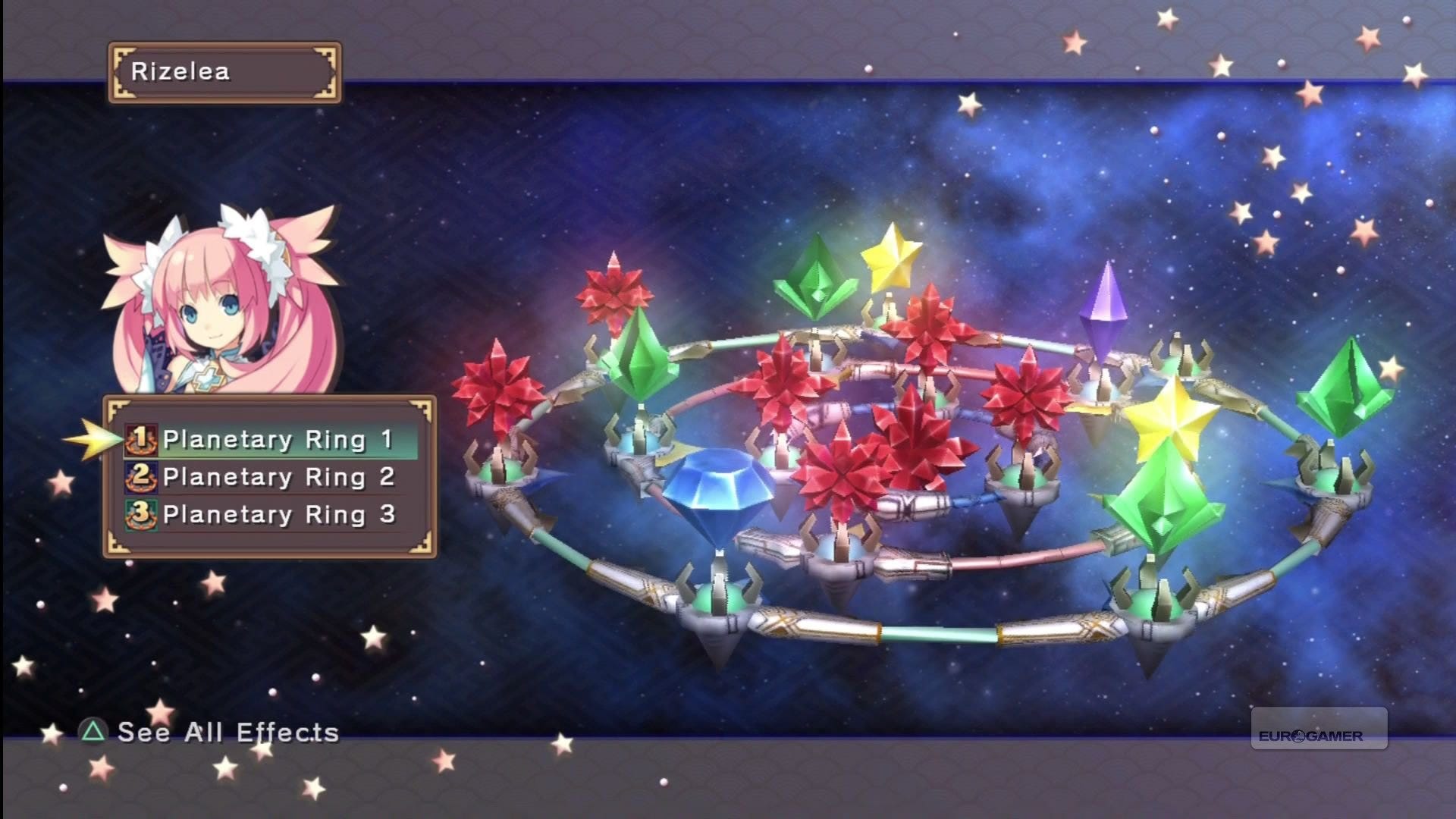
In Valkyrie Rizelea's campaign, you can position meteorites around planetary rings for boosts.

Many of these objects are meaningless decoration, but others house shops or inns, with the largest objects containing dungeons to grind through. For all the bizarre window-dressing, this is a fairly traditional RPG at heart, with a structure that will be familiar to anyone with even a passing interest in the genre.

You'd need more than a passing interest to be part of the audience for Trinity Universe, though. In the West, Nippon Ichi is pitching towards a very narrow niche with this: the kind of gamer for whom the idea of playing as Disgaea favourites Flonne and Etna brings a frisson of excitement. So it seems odd that NIS and Idea Factory initially appear to be tilting towards new players, offering a difficulty mode recommended for beginners, and drip-feeding abilities throughout the opening stages to get everyone accustomed to what are fairly recognisable RPG mechanics.

Sadly, it's obvious that the developers aren't exactly well-versed in tailoring their games accordingly. The simplest of concepts are laboriously detailed, while less obvious facets are glossed over all too quickly.
2

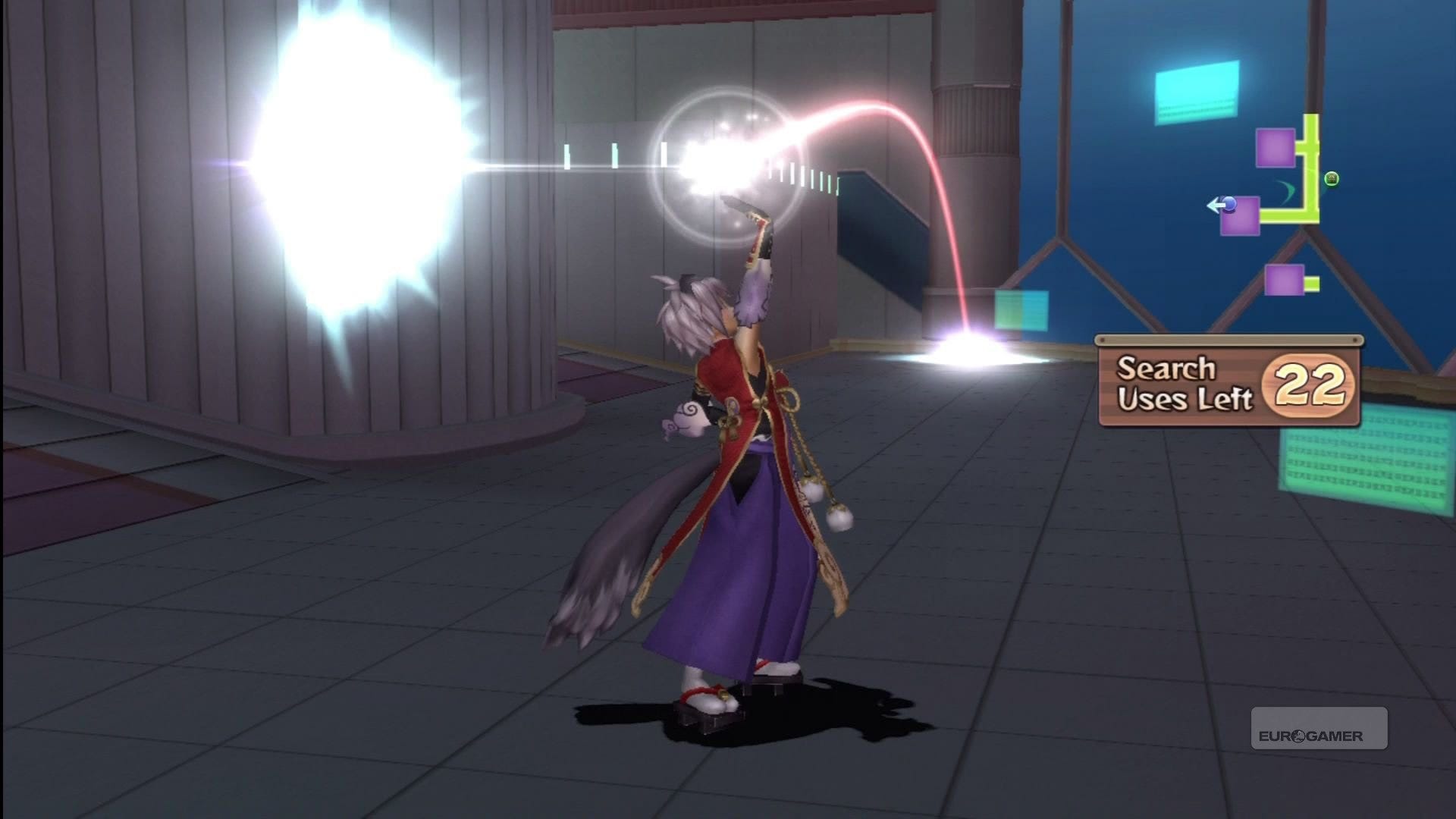
Use the Search command in dungeons and coloured lights arc from Kanata's fingertips, highlighting the location of hidden items like Managraphics and treasure.

The intricacies of the character-switching Fury Chain battle system take some time to get to grips with after an all-too-brief tutorial, and even then, the timing-based commands hardly feel like the most accessible control set-up for newcomers. Particularly so, given the lack of clarity when swapping between party members: it's all too easy to lose a combo because the next Action Point gauge has started counting down while you've been concentrating on perfecting the initial character's attack.

Everything seems to be introduced either too early, too late, or at the wrong pace. The very start of the game mentions that Kanata's campaign allows players to create their own monsters to battle against in the Coliseum from an early stage, and thus gaining levels and acquiring key stat-raising items is theoretically simpler. Yet the first time you have the means to make a monster, you'll barely get a couple of turns in before they've sent you packing, as they're almost comically over-levelled.

Similarly, the game warns you of the occasional appearance of hugely-powerful Lurker monsters who surround your group with a dark aura, and can easily wipe most of your team out in a single turn. Yet I was only informed after I'd been soundly beaten by one of these creatures. Fortunately, it hadn't been long since I'd saved, unlike the time when I happened across an absurd difficulty spike of a boss who lost me about two hours' play thanks to the archaic save system.

It's a shame, as once you grow accustomed to the battle system's foibles, combat becomes much more fun, and there's a good degree of flexibility. Though too many enemies are easily dispatched with the most basic attacks, and the early bosses feel like wars of attrition - most will simply alternate between attacking with a pair of characters and healing with the other two - larger battles eventually see the hit counter ticking over well into the hundreds. Pulling off a well-timed combo attack to finish off a particularly gruelling encounter is satisfying for the knowledge that you've not simply picked an option from a menu: timing is all-important.

On top of the usual ability buffs and stat-boosting accoutrements, Managraphics are something a little different. A couple of hours in, you'll meet a timid artist named Miyu who can paint your weapon with mana you've obtained from dungeons. As well as making weapons look more interesting, these add elemental damage and battlefield effects to your attacks.

The unstable nature of the dungeons means that they offer up fresh items should you revisit them at a different time of day, and they can also start to drift into deep space while you're exploring them, forcing a rush towards the exit as a timer ticks down. It's often worth hanging around until the final seconds, as valuable objects often materialise in rooms and corridors you've previously visited.

3

Certain spots can be used to hunt monsters, essentially allowing you to get the grinding done in one go.

Fail to reach the start in time and it's not game over, though you'll need to pay a fee to any passing space travellers to get back to Empyria. Unfortunately, it's usually during these drifts that you'll happen across the Lurkers, and it's infuriating to lose your team - and half an hour of hard work - so close to home. It'd be an interesting risk/reward idea if it wasn't for the fact that Lurkers so often seem to block your one route to the exit.

The 2D art is very pretty, with otherwise static cut-scenes brought to life with so-called Active Animation. By comparison, dungeons are pretty ugly: character models and backdrops are little more than hi-def PS2 visuals and monster design is similarly uninspiring. The music is fairly forgettable, with one catchy piece of J-Pop repeating just a little too often for comfort, amongst a host of nondescript dungeon themes.

Though the quality of the acting is generally decent, the English language track is only a partial dub, so much of the text appears in silence. That said, you'll welcome the respite from the irritatingly shrill pitch of much of the spoken dialogue. By the five-hour mark I was so fed up of Prinny's whining and "dood" after every single utterance that I'd switched to the Japanese voice track, and that's hardly an improvement.

4

This being a Nippon Ichi collaboration, it's little surprise that the numbers get ridiculously large.

It's tempting to simply skip through the dialogue - and it's admirable that there's an option to do so - but for the fact that you'll miss some genuinely amusing exchanges. Nippon Ichi scripts have always had their share of fourth-wall-breaking moments, but there's plenty of bawdy humour too, with an early exchange seeing Etna erupt at comments about her flat chest, and the unfortunately-named Recit being mercilessly mocked for "sounding like something you'd throw in the trash".

It's the script that carries you through the tedious one-button bludgeonings you'll deal out to weaker foes and the spikes of frustration with Lurkers and bosses. It will allow some to look past the sluggishness of the attack commands and the brief but irritating loading pauses for each battle.

But Nippon Ichi fanatics already have the deeper, more tactical Cross Edge, while newcomers have plenty more accessible - and vastly better-looking - role-players on PS3 to keep them busy. While it's commendable that publishers are still localising these quintessentially weird and wonderful Japanese games, ironically, Trinity Universe's biggest problem might just be that it's not quite crazy enough.

6 / 10

Read the Eurogamer.net scoring policy

Comments (58)

Comments for this article are now closed, but please feel free to continue chatting on the forum!

  • Loading...hold tight!