Version tested: DS
Kids love collecting things, as anyone who's ever been embroiled in a Panini sticker-related dispute can testify. So it's no surprise the vast majority of videogames involve collecting things, whether that's coins or points or Pokemon or Enchanted Wizardweave Leggings of Maximum Fire Resistance.
Treasure World revolves entirely around the concept of collection. The twist is you don't pick up items as you explore the in-game environment - in fact, there's barely an in-game environment to explore. Instead, you gain new stuff by wandering around the real world with your DS in tow.
On hand to explain all this is a cheery professor type. He looks like what Dr Robotnik would have turned out like if he'd had a happier childhood. He's accompanied by the Wish Finder, a little robot character who is surely the lovechild of Clank and Nono (small robot you know). Their spaceship, Halley, has crashlanded in a moonlit garden, and naturally they need your help.
Your mission is to earn enough in-game currency - otherwise known as Stardust - to get Halley powered up again. In exchange for Stardust the professor type will give you in-game items, otherwise known as Treasures. These include items of clothing you can use to dress up the Wish Finder, such as t-shirts, baseball caps and ninja outfits. But there are also environmental objects to collect such as flowers, trees, mushrooms and cacti, plus a huge number of random items like teddy bears, hay bales, Easter eggs, four-leaf clovers and anal beads. Maybe not the last one.
Both Stardust and Treasures can be found by telling the Wish Finder to scan the skies for stars. In practice, you're telling the DS to scan the surrounding area for wi-fi signals. Each signal generates a unique star and each star yields a prize, which might be 10 units of Stardust or a lavender plant or a new pair of trousers and so on.
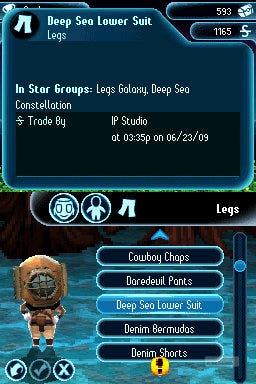
We've yet to find a sombrero, sadly.
If you live in a built-up area you can pick up plenty of rewards without leaving your lounge, but it's really about exploring the world around you. Just set the Wish Finder to scan, pop the DS in your bag and go about your everyday business. The scan continues even with the handheld's lid closed, and a satisfying "Plink!" is emitted each time a new signal is discovered. (You can turn the volume down if you find this annoying or are at a funeral.)
This is where the fun starts. You might return from the corner shop to find you've picked up a prickly pear, a belly dancer's bra and a new kind of hedge, although you only went out for some fags. During a 30-minute expedition around magical South-East London (through the estate, down to the Harvester then back up past Tile Magic) I came across 103 new Treasures. (Plus 47 empty Stella cans, two abandoned sofas, four cross-looking gentlemen who probably ought to have been at school and one incidence of racist graffiti, but that's by the by.)
There's something stupidly pleasing about opening up the DS again to discover you've acquired a host of new Treasures. That applies even for grown-ups, though the novelty wears off a lot quicker than if you were nine. Still, the collection element of the game is innovative and works well. The problem is, there isn't that much to do with all the masses of stuff you acquire.
Dressing up the Wish Finder in different outfits has limited appeal, as does buying extra items from the professor - you're picking up new ones for free all the time anyway. So it really comes down to the feature which allows you to create music tracks, or Songscapes as they're called here. It turns out the garden is a 32 by 9 grid which works as a musical stave. Each Treasure you collect makes its own sound, and you drag and drop Treasures onto the grid to build up Songscapes.
You can create music from scratch or play around with the preset tracks you've collected - these are generally familiar tunes such as Home on the Range and the Anvil Chorus. There are different tempos and scale types to choose from. You can record the Soundscapes you've created, play them back and edit them. And that's about it.
While it's fun to try out new items you've collected, constructing entire songs is a bit fiddly. The menu system is overly complicated and has too many layers, making it hard to compare sounds or navigate between them quickly. The grid points are very close together and sometimes the DS struggles to read where you're trying to place items. In addition, the small size of the grid means that while you have a host of instruments to play with, you're strictly limited in terms of the length and scope of the pieces you can create.
If you do put the effort in, though, you can then share your creations via Club Treasure World. This website lets you upload your DS save data and create an online profile. It's also the place to go to unlock items with the special Treasure Keys you've collected - or that's the plan. The release of these items will be staggered, and the six keys I've earned so far currently unlock nothing but the words "Coming Soon!"
Southwark Council has been contacted re: racist graffiti.
There's a social networking aspect to Club Treasure World - you can make friends, trade Treasures, exchange messages and chat on the forum. Treasure Map, potentially the coolest feature, will allow users to place pins on a Google-style map indicating where they found coveted items. However, the Treasure Map was also stamped with "Coming Soon" at the time of writing. The community using the site appears to be pretty small, but the game is only available in the US at this point and was released less than a month ago.
There's certainly potential for Treasure World to be a big hit with kids. The method of collecting is unique, gratifying and fun, and with more than 2500 items knocking about there's plenty of work to be done. The idea of a game that motivates children to get out of the house and keeps them occupied during journeys will appeal to parents, too.
The problem is whether the game has enough depth to provide long-term entertainment. It definitely doesn't as far as adults are concerned, and only the most fanatical of kids are likely to stick with it for long. There's just not enough to do and not enough reason to keep on collecting once the novelty has worn off. You can't use the items you find for combat, as with Monster Hunter and Pokemon. There are no mini-games to play, as with Animal Crossing, or puzzles to solve like in Professor Layton. You're left with a basic, limited, fiddly music composer. And if it's a DS music composer you're after, you'd be better off with Electroplankton or KORG DS-10 Synthesiser. Treasure World has a nice idea at its core and is fun as far as it goes, but it doesn't go far enough.
5 / 10
