Why Tomb Raider IV: The Last Revelation? Tomb Raider I is loved with nostalgia, Tomb Raider II is the best in the first run of the series, Tomb Raider VI (The Angel of Darkness) has the novelty value of being awful beyond explanation, and VII, VIII and IX have all been absolutely superb. So why IV?
Because it has the dumbest ending of any game I've encountered.
Clearly games have worse endings. Some games grind meaninglessly to a halt. Others suddenly declare themselves "to be continued". Many endings are incoherent nonsense that fails to pull together the various threads. But Tomb Raider: The Last Revelation's is the dumbest.
Astute readers will have detected the possibility that this piece may contain the odd spoiler. For instance, Lara dies at the end. Eleven years ago. She's doing well for it.
The Last Revelation is interesting for another reason: it's pretty good. It's easy to forget that. It reviewed reasonably well too, but it was certainly the start of Lara Fatigue, a syndrome entirely the fault of Eidos' over-zealous marketing.
(It was also successful marketing, you can argue. The game went to No. 1 all over the world, and by 1999 everyone in the universe had heard of Lara Croft, even though it was still two years until Angelina Jolie would don the shorts, and waste the second half of the film searching for the second half of an object that must never be united, rather than just smashing the first half and going home for tea.)
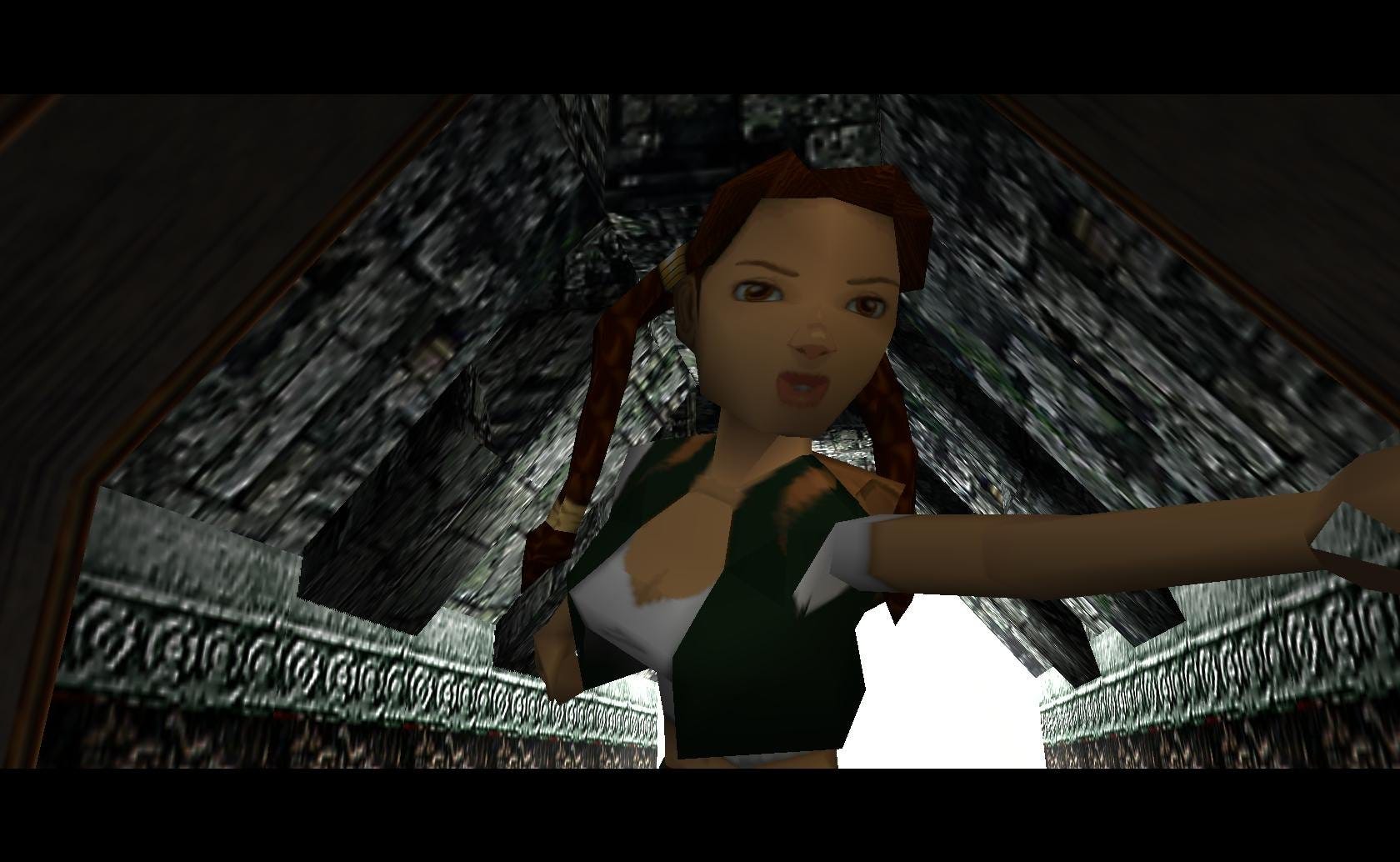
This is about seventeen kinds of wrong.
Having permeated into the mainstream, you could credit Ms. Croft with an awful lot of the transition of console gaming from niche pursuit to commonplace television company. But of course being popular is a curse, and most people were becoming sick of her. This wouldn't affect reception until the perfectly good fifth game, Tomb Raider Chronicles, which was poorly received simply because it was the fifth game. "Too many," people cried. "Stop releasing these solid, fun games!"
I think The Last Revelation might actually be to blame, as it happens. After Tomb Raider III placed Lara in some modern-world settings, in cities far from any tombs, then-developer Core Design took the series back to Egypt for part four. And in Egypt it stays, Lara's traditional globe-trotting abandoned for a distinctly sandy vacation.
It's Tomb Raider squared, heavily focusing on what she was originally all about, and so, aesthetically at least, a step backward. When Chronicles appeared, everyone had spent as much time robbing yellow tombs as they could face, and despite the fifth game featuring levels in modern office blocks and the like, everyone was exhausted. Exhausted, I contend, by IV.
By this point Core was sticking to its established formula - something Angel of Darkness proved it should have always done. Because when your established formula is huge, fascinating levels, packed with secret tunnels, elaborate puzzles, and enormous multi-threaded tasks, it's something you should be proud to repeat.
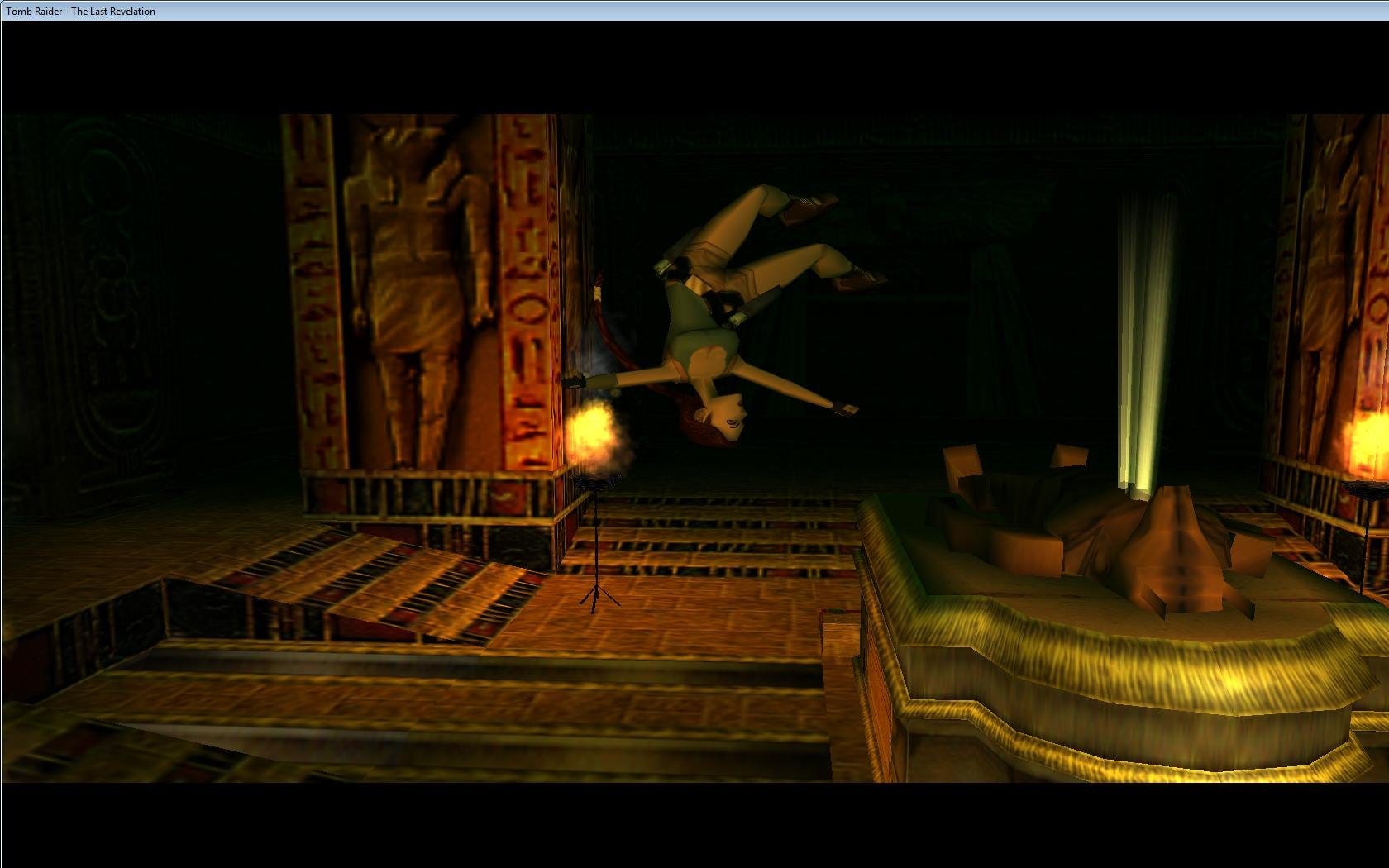
The tumbling is still superb.
Of course, this also meant sticking with controls that led to PC versions of the series always being something of a jumble. Wholly designed for a gamepad, and refusing to accommodate the mouse (since you couldn't turn the camera, a mouse would have been of limited use anyway), it was always a muddled keyboard affair.
However, my first attempt to replay this game was on the Dreamcast, thinking that a more interesting approach. It was certainly interesting. After struggling painfully for over an hour I'd still not cleared the tutorial, so horrendous were the d-pad or analogue controls.
Lara steers like a wayward shopping trolley desperate for a river to die in, determinedly veering off any ledge she can find. Short of installing Samaritans hotlines on every platform, nothing was going to keep her alive. And so to the PC I switched. Where the 360 pad was no better.
And then I remembered! My patented Tomb Raider control method, which had done me proud throughout the nineties. I've described it to people before, and they've always thought me mad. But once again it proved to be the only reasonable way to play.
Because Tomb Raider assumes it's being played on a gamepad, the nature of jumping, rolling, crouching and firing is designed around a collection of buttons. But since Lara can't make a slight turn without launching herself onto the nearest spikes, the ambiguity of both an analogue stick or d-pad is useless. So it's left hand on the keyboard to steer, right hand on the right half of the gamepad.
And it works. Suddenly the game is under my control. Or as much control as the games offered. For Lara cannot run to her left or right - something we're so used to in games now that its absence feels like a missing limb. She's steered from behind, a sort of rear-wheel drive human. It takes a lot of getting re-used to.
The game opens with a tutorial featuring what appears to be an early-teen Lara, already troublingly endowed. With her hair in pigtails, her voice an annoying yip, it's more than slightly disturbing that she should be exploring tombs with creepy Austrian Werner Von Croy.
This of course sets up his return later, where he's possessed by Egyptian god Set, chasing Lara about the country as she struggles to reincarnate his rival Horus (the endless bear).
But of course this possession is entirely Lara's fault. Lara is, let's not forget, a truly dreadful person. Much has already been written about how she's a grave-robbing thief, uncaring about either history or wildlife. And despite her having encountered dinosaurs, dragons and giant killer statues, she's utterly blase about ignoring ancient texts warning of terrible plagues being unleashed upon the Earth if she takes one trinket or another. Screw Earth! She wants the shiny thing!
Yeah, just steal it Lara. No one minds if you KILL EVERYONE ON EARTH.
But of course Von Croy is the baddy, because he tried to do the world and its history a favour by killing her when she was a squawky teenager.
So once the controls are under control, Tomb Raider IV is once again a ludicrous pleasure to leap about. Those special moves, turning mid-backflip, swan-diving into water, the elegant handstand pull-up - mastering this feels remarkable. It's still wonky, and her idiotic desire to sprint off any ledge is maddening, but when it works it feels fluid and splendid.
The big trouble here, though, is having the faintest idea where you should be going. To both its credit and its failing, TLR has enormous, sprawling levels, requiring you to collect objects far and wide, trying to remember/guess what goes where, and where it opens up next. In lengthy yellow/brown chambers, remembering which of the sixteen thousand doors was closed before is a little much. It's so easy to find yourself charging around in complex circles, searching for whichever passage now lets you go left as well as right.
Which brings us to its ending.
So here's the thing about Tomb Raider: you die a lot. Whether because Lara bellyflops into the nearest pit, because you screw up a difficult jump, because scarabs eat your feet to death, because you run out of oxygen when swimming through underground tunnels, because she gets shot at by enemies, bitten by dogs, poisoned by scorpions, because she's crushed by a descending ceiling or rising floor, wedged on spikes, set on fire, run over, stabbed, sliced, or because you deliberately plunge her into a hole because she's just so rude, you die a lot.
The ancient Egyptians were rubbish at chess.
So having an ending in which she's crushed by a temple is perhaps as dumb a decision as anyone could make.
It's like an FPS ending with your character being shot by an enemy. Or a strategy game ending with your troops being overwhelmed by a more capricious army. What do you do when you die in a game? You press the quickload button. You do that a great deal in Tomb Raider, in the precise circumstances in which Lara loses her faculties in the closing cut-scene. But quickload only takes you back to the moment before the game forcibly kills you.
It's argued by some that she doesn't die. I'd argue that a temple falling on your head can often prove fatal. The next game takes place at her funeral and wake, associates recalling past adventures we've not previously experienced.
That Angel of Darkness forgets this, and seemingly revives her without explanation, is the least of its problems. (I think this is the case. I haven't the strength to try playing it again to be sure.)
This ending makes all your efforts futile. The entire game is about keeping her alive despite enormous odds. For the game to then eradicate all this hard work by filling her with bricks is a slap in the face. It is, I contend, the dumbest ending ever.
