It's a minority view, but of all the great Zelda games the one I've enjoyed the most is Wind Waker. I found the divisive visual style utterly captivating, bursting with charm and revealing the perpetually tongue-tied Link at his most emotive and expressive. The scene in which he retrieves the Master Sword as colour bleeds back into the world remains one of the most enchanting sequences I've experienced in a videogame.
But above all, it was the boat, the freedom of the ocean, the journey into the unknown. Structurally, it was classic Zelda, but the visual metaphor made every trip feel like a voyage of discovery, happening upon strange islands with Columbus-like relish, with the spell only broken during the laborious fetch-quests towards the end. Simply rocking gently on a moonlit sea, gazing out at the stars gave a sense of vastness and isolation I've only encountered elsewhere in Shadow of the Colossus.
So when Nintendo announced the series' DS debut would return to this cel-shaded universe, with Link's home console adventures re-adopting a grittier aesthetic, I was ecstatic. Though the exploratory elements were curtailed, Phantom Hourglass didn't disappoint; and now its direct sequel, Spirit Tracks, is due to arrive next month.
Its creator, Eiji Aonuma, the man in charge of the series since Miyamoto took one hand off the reins following Ocarina of Time, makes a compelling case for the deployment of the cartoon style on handheld.
"On handheld devices like DS, for the grand universe of Zelda to be correctly depicted, cel-shading or toon-shading style is the most appropriate," he tells Eurogamer. "If we were going to apply photorealistic proportions between human characters and objects, the player character would have to be really small."
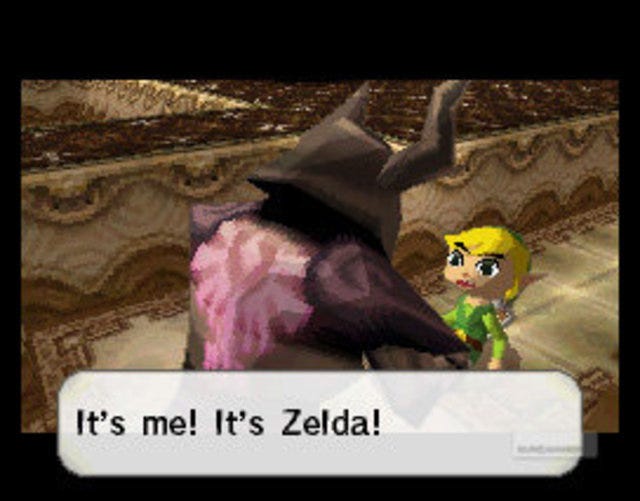
Being dead has its advantages. If 'soldier of darkness' possession can be considered one.
"Thanks to that kind of graphical style we are now able to put Zelda in an adventure where people can identify the most important items without difficulty in understanding proper distance or proportion between character and object."
And, of course, it looks gorgeous. Aonuma's in London to promote Spirit Tracks. The greying hair tells you he's no longer a young man, but the infectious smile and animated enthusiasm, regardless of the language barrier, communicates a sense of childlike wonder he shares with Mr Miyamoto, which infuses the games he makes. This perhaps explains the change of direction in Spirit Tracks.
The sequel shares the fundamentals of Phantom Hourglass - and Zeldas of yore - as closely as you'd expect. The primary structural change is the mode of transport: the high seas replaced by dry land, this incarnation of Link (the game's set 100 years after Hourglass) occupying the dream role of many a child since the industrial revolution: train driver.
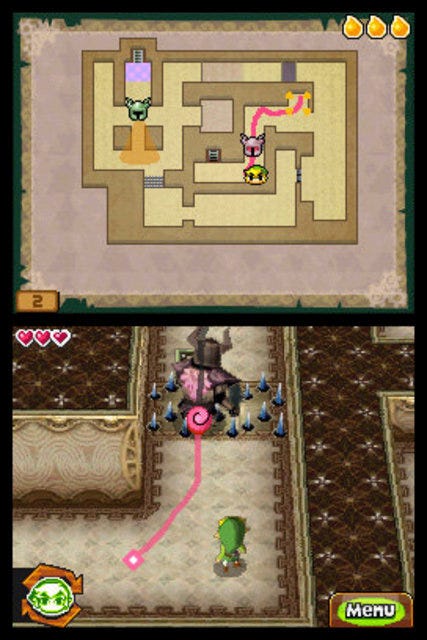
Phantom control in action, its route mapped out by the stylus.
Broader exploration of the world, therefore, is now literally on rails, with new sections of the rail network opened up across the map as the player progresses. The steam-powered vehicle's controls are accessed via a panel on the right of the touch-screen, with forward, fast-forward, reverse and emergency stop. There's also a cute whistle to toot, by drawing the stylus over a rope in the top-right corner. Which can, I'm told, be used to scare off beasties, but also undoubtedly plays to the train driver fantasy. Toot, toot!
Out in the wild, the train operates much like the boat in Phantom Hourglass: a canon is acquired to blast enemies that appear sporadically, and routes across the network are pre-determined by scrawling appropriately on the map (though as junctions approach you are given the option to switch between tracks as you go).
Christian described the setting and opening scenes in detail back in his E3 preview. Frustratingly, during this playtest I don't see a great deal beyond this, with one crucial difference: Zelda.
As revealed earlier this month, the eponymous princess tags along with Link for the first time in the series in spirit form. It's not exactly a massive spoiler if you think through this logically to conclude that something rather unfortunate must have befallen the poor lass, which is explained in the beginning.
A Nintendo rep tells me Zelda's spirit performs a similar function to that of Navi in Ocarina of Time. Moreover, she is able to 'possess' phantom characters, which can then be directed and will likely form a cornerstone of the game's puzzle-solving. The introduction to this mechanic is gentle: in the first dungeon, once Link has collected three Tears of Light to power-up his sword, he can disable a phantom for Zelda. The phantom can then be controlled by drawing its path with the stylus, called upon to follow Link, and stood on from higher ground, essential to navigating certain areas and seeing-off raised enemies.
Link's also been working on his musical repertoire. Once the Spirit Pipes are picked up, specific tunes can be learned and played ocarina-like in front of Spirit Stones to engage certain effects, such as exposing all the hidden chests in area. To play, you hold the stylus over one of the coloured pipes, and blow into the microphone. Expect violent assaults on public transport to soar in the game's wake.
The mic is also used for the Whirlwind power, acquired in the first dungeon, which is necessary to disperse impenetrable black clouds obscuring the screen and attack certain enemies. I also briefly get to try out Link's new Indiana Jones-style whip, used for lashing baddies and doubling-up as an improvised swing to cross pits.
Before grabbing the iconic green garb, Link looks terribly dapper in his train driver's uniform.
Aonuma and his team have addressed one of the main criticisms levelled at Phantom Hourglass with the Spirit Tower. Where, in the previous game, frustrating repeated playthroughs of the hub dungeon were required just to push through a little further each time, new sections are now hidden behind doors along a spiral staircase within the tower. As each boss is vanquished, Link and Zelda enter a side-room where a train is waiting for the princess to enchant the next section of track.
The Zelda timeline is a curious thing, allowing for echoes of previous adventures to emerge in the unlikeliest of places. Spirit Tracks proudly maintains this feature, and veterans of the series will feel that familiar twang of deja vu in encounters with people and places, an element I've always found gives the experience a consoling circularity.
One thing I do see for the first time is multiplayer. In Phantom Hourglass, a one-on-one battle mode was included, but Aonuma has expanded this for the sequel with up to four Links able to compete against each other.
This being a Zelda game, every dungeon ends with a humongous, multi-screen boss encounter.
A range of arenas is available, ranked according to difficulty and offering a variety of conditions, from rising and falling lava pits, to maps with invisibility sections where rivals disappear from the location map. The aim is simply to be the Link with the most gems as time runs out.
I play a couple a games against Aonuma and another guy. The designer shrieks and howls with competitive delight, never letting his broad grin slip, as we all scramble for gems, setting off booby traps, fleeing phantoms and hurling bombs at each other. It's uproarious fun for 10 minutes: whether it sustains interest in the longer term, we'll have to wait and see.
Fans of The Legend of Zelda know what to expect by now: and where Spirit Tracks is ultimately placed in the Nintendo pantheon will depend, as ever, on the levels of invention, charm and engagement Aonuma and the rest of his team at Nintendo EAD are able to conjure.
Just before I leave I ask him if he's doing anything fun before he heads home. With a twinkle in his eye he tells me he's going to spend his final free morning going to King's Cross station to get his photo taken by the Harry Potter platform "for my son". For your son? Yeah, right.
The Legend Of Zelda: Spirit Tracks releases exclusively for DS on 11th December.
