The Great Digital Gold-Rush

And how RuneScape reckons it beat it.

It took me endless hours of picking herbs in World of Warcraft before I decided to use real money to buy gold. I spent about fifty quid for an in-game thousand, and bought a purple epic mount. I went back and bought more as time went on; money that helped push our guild into hardcore raiding and splash out on other members. I was greedy with it as well, covering my second character in the very best.

Therein lies the lure of real-world trading, which extends to buying characters and items as well as gold. It's not a new thing, it goes right back to beginning of massively-multiplayer online role-playing games (let's say Ultima Online for argument's sake). However, these days if you search for "buy gold" you are rewarded with endless results. You may have heard of it through Blizzard or Square Enix banning thousands of accounts.

The problem lies in how the money is gathered, which is where "Chinese Gold Farmers" come from. The idea is that a gamer will spend all day working for a company doing boring tasks in a game to earn gold. This can cause repercussions in the persistent world, with companies monopolising resource-rich areas. It also leads to bots; automated characters that do the hard work for you and appear to be zombies to anyone communicating with them. Are you Sarah Connor? Are you Sarah Connor? Are you... [We get the idea - Ed].

Some have tried to legalise this sort of trading, like Sony with its Station Exchange in EverQuest 2. This lets it act like an official auctioneer. And others ban. But RuneScape, a web-based MMORPG with over six million active accounts, has found a new way. So we cornered content chief Imre Jele to hear more, and find out why it is such a big problem in the first place.
Eurogamer: So, why is real-world trading such a big problem?

runescape

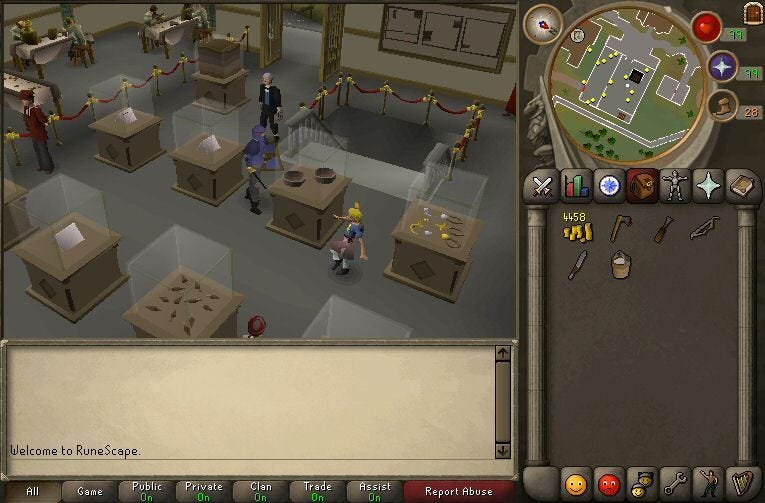
RuneScape: remarkably similar-looking to Ultimate Online.

Imre Jele: Oh, big question. I'm going to approach this from two different perspectives. Illegal real-world trading breaks the game and it breaks the business, to put it simply. As for the game, what happens is there are several types of attack. The first one is that they use automated characters - bots - to play the game and collect the gold. And the presence of those bots in the game is really annoying; characters standing there doing the same thing over and over again.

The second thing is that illegal real world trading is pretty much like cheating. It can be fun to have unlimited health for 10 minutes, but after that the game becomes boring because there is no other challenge. And those people who buy their way through the game are going to experience this. Anyone who is using real-world trading and actually getting money is effectively cheating the game and going to get bored and leave. Anyone not doing that is going to be annoyed by these people because they have an unfair advantage. It breaks the game model pretty effectively.

The other side of this story is the business side. Obviously we can talk about the fact they are effectively stealing money from us because they are using our game environment to make money - that is annoying but not our biggest concern.

The biggest concern about real-world trading is - sorry for this example as I know it is not politically correct - it is a bit like prostitution. It's not necessarily the prostitution which is a problem, although you might have moral problems with [real-world trading]. But the real problem is the organised crime that's built around prostitution; the human trafficking, the drugs, etc. And that's the same with illegal real-world trading. The problem comes in when they start doing other illegal activities. One of the biggest is the use of stolen credit cards. They realise that if they pay GBP 3.20 and become members of RuneScape they can make more gold in-game, therefore make more money in real-world terms. So they realise hey, why would I pay for this if I can use a stolen credit card? It brings a terrible financial burden to us, not to mention the other problems we might have legally or financially around this.

Eurogamer: What's a bigger problem, the bots or the money-buying?

Imre Jele: As a player I am more annoyed by walking around and trying to talk to someone who doesn't answer because it's a bot. Obviously if I take it to a higher level as a game designer then I see how people ruin their own game experience by cheating.
Eurogamer: What if people spent their own time gathering in-game resources to sell in the real world?

mounts

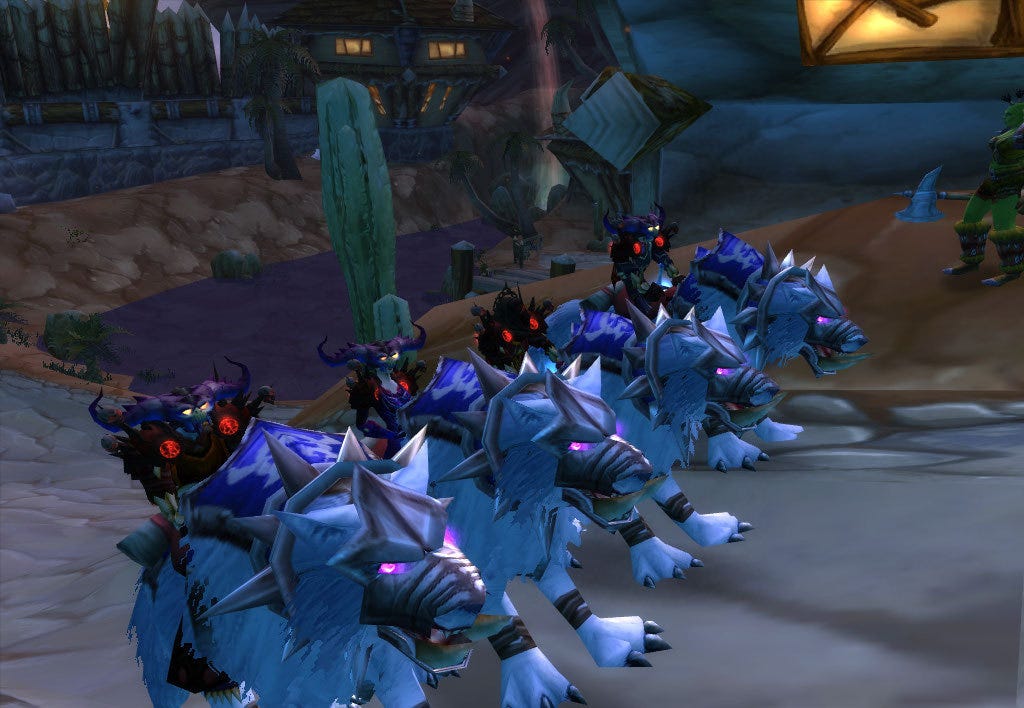
What people buy with their money in World of Warcraft.

Imre Jele: Legal real-world trading is something a lot of companies are playing around with the idea of, and it's not necessarily a bad thing. But you have to design your game with real-world trading in mind from day one, you can't just chuck it on top of the game. In the future we are going to have games, good games, where you're going to have professional players who create an account and sell it for real-world money and manage to make a living by playing. And that's going to be fun. But RuneScape is not designed on that principle. RuneScape is designed so you experience the whole game as an art. For us this illegal real-world trading is breaking the game experience and is not something we want to cater for at the moment.

Eurogamer: Are you saying we will have to wait for the next generation of games before we can hope to control this? What about Sony with its Station Exchange service in EverQuest 2?

Imre Jele: Yes, yes. Let me answer it one by one. I think it's very simple. We have more MMOs now that are more and more successful, and MMOs are the perfect ground for illegal real-world trading, therefore we have hundreds of companies. We are talking about a huge amount of money: millions and millions of dollars and pounds are changing hands here, so it's a great business for those people.

Different companies have different approaches. Some companies like Sony with the Station Exchange have tried to legalise it and tried to make some money out of it. But let's not forget, Sony has been very, very careful about what they said; once you have the real-world trading you can never get out [as your account is stuck on those servers]. So they also realised that it breaks the gameplay, but said it's OK if everyone is doing it. And so those servers are a different EverQuest and you can never get out of them.

Another approach is what we are doing. To be honest, I don't understand why other companies don't react to this. It seems to me that the bigger half of the MMO industry puts their heads under the sand and pretends like it's not happening. Most of the companies try to tackle the issue by putting more and more people on it. We were doing it as well. For years we were releasing software updates to tackle bots and hiring more and more people in player support to hunt them down. But every time we put on an extra person they put on two; every time we created a new engine update they coped immediately.

Our new policy is very useful for many of the major MMOs out there. We said we're not going to play around any more, but we are going to put up a fight. And that's what this whole RuneScape real-world trading change is all about, to grab and address the issue at a core level. We changed the game in a way so that real-world trading doesn't make any sense any more.

Eurogamer: And you've tackled it by stopping unbalanced trades; that is to say one person giving another something like a pile of gold for nothing in return, because they would have presumably bought that outside of the game world?

Imre Jele: We said the core of the problem is unbalanced trade. Say I'm the real-world trader and you are the player. I'm giving you one million gold but you don't give me anything back because in real-life you have given me the five dollars or 10 dollars or whatever. That had to be addressed. It sounds like a very easy solution, but it isn't. That's the key to why we were successful, because we realised it wasn't going to be easy. We looked at what areas of the game were affected by removing unbalanced trade, and every time something was affected we tried to introduce something even better in its place.

Take trade. Now if I give you a million gold you have to give me something of around the same price back. We see this as a limitation, as we are taking something away from the players. So let's give them something in exchange. And we introduced the Grand Exchange, a unique way of trading that none of the other MMOs have. It's not a traditional selling house that you find in other games. We wanted ours to work like a stock market. For example, if everyone tries to sell pens then the price of the pen is going to go down, but if everyone tries to buy a pen then it's going to push the price up. Our prices react dynamically to the needs of our players. Also, in the old system you have to stand in front of the other person if you want to trade. From now on you don't have to, you don't have to be in the same world, you don't even have to be logged in. And that's how our approach works: we look at what we are going to take away from the game and introduce something better.

Eurogamer: What sort of results have you had?

runescape2

Equipment slots. For items that cost money.

Imre Jele: We're really happy to say that people love us. There was a bit of uproar, obviously; players were very upset in the beginning. But we introduced the change in December and by the end of the year fan-sites had articles saying it was a harsh but necessary change. Even some saying it was really taking the game forward; really thinking long-term rather than just short-term. So we were able to win over players pretty fast. We were really afraid we were going to lose our members over this change, because other games had in the past. But we are very, very pleased to say that we have lost practically none of our members.

On the other hand, we pretty much won over real-world trading immediately. Two days after the big release you were practically unable to find any bots in the game, instead of the many hundreds that were there before. The prices of gold on many real-world trading sites was jumping quite high [because little was left], but most simply shut down because they couldn't do business any more. It was a pretty massive success, so I was very pleased about that.

There are still some issues when real-world traders find a loophole or find a bug. But we are no longer running after them. Both from gameplay and business perspective, RuneScape is massively different, with a very limited loss in players. I think that's down to the care we put into the project. Down to the communication. We felt it was very important to inform our players about everything we were doing, and we keep developer diaries on our website.

Last but not least I have to bow to our player community, because I myself was surprised at how adult they were and how well they were able to understand the complexity and depth of these changes and why they were necessary.

There were a few issues that people were still upset about, giving a gift, for example. But we are already working on system where you can lend items, and working on filling in those last gaps.

Eurogamer: What should other MMOs be doing to combat real-world trading? Could they use your system?

Imre Jele: Anyone who is developing a new game should take this into account from day one. Surprisingly, current MMOs...I have friends all over the industry and I know they don't try do anything about this, which to me is shocking. Anyone in the market needs to have a serious look at what they are doing. World of Warcraft, for example - they are doing fantastic business and I know they are hiring more and more people to tackle the issue. But there is going to be a point where you just can't compete with the real-world traders. You have to tackle the issue at a core level, and I'm confident that it is the only way for the whole MMO industry to get out from this. I'm quite sure other companies are going to follow our lead one way or another.

limit

World of Warcraft has a gold limit. This person reached it. It's worth USD 6450 to dirty money-launderers.

Eurogamer: If you want to tackle it at a core level, is there an argument for getting rid of the inherent grind mechanics of the genre that real-world trading has grown up around trying to "cheat"?

Imre Jele: That's a very, very interesting idea, and the only thing I can tell you now is that we have some amazing products going live next year - a new MMO - and we are tackling this issue at a core design level. I think you summed up a very reasonable way to approach this.

Eurogamer: Lord of the Rings Online boss Jeffrey Steefel told us the MMO business model would change over the next five years to incorporate real-world trading. What do you think about that?

Imre Jele: I think there are going to be different models. There are going to be companies that sell things to players for money. There are going to be other companies that go the way of Sony and say I'm not selling anything but players can sell to each other. Then there are going to be other companies who think if you subscribe to the game then you should enjoy it fully without spending extra money. But those games need to have different game design approach. I don't think there is one single solution.

Eurogamer: What would you say to someone who buys gold in World of Warcraft or RuneScape or Lord of The Rings Online, etc.?

Imre Jele: Don't [laughs]. Everyone is an adult and knows what they are doing, but the thing many don't seem to realise is that these games are tailored around the experience of getting through the game, and if they buy their way through then they are going to miss out. They are going to lose out on what the whole game is about.

Eurogamer: ... but how are people missing out on content by short-cutting the need to spend hours picking herbs to make enough potions to fuel a raid or to sell so they can buy a horse, for example? [Innocent whistle - Ed]

Imre Jele: It's not where you get, but how you get there. The gameplay experience is not about being level 60 or level 70, but the experience you have on the way there. To be honest, I think instead of real-world trading, games have to be designed in a way that they provide enough fun while you are getting there. If I am incapable of providing you with enough fun while you collect that 1000 gold for a steed, then the game is not good enough.

Comments (25)

Comments for this article are now closed, but please feel free to continue chatting on the forum!

  • Loading...hold tight!