The Casuals Are Coming!

Leave those kids alone.

When you look ahead to the future of gaming, what do you see? An ever-expanding electronic frontier, where games become more varied and immersive as technological boundaries are broken? An infantile playground for the undiscerning masses, dominated by repetitive tasks involving colourful blocks?

If you took the first option then congratulations - you have yet to fall victim to the creeping menace of casual-phobia, a silly and baseless fear that seems to have taken hold of certain vocal corners of the gaming community ever since the Wii merrily danced its way into the number one console spot with a insouciant waggle of its magic wand. "Casual gamers!" goes the paranoid cry. "They're ruining gaming! Nobody will make proper games for us if they can make millions from mini-game compilations!" Whining babies, the lot of them.

As with any perceived fad, "casual" has somehow become a buzzword wantonly misused by both gamers and executives alike, as if it represents some new, mysterious evolutionary avenue for our beloved hobby. As anyone with a sensible grasp of gaming history can tell you, this is nonsense.

Even the term itself is loaded with semantic confusion. How do you actually define a "casual" gamer? I play the bloody things for a living so, as far as I'm concerned, most of the people reading this will be casual gamers by default. Is it someone who just plays games for fun? And, if so, isn't that what games are supposed to be for? Maybe it's the gamer that plays games for a certain kind of fun - just a commitment-free quick-fix of electronic amusement, something to be fitted in between other real life pursuits? When you look at it like that, isn't it what we've all done at some time or another?
1

Is this cool?

And where then does that leave the "hardcore" gamer, the self-identified and adolescently-titled polar opposite of the dreaded casual? Are they expected to spend hour upon hour doggedly dedicating themselves to games as if there's some prize for taking playtime too seriously? However you try to define it, casual gaming becomes that most ephemeral of things - a phenomena that nobody can exactly agree on, but everyone is sure they know it when they see it. Whatever its nature, it's here, it's growing and it's spoiling our industry. Right?

Wrong, and it's here that the real problem with the whole casual/hardcore dichotomy really lies. Casual gamers are not invaders or interlopers, encroaching on hallowed gaming soil with their shallow interests and gimmicky controllers and silly party games. Casual gamers - and you may want to sit down for this bit - were here first. Take, for example, an infamous mini-game compilation based on a top-rated soap opera. Typical casual gaming shovelware, right? Don't go looking for it in the upcoming Wii releases section though. It's Eastenders: The Computer Game. And it came out twenty years ago on the ZX Spectrum.

When you look at the broad span of gaming history it's the self-proclaimed hardcore that stand out as a cultural anomaly, a mutation in the gaming DNA that really only began in the last decade or so as games were able to become more complex in both structure and narrative. Yet so vocal and so lucrative has this demographic become in recent years that the common perception is that the gaming landscape was designed with these hardcore players in mind. Developers, publishers and console manufacturers are all forced to make reassuring noises, promising that their latest products won't alienate or abandon the poor faithful hardcore gamer, while they all secretly hope that they've made something appealing enough to attract big bulging sacks of lovely, casual money.
2

Is this cool?

This vision of twin industries in constant opposition is an illusion, however; a faulty perception created by internet chatter, PR spin and the willingness of the media to label a bandwagon and ride it into the ground with no remorse. I've reluctantly been guilty of it myself, using the phrases "casual" and "hardcore" in reviews despite my fundamental dislike of them, because for better or worse they've become an effective form of shorthand for games discussion.

Yet journey back in time to the dawn of gaming, when the first Space Invaders descended relentlessly into the public consciousness and, outside of a small cabal of high-score junkies, there was no such thing as "hardcore" gaming. Even as the Atari 2600 began the process of moving gaming from the arcade to the living room, it was still something people did for fun, even though the games in question were far tougher than the hardest of today's hardcore titles.

And everyone did it. The first games consoles found their way under the bulky TVs of ordinary families everywhere, and bleeped and burped the soundtrack to millions of Christmas mornings. It was a fad, claimed the Luddite naysayers. A gimmick. A little toy that people would soon tire of. Hey, that argument sounds familiar! Yet here we are, a quarter century later, only now gamers themselves are using the exact same baseless argument, trying to hold back the ebb and flow of the casual tide like King Canute clutching a joypad.

Throughout the 80s and into the 90s, gaming remained a fun hobby, largely free of joyless demands to be "hardcore". Spectrums, Commodores, Master Systems, Megadrives, Super Nintendos and GameBoys. All found a place to snuggle in the mainstream bosom, and nobody batted an eyelid. While the limits of technology certainly played a part, games were accessible - not simplistic - with developers able to focus their attention on well-defined gameplay goals rather than trying to be all things to all people. The result was games that kickstarted entire genres, captured the popular imagination and achieved levels of recognition that still endure to this day. Indeed, there was a time when gamers would rejoice at these moments of ubiquity for their hobby, bringing as it did some much-needed validation against those who had declared gaming a passing fancy, a folly of the early electronic age. It's hard to sniff snootily at gaming when you're addicted to Tetris, after all.

3

Are they cool?

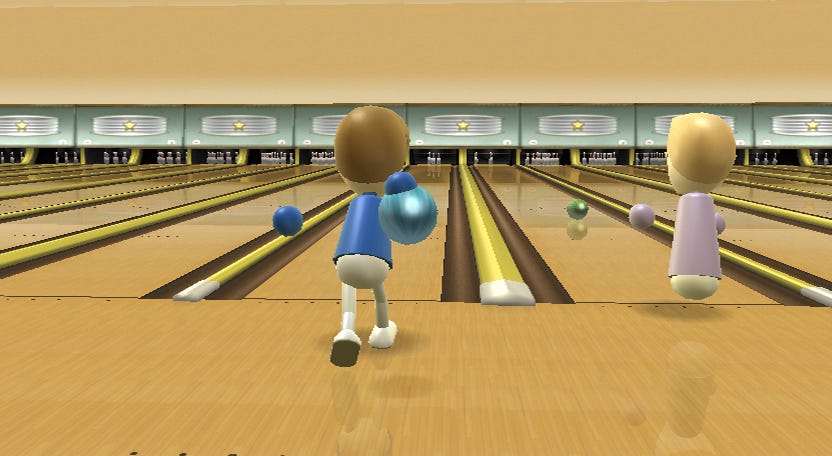
Viewed in this perspective, it's hard to be surprised at the success of the Wii, since it falls squarely into a pattern of gaming that has been with us since the beginning. It's notable that Nintendo's two biggest stumbles came with the N64 and GameCube, as it tried and failed to adapt its business model to compete with the hipper-than-thou PlayStation brand. With the Wii, Nintendo shrewdly ducked out of the escalating hardware war and went back to the basics of gaming that served it so well in the past - a family-friendly box of fun that even your mum can have a go on when she's had too much red wine. Criticising this egalitarian approach as being bad for gaming seems misguided at best, bitter paranoia at worst; more an act of tiresome snobbery than self-defence. It's really just another variation on the old "I liked this band before they were famous" line, except the band is now videogames and the lead singer is your dad playing Wii Sports.

Personally, I'm thrilled to see that the core values of immediacy, playability and accessibility are all making a comeback alongside the development of more ambitious games. If history teaches us anything, it's that casual gaming is good for gaming in general. Where would gaming be without Pac-Man? Or Tetris? Without The Sims there would be no Spore. There'd be no Guitar Hero. Casual games can also be smaller in scope and therefore easier to produce and sell. People are more likely to impulse-buy a cheap game that looks fun than splash out forty quid on some unknown quantity, which means small developers - or even lone coders such as Audiosurf's Dylan Fitterer - can once again reach customers and even make a profit, just like the good old days. There will always be shovelware and cheap crap, but it's in this sort of lower-risk environment that the solitary geniuses of gaming's past were able to make their mark, and it's here that I'm certain we'll see the next generation of visionaries emerge.

4

Am I cool?

Casual gaming is just gaming. It's that simple. It was here at the beginning, and it will be a vital element of gaming in the future. There's no big conspiracy. No invasion. No impending apocalypse that will change our hobby forever. Publishers are not going to stop producing first-person shooters and epic RPGs to fund development of nothing but colourful shape-matching puzzle games. All that's happened is that those terribly scary hordes of normal people out there on the high street have been reminded that games can be accessible and sociable and fun. They'll maybe go on to buy more consoles, and they'll buy more games. A lot of the time, they won't buy the best games, but it's important to remember that the dross - those 3/10 games that Ellie loves to review - fail because they're bad games, not because they're casual games.

So how about we celebrate the diversity of gaming, rather than grumbling about dirty outsiders gate-crashing "our" party, eh? Maybe stop using "casual" as an insult, and appreciate that playing games for enjoyment is hardly the greatest sin in the world. After all, you were casual once as well.

Comments (136)

Comments for this article are now closed, but please feel free to continue chatting on the forum!

  • Loading...hold tight!