Tales of Monkey Island: Launch of the Screaming Narwhal Review

Tales of the expected.

Version tested: PC

The return of the Monkey Island series after a nine-year absence has provoked almost as much hand-wringing worry as it has celebration. With so much love for LucasArts' long-dormant series among adventure enthusiasts, the pressure for Telltale Games to get it right is, to say the least, intense.

Announced just one month ago, Launch of the Screaming Narwhal is the first of five episodes scheduled for the season, and launches this week, just ahead of next week's Xbox Live Arcade remake of the seminal 1990 classic, The Secret of Monkey Island. Four further episodes are scheduled to follow at monthly intervals.

Chapter 1 finds the 'mighty pirate' Guybrush Threepwood in familiar territory - onboard a pirate ship, trying to save his wife Elaine from the clutches of nefarious zombie pirate LeChuck. After a simple rescue attempt goes awry, Guybrush finds himself in an even bigger jam. Trapped on the interminably windy Flotsam Island, he and therefore you are tasked with not only finding a ship to make your escape, but with putting a stop to the powerful gusts buffeting the place.

Designed by LucasArts veteran Dave Grossman, it's no surprise at all to find that Tales of Monkey Island slips straight back into the old routine. With Michael Land's nostalgic score setting the tone majestically, and Dominic Armato returning as Guybrush, it doesn't take long for that old Monkey Island magic to flood back. With a familiar array of snappy one-liners, throwaway puns, ludicrous characters and daft puzzles that stay true to the formula, all the ingredients are there for another feel-good adventure.

But things don't quite get off to the flying start that you might wish for. The first element to get to grips with is a control system best described as "interesting". Rather than adopt the simple, traditional point-and-click interface of old, Tales of Monkey Island insists that you move Guybrush around by holding down the mouse button and dragging in the desired direction. It takes some getting used to, but fortunately Telltale also allows for direct movement control via the cursor keys or WASD if you prefer. I did.
1

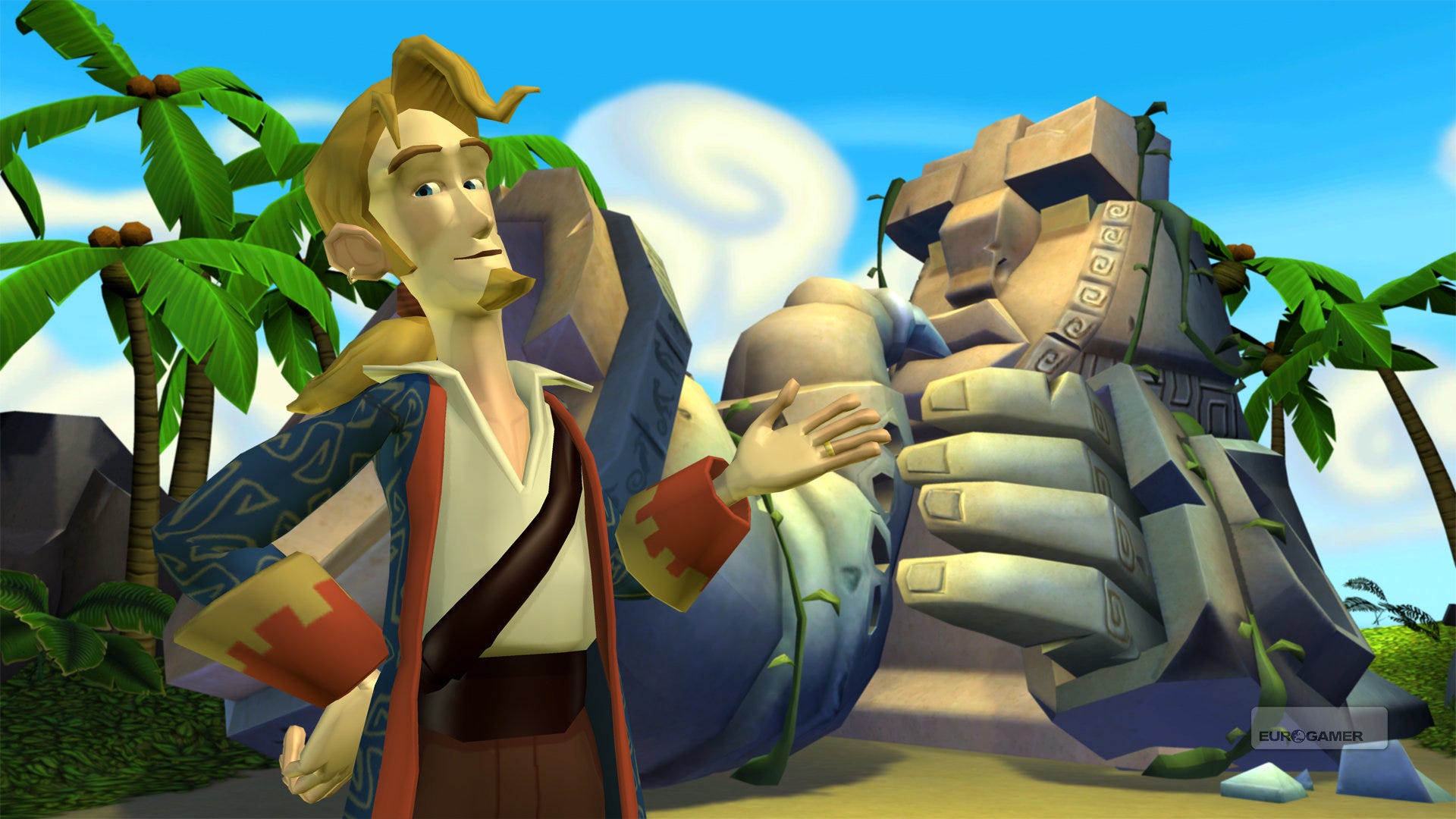
How do you like my Jimmy Hill beard?

In addition, the introductory section also suffers a little because of a lurching camera, caused by the swell of the ocean waves. With the entire playing area bobbing around rhythmically, it makes the routine process of finding hotspots rather more troubling than it ought to be, and in tandem with the quirky new control system it feels like Telltale almost set out to make you feel seasick. Fortunately once you reach dry land, normal service resumes, but it's nevertheless not the most seamless way to resume the series.

As you might hope, the gameplay hasn't really changed one bit, and Telltale has clearly focused on nailing the fundamentals. It's still a straightforward mixture of dialogue-tree japery and bizarre inventory-manipulation, and follows the adventure game lineage faithfully. With the inventory tucked away on the right-hand side, the screen is free of icons and clutter, so whenever you want to dive into your infinite pockets, you have three basic options. Firstly, the magnifying glass lets you examine objects more closely, while two separate inventory slots allow you to slot in each object and perform the good old adventure game ritual of attempting to combine them. In addition, you're also able to take items out of the inventory and, say, give them to another character, or try and use them on something in the game world.

One of the most important elements in any adventure game is the quality of the puzzle design, and this is one area Tales of Monkey Island gets bang-on time after time. In true Monkey Island fashion, the solutions are mostly absurd, but also bizarrely logical in their own sweet way. On at least a handful of occasions, there is as much comedy to be found in finding a crackpot solution to the problem at hand as the story and dialogue itself.

Most of the game's many puzzles present themselves as good old-fashioned object-manipulation, either finding an unexpected use for an otherwise innocuous item, or fashioning an entirely new one out of two unrelated ones. You know the drill (or rather monkey wrench). Happily, Telltale has also gone beyond the adventure game template on a number of occasions, notably on the map-based puzzles where the solutions are especially gratifying once the penny drops, and on a set-piece where Guybrush finds himself strapped to a doctor's chair. Sometimes, of course, you'll hit a brick wall, but the game's subtle built-in hint system (which you can turn off altogether if you prefer) does a decent job of guiding the way without ruining it for you.

Another area that Telltale succeeds in is the writing department. The story is, as you'd hope, classic Monkey Island nonsense, and it's impossible to overstate how instrumental Dominic Armato's performance as Guybrush is in getting the 'feel' just right. At its best, the script is generally sharp and witty, with some fantastic one-liners and moments of cackling silliness complemented by knowing nods to the past. For the most part, the fan service is excellent.

On the downside, Tales of Monkey Island suffers from the same syndrome which afflicted Telltale's Sam & Max games, where the lead characters were excellent, and had uniformly top-notch lines, while the supporting cast were a little forgettable, and sometimes just not that funny. For whatever reason, some if not most of the supporting cast of Tales of Monkey Island are hackneyed regional stereotypes: the eccentric Frenchman, the gruff Irishman, and so on. Next to the wry delivery of Guybrush, many of these characters feel somewhat two-dimensional, and it detracts somewhat from the overall quality.

Worse still, the visual representation of some of these characters feels like it was rushed, with at least three of the supporting cast based on the same basic character model. The graphical style, too, is an uneven mixture of excellent and extremely average. Sometimes, the environments feel elaborate and intricate, and other times comparatively bland - a factor not helped in the least, you feel, by an ageing 3D engine and an occasional lack of artistic inspiration.

2

All these years on, I've still never tried Root Beer.

On the one hand, characters like Guybrush are superbly rendered, and wonderfully animated, and on the other, there are a host of completely anonymous supporting characters. It really does feel like a game that could have benefited from a few extra months of polish, and would have been improved no end if more love had been lavished on the supporting cast. Sad to say, but it feels like Telltale simply ran out of time and money and had to make do.

Not wishing to end the review on a downer, Telltale has at least learned one major lesson from its previous attempts at reinventing a LucasArts franchise: increasing the number of locations, and, in turn, making it feel much like the first part of a four-to-five-hour mini-adventure, rather than merely a standalone episode. Word is that future episodes of Tales of Monkey Island will avoid the rampant recycling that was present in previous Telltale adventures, so there's every reason to be excited by what's to come over the next four months.

Although it's not quite everything it could have been, Tales of Monkey Island marks a highly entertaining return to a much-loved series. Despite a rather forgettable supporting cast, Telltale makes up for it with consistently excellent puzzle design, and occasional flourishes of comedy genius. Adventure game fans might pull a face about one or two things that Telltale dropped the ball on, but overall no one can deny that it's great to have the series back.

7 / 10

Read the Eurogamer.net scoring policy

Comments (87)

Comments for this article are now closed, but please feel free to continue chatting on the forum!

  • Loading...hold tight!