Taito Legends Power-Up
Sadly missing most of Taito's best efforts.

The two Taito Legends compilations released over the past 18 months offer an almost exhaustive peek into the archives of one of Japan's most important publishers of all-time. For less than the price of a full-priced title, you can now easily pick up both and trawl through about 68 games spanning arcade glory years from 1978 to the less celebrated '90s.
The fact that only about a dozen of those titles have stood the test of time isn't really the point - after all, how could such technically impoverished relics designed to gobble up loose change really cut it today? But for those interested in glimpsing how arcade gaming evolved from its humble early days, it offers a fascinating insight into some creative hits and misses that makes you truly appreciate how far gaming has come in such a relatively short space of time.
Having pretty much scraped the barrel with volume two (with a few notable omissions such as the licensing-affected Chase HQ), Taito has now turned its attention to the PSP, where the instant short-burst thrills of retro gaming on the move perhaps make more sense than on the big screen in block-o-vision. But rather than simply re-issue volumes one and two all over again, this 'Power-Up' edition selects 21 titles from both editions, presumably with the intention of bringing together something of a definitive 'best-of' edition.
Woolies here we come
Sadly, the end result is more of a random pick and mix, with the majority of the 21 titles comprised of the sort of also-ran chaff that even hardened retro nuts would give short shrift to. Bah, and double pah. Six titles from volume one make it into Power-Up, 13 from volume two, while two titles that escaped inclusion on either volume make it onto a retro compilation for the first time.
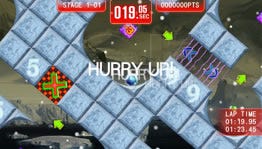
In terms of the 'good stuff', we get acknowledged all-time classics like cutesy platformer The New Zealand Story (1988), Elevator Action (1983), two functionally identical Space Invaders titles (except one has colour overlays) from 1978/9, not to mention some overlooked platform gems from the Bubble Bobble lineage like Chack 'N Pop (1983) and The Fairyland Story (1985), while addictive maze dot gobbler Raismais (1988) is absolutely perfect pick-up-and-play commuting fodder. The ball-rolling, maze-tilting genius that is CamelTry (1989), meanwhile, may well be the most supremely addictive lost gem of the '80s. There's definitely a more than solid case to recommend Power-Up on the basis of these inclusions alone, especially if you can track this collection down for under £20.
Other honourable mentions go to the historically important titles like the Galaga rival Phoenix (1981), while some might have a special place in their hearts for platform hack and slash Rastan Saga (1987), or rescue-shooter Lunar Rescue (1979), and jumpy ninja slasher Legend of Kage (1985). None of them date at all well, though, and any sense of genuine enjoyment will be based on rose tinted nostalgia, unfortunately.
Give me space, man
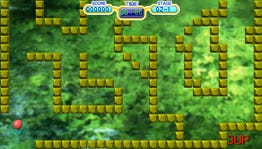
Neither of the two 'new' additions, Space Chaser (1979) and Space Dungeon (1981) are worth more than a fleeting glance unless you're a Taito completest and have the urge to experience games that were bad even then. Space Chaser might pre-date Pac-Man by a full year in the dot gobbling stakes, but is unforgiving and lacking any charm whatsoever. Space Dungeon, meanwhile, offers up room-to-room treasure hunting while fighting off waves of enemies in a Robotron fashion, but, again, is just way too fixated on killing the player off to be even remotely enjoyable.
As for the more familiar flops, the dreadful Alpine Ski makes a pointless appearance, as does proto-Kuru Kururin title Crazy Balloon. Meanwhile, Qix (1981) was a brilliant idea badly implemented the first time around (and revived by Activision superbly under the name of Zolyx a few years later), while cutesy Commando rip-off KiKi KaiKai and Kung-Fu Master rip-off Kuri Kinton are solid but instantly forgettable filler fodder. Try saying that with a mouthful of pie.
The standard of the emulation, though, is absolutely flawless, with the option to switch many of the vertically aligned games to fit the wide-screen dimensions of the PSP. By rotating the PSP, you can enjoy full-screen (or even stretched screen if you want to fill the entire play area) retro gaming with a mere stab of the triangle button. The controls, cunningly, even dynamically switch so that you can use the d-pad or analog nub in the new orientation. Fire buttons, meanwhile, are mapped to the face buttons, but it's something you get used to very quickly. There's even a game-sharing facility if you've got a retro buddy to hand, and a slick menu system that does all sorts of nice things like auto-save if you're into high score preservation.
Crispy redux

As a special bonus, Taito has even gone to the effort of chucking in four 'deluxe' versions of certain games in the set. In particular, Crazy Balloon benefits enormously from a re-make, seeing as the actual concept of guiding a wobbly balloon through a hazardous environment was a superb one. Here, in its 2005 form, it's actually playable, and rather addictive. Even more addictive is the remake of the bafflingly titled CamelTry, though it doesn't actually improve on what was already a flawlessly executed idea. Rather pointless, though, is the inclusion of a shiny version of Balloon Bomber, while Legend of Kage is still a button-mashing, hop-skipping waste of time, better graphics or not. All round, it's a package that's been given a reasonable amount of love, and has enough gaming treasures to justify shelling out for.
But any Taito aficionado will be spitting chips over the hugely cynical decision to leave some of the very best games off - presumably for the inevitable volume two. Bubble Bobble, Rainbow Islands and Puzzle Bobble 2 are the most notable absentees, while popular titles like Operation Wolf/ Thunderbolt, Space Gun, Darius Gaiden/G-Darius, and gems like Super Qix, Liquid Kids, Don Doko Don and perhaps Ray Storm would have been much more welcome additions than some of the absolute dirge padding out the majority of this set. If you're really that bothered, you could always just buy both Taito volumes on PC, PS2 or Xbox - and Play are offering them at ridiculously cheap prices to sweeten the pill.
If you can overlook Taito's rather calculated and wholly predictable decision to pack out this collection with filler material, then there's a decent amount of quality retro gems to get your teeth into when you've got a few minutes to fill. Sadly though, most of Taito's real big hitters that would have made this an instant must-have aren't here. As much as we love The New Zealand Story, to have it alongside Bubble Bobble and Rainbow Islands would have made a whole lot more sense than surrounding it with obscurities. Even so, for the right price, this is a solid, worthy selection of relics that works superbly on the PSP.