Retrospective: Street Fighter • Page 4

20 years of beat-'em-ups picked thoroughly apart.

Holy #*%$! I've just seen the Japanese intro for Street Fighter IV and it looks absolutely killer. Screw objectivity, I'm going to say right now that from my impressions of the Street Fighter IV arcade game and from what I've played so far of the console release, Street IV could very well be the greatest fighting game ever made. With Eurogamer's review going live tomorrow (Monday 16th February), I'm taking a look back at the different Street Fighter games in their many different arcade transitions. Hold onto your sticks people.

Series by series

Street Fighter

Series:
(1987) Street Fighter

SFI Mechanics:

  • Shotokan - the classic Hadoken, Shoryuken and Tatsumaki Senpukyaku moveset
  • Specials - the three examples listed above

The first ever Street Fighter appeared in arcades in 1987 and was directed and produced by Takashi Nishiyama and Hiroshi Matsumoto, who would later leave Capcom to work for SNK and produce some of Street Fighter's biggest rivals - including Fatal Fury and The King of Fighters. The original Street Fighter offered arcade patrons a fighter experience that was visually far more impressive than Yie Ar Kung Fu or Karate Champ, although the 2D animation, even compared to the first Street Fighter II, is choppy to say the least.

Players didn't have any choice in character selection; Player 1 was Ryu and Player 2 was Ken (if you've briefly played Super Street Fighter II Turbo HD Remix online you'd be forgiven for assuming this is a tradition Capcom never dropped). If Player 2 won against Player 1 it was possible for them to complete the rest of the game as Ken. Although considerably more fleshed out in later iterations, Ryu's initial story didn't go much further than entering a mixed martial arts tournament to prove his strength (and no doubt honour).

1

Humble beginnings. No one would have ever expected Street Fighter to evolve into the Street Fighter IV we have today.

Before the first fight the player had the option of whether they wanted to start their world tour in Japan, the United States, China or England. Each country housed two Street Fighting champions who had to be toppled in the classic best-of-three-rounds format before moving onto the next pair. Seems us Brits have the poorest street-fighting output, with crude bouncer Birdie and the camp, club-wielding Eagle, each named after golf terms. Thailand, however, the final fifth country after the other four have fallen, is home to the superlative Muay Thai Emperor Sagat and his protégé Adon.

Out of the twelve original Street Fighter cast, over half were brought back in later games. Ryu, Ken and Sagat made obvious returns, and Birdie, Adon and Gen all resurfaced in the Street Fighter Alpha series. Eagle, meanwhile, got a lucky break when he was exhumed for Capcom vs. SNK 2. However, generic ninja Genki and underground martial arts champion Joe will likely never be heading the bill for a comeback fight. Character design has moved on considerably.

Similar to the barrel-breaking and car-crushing bonus games of Street Fighter II, Street Fighter preceded its older brother with board- and block-breaking bonus games spliced in-between the bouts. Hearing the crowd boo Ryu after he fails to break a few flimsy boards raises a smile when you consider that some of his Marvel vs. Capcom Supers could probably level a house. Seems his years of training really paid off.

Last year one of our number had a heated discussion with a fellow Street Fighter fan about the first Street Fighter's control system. He was convinced that the cabinet had a joystick and a pressure-sensitive punch and kick button, which, depending on how hard it was pressed, would result in either a light, medium or heavy attack. Conversely his friend was adamant that the original Street Fighter had the same six-button interface as the subsequent Street Fighter II games.

2

Wait a minute, wasn't Birdie black in Street Fighter Alpha?

It turns out they were both right. Street Fighter was sold in a regular six-button cabinet and a deluxe cabinet that utilised pressure-recognition technology. Reports suggest that the pressure buttons were gimmicky at best, susceptible to breaking and made the game harder to play. But we'd wager that a pristine Street Fighter Deluxe cabinet will be a desirable piece for any Street Fighter memorabilia collector.

In gameplay terms, time hasn't been kind to Street Fighter in the same way it has to Street Fighter II. Everything feels imprecise with erratic animation and timing; some bouts can be over in seconds. The classic shotokan moveset of Fireball, Dragon Punch and Hurricane Kick are available to Ryu, even though Capcom left it for players to discover them by themselves rather than including the movelist on the cabinets. The timing for these specials was less forgiving than Street Fighter II, but if you could pull them off most opponents could be downed in two or three hits. Not even Super fireballs can do that these days.

It's common knowledge among fighter fans that Ryu gave Sagat the scar on his chest with a fierce Dragon Punch at the end of the first Street Fighter tournament. We don't know how he lost the eye though - maybe there's a Black Mamba fighter Capcom still hasn't unveiled yet. Those who managed to finish Sagat were rewarded with a message. "There is always someone waiting in line to knock you off the top, be prepared to be challenged." Capcom's future interpretation of this would change the fighter scene forever.

Street Fighter II

Series:
(1991) Street Fighter II - The World Warrior, (1992) Street Fighter II' - Champion Edition, (1992) Street Fighter II' Turbo - Hyper Fighting, (1993) Super Street Fighter II - The New Challengers, (1994) Super Street Fighter II Turbo, (2003) Hyper Street Fighter II - The Anniversary Edition, (2008) Super Street Fighter II Turbo HD Remix

SFII Mechanics:

  • Combo - consecutive hits
  • Throw - don't just stand there blocking
  • Charge Character - Sonic Boom!
  • Dizzy - should you forget to block properly
  • Super (Super Turbo) - suped-up specials
  • Super Gauge - fill her up
  • Air Combo (Super Turbo) - the skies haven't been safe since

A game that surely needs no introduction. Street Fighter II - The World Warrior exploded into arcades in 1991 with the most iconic fighting cast the world has ever seen. Director Yoshiki Okamoto, along with designers Akira Nishitani and Akira Yasuda, took what had been good about the original Street Fighter and improved upon it exponentially. Players were no longer limited to just Ryu and Ken but had access to six other fighting styles from all over the world - including jungle man Blanka and Miss Kickass herself, Chun-Li.

Released at a time when arcade cabinets housed technology significantly more sophisticated than home consoles, Street Fighter II looked stunning and was animated with a degree of fluidity that put every fighter that had come before it to shame - not least the original Street Fighter. Hardly surprising then that Street Fighter II globally made more money than Jurassic Park at the box office.

Combos were a design accident. Noritaka Funamizu, lead producer of Super Street Fighter II and also credited in the original Street Fighter II, discovered certain special moves would cancel the animation of the standard punches and kicks. It was assumed that the timing required was too precise for it to constitute a useable game feature, so it was left in. However, by the time Super Street Fighter II surfaced, Capcom had changed tactic by offering players bonus points for executing longer and more effective combo sequences.

3

Cue the most memorable intro music ever for an arcade game.

Street Fighter II also introduced the concept of charge characters, including Guile with his Sonic Boom and Flash Kick combo. Other firsts included the ability to dizzy your opponent through relentless attacks, and throws were now possible when close to your opponent. Command Throws, like Zangief's Spinning Pile Driver, were also first introduced here.

The original Street Fighter II was notorious for many glitches - likely only discovered due to the immense popularity of the game. Guile was probably the most abuse-able with his Invisible Throw, Handcuffs and Reset techniques - the latter of which would actually freeze and reset the game.

Starting a company trend, Capcom chose to upgrade its existing game rather than releasing a sequel. What excited most fans about Champion Edition were the previously unplayable bosses - Balrog, Vega, Sagat and M. Bison - now being selectable. Other tweaks included redrawn backgrounds, character balancing, the removal of various glitches and, for the first time, the ability for two players to pick the same character at once - complete with groovy new colour schemes.

After Champion Edition came Street Fighter II' Turbo, and with it, new moves including Dhalsim's evasive Yoga Teleport. Turbo also upped the speed considerably - players had to react quicker to punish a jumping opponent. The fourth revision of Street Fighter II, Super Street Fighter II, was the first game to be released on Capcom's highly successful CPS-2 board. The extra power allowed Capcom to graphically revamp Street Fighter to a whole new level. Ken would now catch fire with his fierce Shoryuken, and so he didn't feel left out, Ryu got the Shakunetsu Hadoken.

4

If you got dizzied in Street Fighter II you were probably about to lose the round, unless you were playing against Eurogamer's illustrious editor.

Super Street Fighter II also introduced four new characters in Cammy, Fei Long, Dee Jay and T. Hawk - bringing the grand total to 16. Cammy and Fei Long proved the most popular and are returning once again in Street Fighter IV, whereas Dee Jay and T. Hawk where more tricky to play effectively and generally saw less playtime. Super Street Fighter II also finally treated Sagat and Vega to the air punches they'd previously been denied.

However, many people criticised Super Street Fighter II because the faster gameplay they'd adapted to in Street Fighter II' Turbo had reverted back to the pace of Champion Edition. So when Capcom released Super Street Fighter II Turbo, it made it so that players could choose between three different speed settings. As well as the now classic Super moves, Super Turbo also implemented the ability to combo opponents in the air.

Super Turbo also marked the first appearance of Akuma, who would kill M. Bison before the final fight, replacing him as the boss, if certain conditions were met. Akuma could also be selected by inputting a special code during character selection. Other input codes could be used to play versions of the characters from the previous game - referred to as Super characters.

Due to the hysteria surrounding Street Fighter II during the early-to-mid-nineties, the game and its upgrades received many different ports and conversions. These vary in quality considerably with the SNES conversion of The World Warrior having sold over six million copies. The C64 conversion comparatively was an unsightly mess.

The Street Fighter II scene is still being kept very much alive with the likes of Super Street Fighter II Turbo HD Remix on the 360 and PS3, and has even been confirmed for this year's Evo Championship Series. Even today I still get knowing looks when my Street Fighter II ringtone sounds off in the pub. You probably have to be a certain age to appreciate the impact Street Fighter II had, but for a game that's going to be celebrating its fifteenth anniversary this year, Super Turbo has aged better than virtually anything else out there.

Street Fighter Alpha

Series:
(1995) Street Fighter Alpha - Warriors' Dreams, (1996) Street Fighter Alpha 2, (1996) Street Fighter Zero 2 Alpha, (1998) Street Fighter Alpha 3

Alpha Mechanics:

  • Air Blocking - it's like blocking, but in the air!
  • Taunts - the proverbial middle finger
  • Chain Combo - chaining standard attacks together
  • Alpha Counter - break block stun to counter, requires one Super level
  • Multiple Super - which is it?!?
  • Level 1-3 Supers - supers now come in different flavours
  • Break Fall - recover mid-air
  • Tech Hit - throw back to negate damage
  • Defensive Roll - after being floored, don't just stand up, roll away
  • Custom Combo (Alpha 2) - DIY Super
  • Guard Crush (Alpha 3) - you can't block forever
  • Style Selection (Alpha 3) - which Ism will it be?

Having received positive feedback on the first Darkstalkers game, Capcom crafted the first Alpha in a similar anime style. As a prequel to Street Fighter II, Alpha brought back a lot of characters from Street Fighter I and II, including Chun-Li and Adon. Alpha also included Guy and Sodom from Final Fight, as well as new fighters Rose, Charlie (Nash in Japan) and Dan Hibiki. Dan is a secret joke character who resembles Robert Garcia from Art of Fighting - a retaliatory stab at SNK for Ryo Sazazaki's resemblance to Ryu and Ken, etc.

5

Rolento has to be one of Alpha's best additions. Baton-twirling never looked so dangerous.

Considering Charlie played almost identically to Guile, some fans complained that, although Alpha was a complete overhaul to Street Fighter II, there was a lack of new blood. Alpha 2 helped to sweeten the deal with the return of Zangief, Dhalsim and Gen, Rolento from Final Fight and the first appearance of everybody's favourite school-girl Sakura. Evil Ryu and Shin Akuma also had their suped-up debus in Alpha 2. By the time Alpha 3 showed up the roster was starting to look cramped with many returning characters, plus Cody from Final Fight and Karin and R. Mika.

The first Alpha brought many new gameplay features to Street Fighter, including multiple Super moves per character, different levels of Super move power, the ability to taunt your opponent, air blocking, Chain Combos and Alpha Counters. Chain Combos allowed the player to cancel the animation of a standard attack with another standard attack effectively chaining moves together.

Alpha Counters were a guard-reversal system that allowed the player to interrupt their enemies' attack whilst blocking, at the expense of one level of the Super gauge. The change of dynamic between Super Turbo and Alpha was quite drastic. The use of Supers was much more important, as the gauge would fill to level one very quickly and the revamped combo system allowed for more impressive attack sequences. The ability to block in the air also lessened the risk of jumping in.

Mechanically, Alpha 2 wasn't a massive departure from the first Alpha, with minor tweaks being made to balance the old characters. The most significant change was the Custom Combo system, which replaced the old Chain Combos. With the Super gauge at level one or higher the player could initiate a Custom Combo by pressing two punches and a kick (or two kicks and a punch). The character would then move forwards with a blue shadow - similar to the Super animation. Depending on how high the Super gauge was stocked, this state would last for a few seconds with all the player's attacks being performed substantially quicker and with higher priority. The better Alpha players would often ditch the Supers in favour of their own crazy Custom Combos.

6

By the time of Alpha 3, fireball damage had been significantly toned down from nightmarish projectiles in The World Warrior.

One of Alpha 3's greatest innovations was its three different Ism playstyles. After selecting a character each player had to choose between X-ism, A-ism or V-ism. X-ism (Simple) was reminiscent of Super Turbo - removing the ability to air block but slightly increasing standard damage output and giving the player access to a single powerful Super. Some characters in X-ism would also play differently - M. Bison, for example, would have his Alpha Psycho Shot replaced with his classic Psycho Crusher.

A-ism (Standard) was the most faithful mode to the previous Alpha games and allowed for air blocking, Alpha Counters and gave characters three different levels of Super - but crucially no Custom Combos. However, V-ism (Variable) was aimed at players who had mastered the Custom Combo in Alpha 2. Removing Supers completely, it came with its own V-ism gauge which could be activated by pressing a punch and kick of the same strength once half full. The blue shadow this time would double any attack made - so a Hadoken could result in two fireballs and be much harder to avoid.

In terms of the Alpha series' place in the Street Fighter legacy, it was really an everyman's fighter with accessible depth and recognisable characters. It was a very attractive fighter for the time and, certainly in the case for the first two games, was very much within the tail end of the fabled golden era of UK arcade gaming. Alpha 2 and 3 in particular still play very competently by today's 2D fighter standards. Street Fighter Alpha 3 Max for the PSP even has bonus characters including Yun from Street Fighter III and Ingrid from Capcom Fighting Jam - it's just a shame about the handheld's analogue stick.

Marvel vs. Capcom

Series:
(1996) X-Men vs. Street Fighter, (1997) Marvel Super Heroes vs. Street Fighter, (1998) Marvel vs. Capcom - Clash of Super Heroes, (2000) Marvel vs. Street Fighter 2 - New Age of Heroes

MvC Mechanics:

  • Tag Team - never feel lonely again
  • Super Jump - jump ridiculously high
  • Aerial Rave - epic Air Combos
  • Advancing Counter - pushes your opponent away whilst blocking
  • Variable Attack - tag partner in and out
  • Variable Combo - both characters Super simultaneously, takes two Super levels
  • Variable Counter - similar to Alpha Counters, but tags partner in
  • Variable Assist (MSHvSF) - your partner takes a cheap shot
  • Variable Cross (MvC) - control both characters with unlimited Super
  • Delayed Hyper Combo (MvC2) - characters take it in turns to use their Super
  • Snapback (MvC2) - don't like who you're fighting? Force your opponent to tag out

In 1992 Konami released a scrolling beat-'em-up arcade game using Marvel's X-Men licence. The game was pretty decent for the time and is best remembered from its six-player deluxe cabinet. Marvel then allowed Capcom to produce another X-Men arcade game, which in 1994 became X-Men: Children of the Atom. Akuma was included as a secret boss. This was a competitive fighter that played in a similar style to the Darkstalkers games, and was successful enough to warrant a sequel the next year with Marvel Super Heroes. With Street Fighter Alpha 2 already out and the inherently similar styles of Alpha and the Marvel fighting game, the obvious thing to do was make a crossover fighter. Capcom hasn't looked back since.

X-Men vs. Street Fighter was a fanboy's dream. It was finally time to see whether Wolverine's adamantine skeleton would hold up to the onslaught of Akuma's Raging Demon. Hearing the announcer hysterically shout "this is X-Men vs. Street Fighter!" at the title screen is something I'll never forget. Indeed, the biggest surprise with X-Men vs. Street Fighter was the dual-character selection and tag-team gameplay. Rather than a best-of-three-rounds system, players instead chose two fighters with the match won once both opponents had been defeated. You could team up M. Bison with Magneto, not just for dual scheming, but striking colour coordination.
7

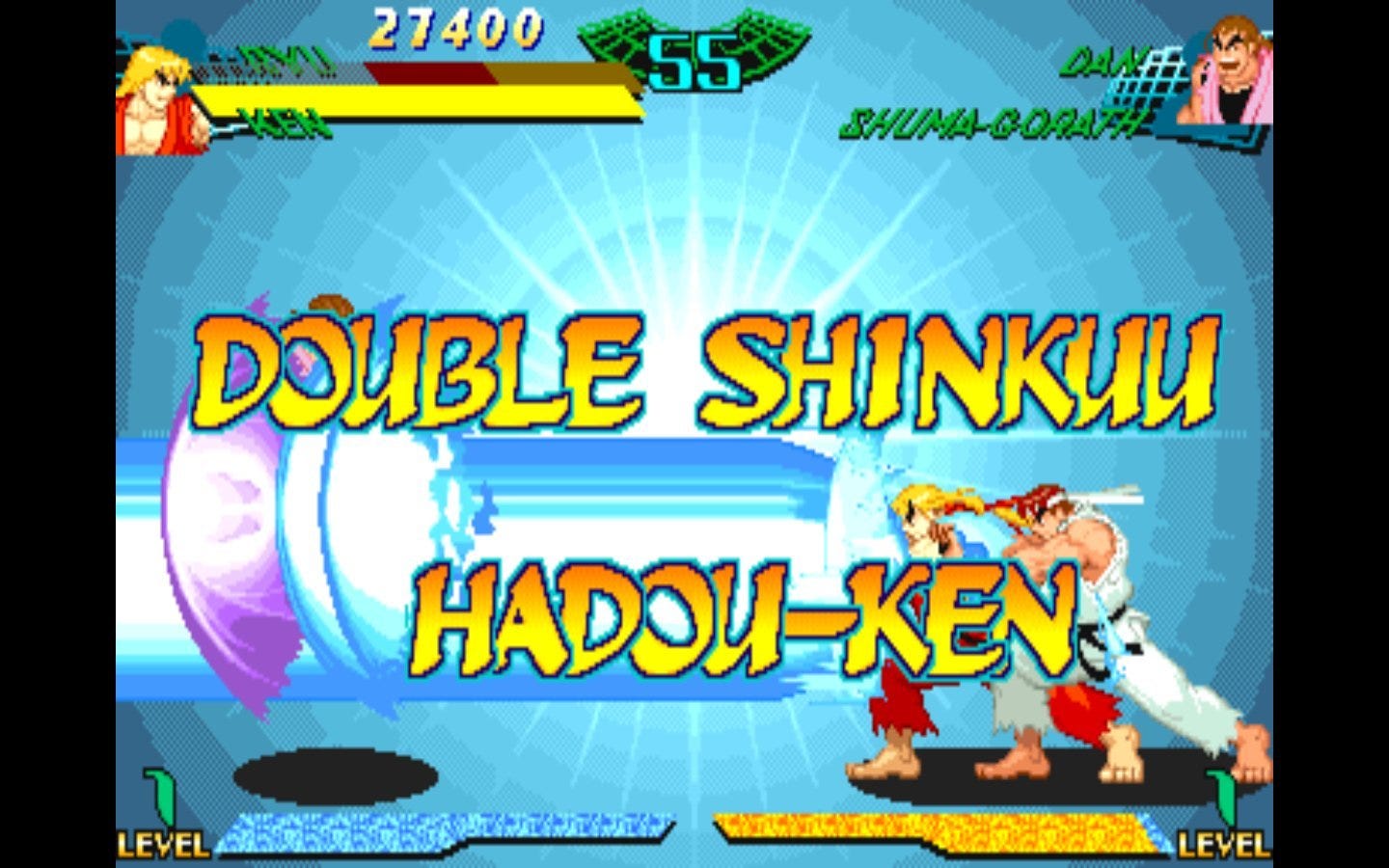
Relive the Street Fighter II: Animated Movie's final fight by taking M. Bison down with Ryu and Ken's Double Shinku Hadoken. Epic stuff.

The pace of X-Men vs. Street Fighter was very rapid compared to Alpha, and players could switch between their two characters by quickly pressing both heavy buttons - the tagged-out character would also gradually recover some of their lost health. Each character also had a launcher move which would catapult their opponent high into the air, and if followed up with a well-timed Super Jump, could be the start of an awesome and highly damaging Air Combo. These would later become the series' signature Aerial Raves.

X-Men vs. Street Fighter just wasn't happy unless you were throwing out a Super every five seconds, with a three-tiered Super gauge that maxed at an alarming rate. Even more OTT were the Variable Combos. This was essentially a dual Super move where both fighters would execute their Supers simultaneously - often for over 50 consecutive hits. Useful considering the end boss was Marvel's gigantic Apocalypse.

A sequel followed with Marvel Super Heroes vs. Street Fighter, which traded a lot of the X-Men cast for broader Marvel offerings like Spider-Man and the Hulk - Wolverine and Cyclops were the only returning X-Men. Marvel Super Heroes vs. Street Fighter removed a lot of the abuse-able infinities in the previous game, but played and looked almost identical to the X-Men outing. One significant gameplay addition was the Variable Assist, which would call your partner in for a quick attack and was useful in extending combos.

Marvel Super Heroes vs. Street Fighter also gave specific names for certain dual Supers and included a Cyber-Akuma for players to take down after they'd toppled Apocalypse, although anyone who's ever played Cyberbots will know this wasn't the first time he'd been mechanised - that Gouki gets everywhere.

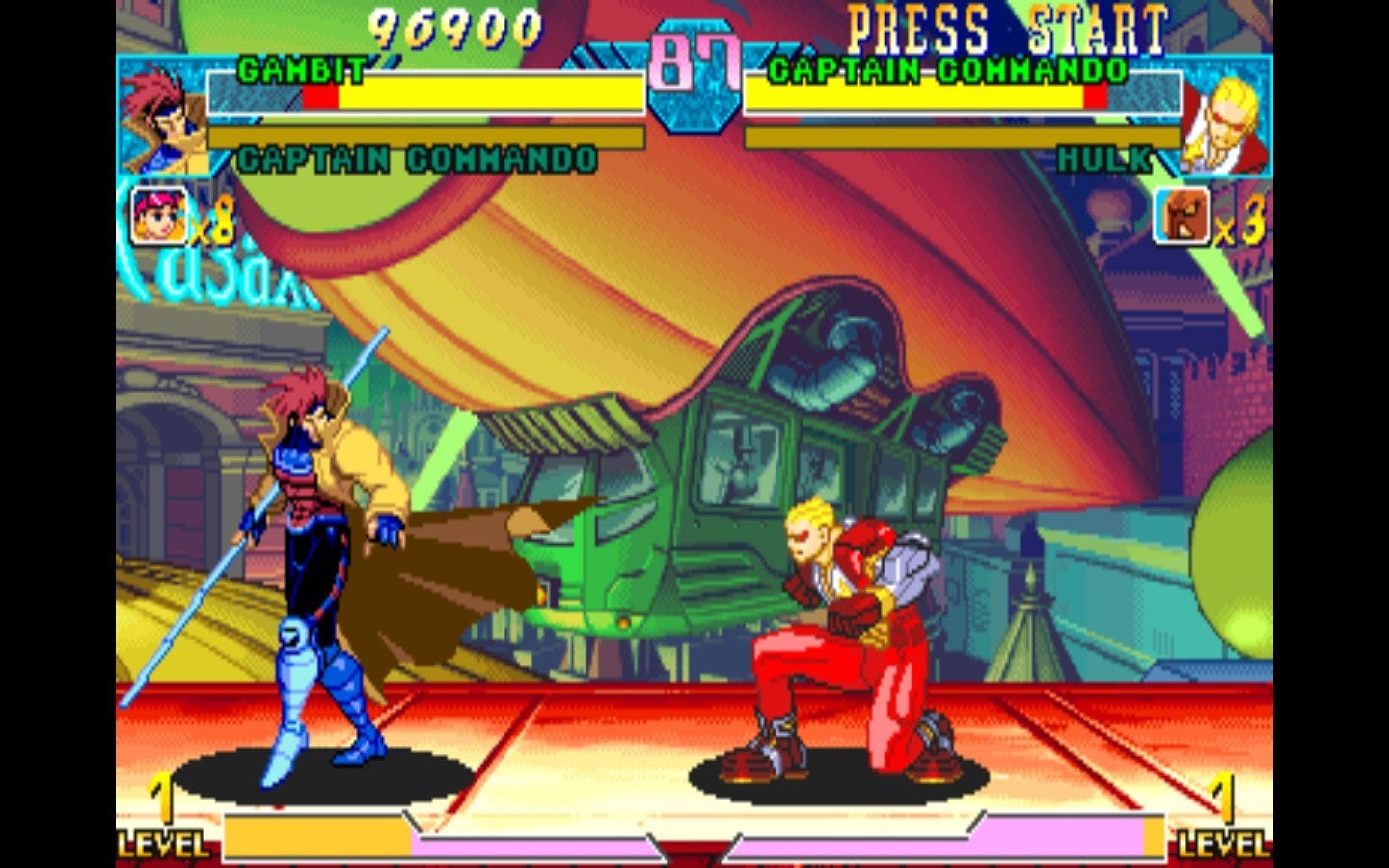
A year after Marvel Super Heroes vs. Street Fighter we got Marvel vs. Capcom, and, as the name suggests, Capcom looked beyond its Street Fighter catalogue and brought us the likes of Strider Hiryu and Captain Commando. Marvel vs. Capcom's first major change was the implementation of a striker system. As well as picking a pair of fighters, each player was also randomly allocated a helper - these ranged from Marvel's Iceman to Arthur from Ghosts n' Goblins. These helpers replaced the Variable Assist and were limited to a few uses per round.
8

Capcom allowed players to beat up the downed opponent after winning in MvC. Do the honourable thing or rub the salt in, your choice.

The other major change was the Variable Cross. With two levels of Super the player could call in their partner and attack simultaneously with both characters for a short time. If this wasn't powerful enough, the player also had the ability to spam Super moves as the Super gauge would remain maxed. Maybe a tad broken, but still fun for everyone who doesn't enter yearly fighter tournaments.

Considering Marvel vs. Capcom had 15 main fighters and a few unlockables, nobody was really prepared for the 56-fighter slugfest that was Marvel vs. Capcom 2. Still seeing fanatical tournament play today, many consider this to be the best fighter ever - although for the record, I don't. It was instantly noticeable that as well as upping the tag team play to three-on-three, Capcom had also removed the medium buttons and replaced them with assist A and B. This radically changed the Variable Assist again with the assist buttons each relating to one of your benched characters.

The degree of choice in Marvel vs. Capcom 2 is immense and quite difficult to explain. Suffice to say each player also had to choose from three assist types for each of their characters - ranging from Spider-Man's Web Ball capture to Jill Valentine's heal assist. Marvel vs. Capcom 2 really has endured the test of time.

Firstly, compared to other fighters in this retrospective it's more middle-aged than old, plus the appeal of the combined Marvel and Capcom licences goes beyond Street Fighter. But mostly, even despite all its many varied and technical fighter mechanics, anyone can pick up and have a laugh with Marvel vs. Capcom 2 - even with the most basic knowledge of Street Fighter II. Visually it's probably the most intense Street Fighter game ever and I'm surprised it doesn't have an epilepsy warning on the box.

Street Fighter EX

Series:
(1996) Street Fighter EX (1997) Street Fighter EX Plus (1998) Street Fighter EX2 (1999) Street Fighter EX2 Plus (2000) Street Fighter EX3

EX Mechanics:

  • Super Cancelling - the ability to cancel a Super into another Super up to three times
  • Guard Break - breaks through an opponent's block, costs one Super level
  • Excel Combo (EX2) - similar to Custom Combos, just go crazy
  • Meteor Combo (EX2 Plus) - a level-three Super
  • Surprise Blow (EX3) - replaces Guard Break
  • Momentary Combo (EX3) - quickly links specials together
  • Critical Parade (EX3) - virtually identical to a Variable Cross, costs two Super levels
  • Meteor Tag Combo (EX3) - essentially a dual Meteor Combo, costs three Super levels

With all the anticipation surrounding the console release of Street Fighter IV, it's easy to forget there's already been a 3D Street Fighter series. Street Fighter EX was co-produced by Capcom and Arika, a company started by former Capcom employees including Akira Nishitani. Arika also developed the Everblue series on the PS2. The first Street Fighter EX made a big deal out of Super Cancelling, where virtually any move, including a Super, could be cancelled into another Super.

Street Fighter EX may have looked pretty rough with very blocky 3D characters, but when you consider its release was pre-Tekken 3, you can give it a bit of leeway. At least it kept the 2D fighter gameplay alive. Most of the included Street Fighter characters played in their classic styles - although Ryu and Ken's Hurricane Kicks now required multiple inputs in order to link the various hits.

9

Chun-Li's never looked so angular. And that's not in the good way.

As well as a few classic Street Fighters, EX also contained original characters designed by Arika. Many of these were given stories to try and link them better to the Street Fighter universe. D. Dark, for instance, used to serve under Guile in the military and had his unit attacked by Rolento. Supposedly he blamed Guile for the massacre and sought revenge. Oh yeah, he also used to be called Holger, went psycho under the name Doctrine Dark and fights with chains and booby-traps.

Shortly after EX, Akira released EX Plus, which unlocked all the secret characters, including Akuma, Blair and Allen, and also ported EX to the PS1 as Street Fighter EX Plus a. EX proved popular enough that fans were treated to a sequel in Street Fighter EX2. EX2 played pretty much the same as the last game, although the Custom Combo system that proved popular in Alpha 2 was added as the Excel Combo. New characters included the sword-wielding Hayate, and if that wasn't overdoing it enough, new girl Sharon showed up packing an assault rifle.

EX2, and its update EX2 Plus, didn't improve the graphics dramatically over the previous game. Ryu and friends just didn't have the same charm in 3D as they did in 2D - more down to the arcade technology than anything else. They just looked plain and uninspired - perhaps why Arika went so out of its way to "spice up" the new fighters. Still, compared to all the fighters on the Hyper Neo Geo 64, Street Fighter EX really wasn't half bad.

10

Capcom should never have let Vega through with that claw. You turn a blind eye once, and people start to take liberties.

As the first game here not to get an arcade release, Street Fighter EX3 was a PS2 exclusive, and, more tellingly, very close to the console's launch. Its biggest feature was the tag gameplay everybody seemed desperate to put in their game at the time. No amount of Meteor Tag Combos, with Ryu and Ken Dragon Punching someone at the same time, could stop EX3 feeling like a rush job. EX3 had virtually no new characters, Akuma was glaringly absent and ignoring the tag system it played virtually identical to EX2 Plus.

The Street Fighter EX series is fun enough to play today and chaining three Supers together is still a definite high. But they were never a patch on most of the other Street Fighter games. Still, they're better than Final Fight Revenge. Arika can at least be thankful for that.

Capcom vs. SNK

Series:
(2000) Capcom vs. SNK: Millennium Fight 2000, (2001) Capcom vs. SNK: Millennium Fight 2000 Pro, (2001) Capcom vs. SNK 2: Mark of the Millennium 2001, (2003) SNK vs. Capcom: SVC Chaos

CvS Mechanics:

  • Ratio Match - we always suspected that Sagat was a better fighter than Sakura
  • Groove Selection - play the game system you prefer

If you'd suggested to anyone during the Street Fighter II heyday that Capcom and SNK would one day join forces and produce a Capcom vs. SNK crossover game, they would have had you committed. The sheer concept back then was as ludicrous as a Mario and Sonic game. Well, we've all learnt a lot since then, and not only did Capcom vs. SNK come to pass, but it did it twice after that too.

The first fully-fledged game in the series, Capcom vs. SNK: Millennium Fight 2000 (I've never played SNK vs. Capcom: The Match of the Millennium on the Neo-Geo Pocket, although other Eurogamers tell me it was good) was developed by Capcom. Rather than the normal six-button affair, Capcom scrapped the mediums and used light and heavy attacks like many of SNK's fighters. The roster was comprised of characters from Street Fighter, Morrigan from Darkstalkers and many SNK fighters from the likes of The King of Fighters.

The game's most interesting feature was the Ratio system. Each character was tiered between one to four depending on their general power and effectiveness - Cammy and King were tier one, Balrog and Terry Bogard were tier two, bosses Vega and Geese Howard were tier three and uber bosses Evil Ryu and Orochi Iori were top tier four. Players could therefore assemble teams of one to four characters. Watching Blanka, Dhalsim, Yuri and Vice trying to take down the all mighty Akuma was amusing indeed.

11

Violent Ken beats Ryu to a pulp with his Shinbu Messatsu, ending in an Orochi Iori pose. Serves him right for always being so honourable.

Rather than limiting Millennium Fight to Alpha-styled play mechanics, Capcom gave players the option of a Capcom or SNK Groove. Capcom Groove was more or less pure Alpha, with three levels of Super charged by attacking or blocking. SNK Groove was similar to the Extra Mode from The King of Fighters '98. It required the player to manually charge their single-tiered Super meter - extra powerful Supers, known as Super Desperation Attacks, were also available with a full Super meter and low health.

Millennium Fight proved highly successful in the arcades, bringing fans of Capcom and SNK fighters together - although most would generally play games from both companies anyway. A minor update in Millennium Fight 2000 Pro was followed by Capcom vs. SNK 2: Mark of the Millennium 2001.

Mark of the Millennium was again developed by Capcom, who this time decided that its six-button system was better and thus reinstated the mediums. Most players' criticism with the previous games' Ratio system was that it wasn't massively accurate in determining power and didn't allow for certain dream match-ups. In came Capcom with the Free Ratio system. This time players determined the ratio for each character rather than it being preset - so you could effectively have a tier-four-powered Dan.

Mark of the Millennium also significantly upped the character count with new inclusions like Kyosuke from Capcom's Rival Schools and Hibike Takane from Last Blade 2. Mark of the Millennium also saw the return of Shin Akuma as a secret boss along with Ultimate Rugal - Rugal having absorbed Akuma's Dark Hadou.

12

Seeing Ken turned into a blonde girl wearing a wedding dress, before exploding in a ball of fire, is not something you forget quickly.

Capcom also upped the customisation by adding four further Grooves. A-Groove used a system similar to the V-ism Custom Combos from Alpha, P-Groove was limited to level-three Supers and used the parrying system from Third Strike, N-Groove was a more classic King of Fighters style and K-Groove worked like a combination of Samurai Shodown's Rage Gauge and Mark of the Wolves' Just Defend system. Only Marvel vs. Capcom 2 can really challenge Mark of the Millennium for its level of diversity.

Playmore took the reigns for the final SNK Capcom title, SNK vs. Capcom: SVC Chaos (it seems the developer gets to have its name in the title first). Chaos is an SNK game through and through, and was produced on SNK's archaic AES hardware. Even though Playmore crammed every last drop of graphical performance out of the AES, Chaos still looks dated alongside Mark of the Millennium - although I have to admit I do prefer the 2D backgrounds in Chaos.

Chaos returned to the four-button setup SNK always championed and also completely removed the Tag and Groove Selection systems. In most respects Chaos is more a spiritual sequel to Mark of the Millennium and mechanically shares little in common - playing more like The King of Fighters 2002 with bonus Capcom characters. This was by no means a bad thing as the game still played well with its extra-powerful Exceed Supers. Street Fighter diehards had to adjust their fighter skills to the comparatively faster King of Fighters pacing.

In the same way Ryu has his Evil Ryu alter-ego, SNK also saw fit to give Ken a Violent Ken variation for Chaos - his Exceed animation had a similar feel to angry Orochi Iori. Extra fan-service was added with hundreds of fighter dialogues that pre-empted each match, with Dan repeatably being mistaken for Ryo and Robert. More hilarious still was Darkstalkers' resident vampire Demitri and his Midnight Bliss Super. Said Super turns any male opponent into a woman before Demitri bleeds them dry. Apparently the Japanese actually have miniature figures dedicated to this alone.

Street Fighter III

Series:
(1997) Street Fighter III - The New Generation, (1998) Street Fighter III - 2nd Impact, (1999) Street Fighter III - 3rd Strike

SFIII Mechanics:

  • Super Arts - pick the Super that's right for you
  • Parrying - completely negate an attack rather than blocking, sets the men from the boys
  • Leap Attack - jump slightly and hit a crouching opponent
  • EX Specials (2nd) - powered-up specials attacks
  • Personal Action (2nd) - elaborate taunts
  • Grab Defence (2nd) - throw immediately after being thrown to cancel it
  • Red Parry (3rd) - parry during a block, timing is very tight

Up until now I've listed all the Street Fighter games sequentially (I think), but I decided to leave Street Fighter III to last. Capcom's successor to the CPS-2 arcade motherboard, oddly enough, was the CPS-3. It was only capable of 2D graphics in a time when 3D arcade games had taken over, and if it wasn't for the Street Fighter III series, it would be considered one of the greatest arcade flops ever, with only six known games. Fortunately Street Fighter III - The New Generation made the fighter hardcore take notice, and at the time it visually eclipsed all its 2D competitors with stunningly fluid animation.

New Generation initially felt like a mixture of baffling design choices. Ryu and Ken were the only returning Street Fighters on the character-selection screen, and rumour has it Capcom only included them at the 11th hour. Filling the many gaps were the likes of ninja Ibuki, Kung Fu practitioner Yun and grappler Alex. Some of the other characters had a similar feel to the old Street Fighter II cast - Dudley was a boxer like Balrog and Necro's extending arms and electric attacks played like a Dhalsim and Blanka hybrid.

13

Street Fighter III end boss Gill is ultra cheap. Able to completely restore his health and chip you to death.

The gameplay also seemed more Street Fighter II than Alpha. Players had to choose just a single Super move from a selection of three and air blocking had been completely removed. But in its place was the new parry system. By pressing forward or down in time with an opponent's attack, the player could negate all damage, leaving just enough time for a counterattack. Many players were apathetic towards the parry system initially, but it nonetheless provided a dual offensive/defensive system that required serious skill to master.

In times when arcades were becoming dominated by Tekken 3 machines, observant players may have noticed the New Generation cabinets being upgraded to Second Impact. Visually even more impressive than New Generation, Second Impact brought new characters Hugo and Urien into the fray as well as bringing back Akuma. Yang, Yun's palette swap from New Generation, was also given his own moveset.

Second Impact didn't really change the basics of New Generation that much - except in the case of EX specials. By pressing two buttons rather than one, the player could execute a special move that cost a small portion of their Super meter, but was stronger than the heavy special and had higher priority. This technique is being brought back for Street Fighter IV and its implementation will be one of the first steps to Street Fighter IV mastery.

As good as New Generation and Second Impact were, they were mere precursors to the excellence that was Third. On the face of it Third Strike didn't progress Street Fighter III all that far. It brought back Chun-Li and added four new fighters including Makoto and Remy, but Remy's Light of Virtue and Rising Rage Flash were just Guile's Sonic Boom and Flash Kick in disguise. Behind the scenes though, all the characters' moves were tweaked to near-perfection and little changes, like air parrying not pushing you back like it did in New Generation, all added to Third Strike's brilliance.

14

If you can't even parry a fireball in Street Fighter III, then you still have a lot to learn.

I'll probably get scorned for using such an obvious example, but Diago Umehara's well-documented fight with Justin Wong, during the losers' bracket final of the Evo Champion Series 2004, is a classic example of the parry system mastered. On the brink of defeat, where even blocking a hit would cause him to lose, Diago waits for Justin to pull off Chun-Li's rapid 15-hit Super, the Houyoku Sen. Diago, to everybody's surprise and not least Justin's, parries every single agonising hit and follows up with a perfectly-executed 12-hit combo, Super Cancelling into Ken's Shippu Jinkai Kyaku. The crowd goes mental and the most famous Street Fighter battle ever is born.

Third Strike was simply classic 2D fighting perfection. It didn't get bogged down with 50 characters or overly complex play mechanics, but instead got all the fundamentals right and tight. Many disliked the new cast and couldn't get to grips with the parrying, fair enough, but to my eyes Third Strike is not only the greatest Street Fighter, but also the greatest fighting game made up to now, and the standard by which the long-term success of Street Fighter IV shall be judged. Nearly ten years old, Third Strike is still possibly the most hotly contested fighting game in Japan, and for damn good reasons.

And the rest...

(1990) Street Fighter 2010

A platform game on the NES that doesn't really have anything to do with Street Fighter, although it was developed by Capcom. In the Japanese version the main character was a cyborg cop called Kevin Striker sent out by the galaxy police to control a parasite outbreak. The English localisation team saw an opportunity to make some quick cash and so changed Kevin to Ken. The story read: "even though it's been 25 years since Ken was king of the street-fighting circuit, it's nothing a few good bionics can't fix". To be honest, Ken's cheap enough without bolting machineguns to his arms.

15

Here's an interesting fact. The actor who plays Akuma in SF The Movie, Ernie Reyes Sr., also plays Prince Tarn in the 1985 flop, Red Sonja.

(1995) Street Fighter - The Movie

As if it wasn't bad enough that they made Street Fighter into a live-action movie, Capcom had to make things worse by releasing a game based on the movie of the game. Two versions of "The Movie" were made - the arcade version was developed by Incredible Technologies and the Saturn and PS1 home version was developed by Capcom. Both games used digitised sprites like Mortal Kombat in a vague attempt to replicate the actors onscreen. Although the games had slightly different mechanics, they had one major thing in common - compared to Street Fighter II they were horrendously bad. If you ever get the chance to play one however, it can be quite funny regardless.

(1995) Street Fighter II: The Interactive Movie

Unlike the above, Street Fighter II: The Interactive Movie is an adventure game based on the anime Street Fighter II: The Animated Movie (which is awesome). Released for the Saturn and PS1 in Japan only, the player took control of a Shadaloo monitor cyborg searching for Ryu across the world. The game also spliced in footage from the film and had playable fights based on the Super Street Fighter II engine.

16

Aw, aren't they cute?

(1997) Super Gem Fighter Mini Mix

Using the same deformed style from Super Puzzle Fighter II Turbo, Super Gem Fighter included characters from Street Fighter, Darkstalkers and Red Earth. Originally released in the arcades, it had just four buttons - Punch, Kick, Taunt and Special - and although specials were pulled off in the normal manner it played very differently to any other Street Fighter. Players had to collect gems during fights to power-up their three different specials. Super Gem Fighter also had a cosplay vibe, with combo sequences dressing Akuma up as Leo from Red Earth and Chun-Li as Jill Valentine.

(2004) Capcom Fighting Jam

Probably still fresh in most fighter fans' memories, Capcom Fighting Jam was an in-house crossover featuring fighters and their inherent systems from Street Fighter II, Street Fighter Alpha, Street Fighter III, Darkstalkers and Red Earth. The game was poorly received due to its lack of originality, character simplification and unbalanced roster. The only original character, Ingrid, was salvaged from the canned Capcom Fighting All-Stars, which sums Fighting Jam up quite well.

Look out for Eurogamer's Street Fighter IV review very soon.

Comments (67)

Comments for this article are now closed, but please feel free to continue chatting on the forum!

  • Loading...hold tight!