StarCraft II

The new adventures of old faithful.

StarCraft II is fast. Really, really fast. But lead designer Dustin Browder talks faster. The bald-headed, sharp-eyed veteran of Command & Conquer titles, hired in by Blizzard to take command of this sequel to its decade-old real-time strategy warhorse, jumps into questions halfway through and peppers you with rattling bursts of ideas and arguments. It's like he's involved in a constant game of StarCraft II in his head, where precision, pre-emption, and speed of execution are absolutely everything.

Blizzard gathered press at its California HQ this week to reveal the Zerg, the last of the classic trinity of races from the 1998 original. With all three races in place, there was also the first chance to try out the essential core of the game: blisteringly quick multiplayer matches between the dogged Terrans, hi-tech Protoss and the mutating bio-weapons of the Zerg. Although more than half the units in the game are new, that core - from interface to perspective to mechanics to, most importantly, speed - remains virtually unchanged from the one that birthed one of the longest-lasting multiplayer communities, and most active eSports scenes, that gaming has ever seen. Whether building bases and armies, or micro-managing units in battle, in StarCraft II the fastest mouse always wins.

Weren't they ever tempted to slow it down a bit? "No! Not StarCraft," says Browder. "There's something to be said for that kind of fun. You know it's just, 'Gogogo! Oh I lost. Gogogogogo! Oh I won! Gogogogo.' And then you just play again and again. I think that was a kind of fun that we wanted to create again, that the team wanted to do, and it's certainly the kind of RTS that I prefer."

Lead producer Chris Sigaty - the laid-back, long-haired yin to Browder's yang - reinforces the point: Blizzard at no point considered reinventing this particular wheel. "One of the things we hear is, what's the new big thing you're bringing to reinvent RTS? And I'm like, well, we're not," he states flatly.
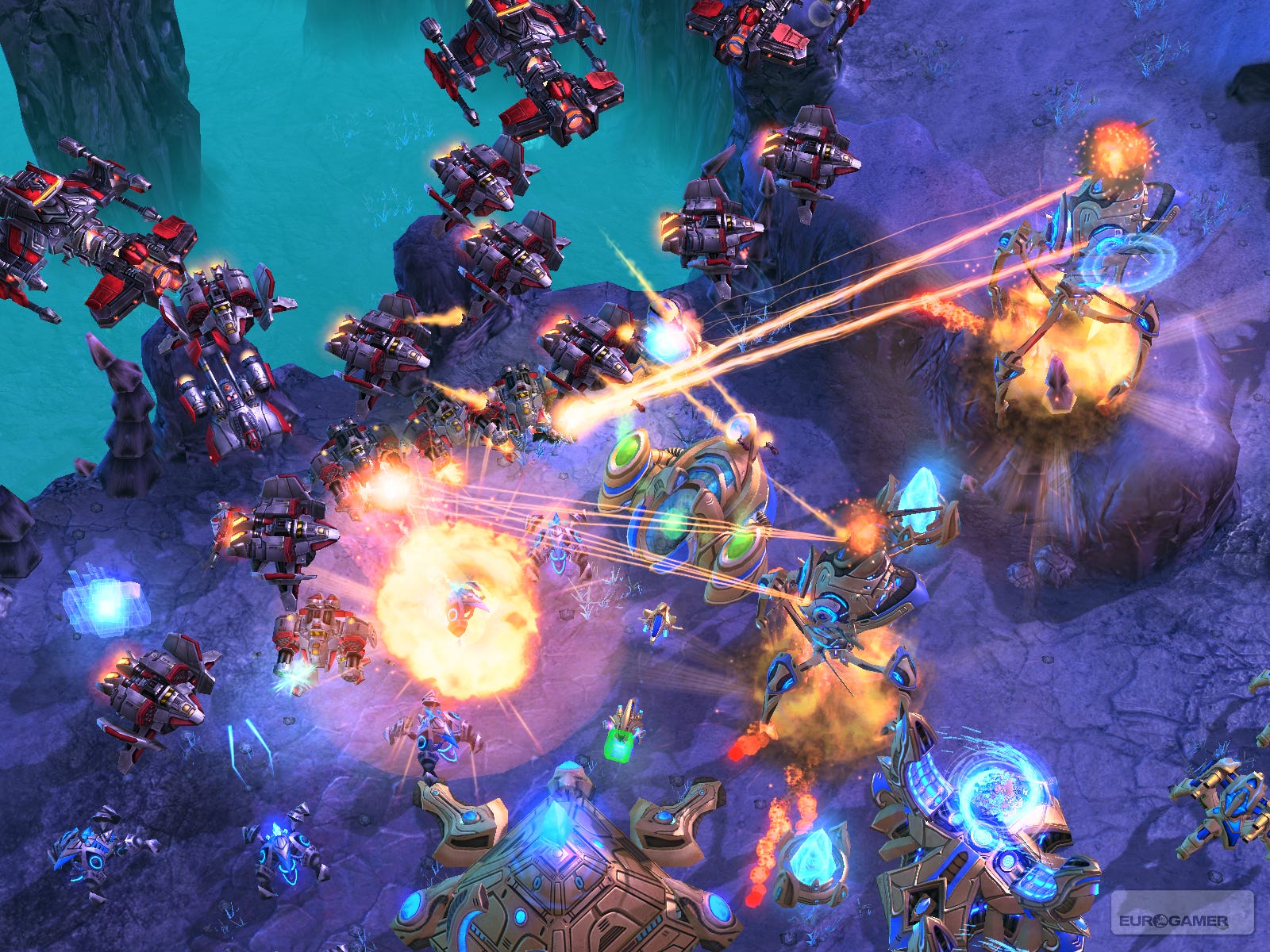
1

The flying Terrans attack the girly Protoss. Oli didn't do these captions - he had to dash to the airport - so they will be rubbish and uninformed.

"We made a conscious decision not to... One of the things that played into our decision was just how popular the original game still is. Had it been different, had it spiked up and sold well and then disappeared... maybe putting first-person elements might have been something that we'd considered. But we never considered that. Stay true to the original; stick with the original three races; make them more diverse."

True to the original it certainly is. Familiarity is instant to anyone who's played StarCraft, and to some extent Warcraft III: the screen layout, the tight camera that apes the original's isometric display, the slight sense of claustrophobia and panic, the simple but effective unit designs, the tendency away from methodical empire-building and towards sudden, heart-in-mouth raids, and of course the seemingly limitless capacity for micro-management that allows the 300-actions-per-minute Korean pro-gamers to manipulate vast armies on several fronts on an almost unit-by-unit basis.

It's both intoxicating and intimidating. There's certainly an adrenalised rush to it - and the astonishingly vivid, distinctive and beautifully animated new visuals are a powerful draw. But playing against seasoned StarCraft campaigners leaves you with no time to even begin to explore the expanded possibilities of StarCraft II's more involved research and tech trees. Perhaps it's just that no-one is fully familiar with the new set-up, but deep-seated patterns seem to reassert themselves very quickly. It's a pitfall Browder is aware of, and he's working to avoid it, in part through more sophisticated map design: line of sight barriers, placing high-yield minerals behind walls of rocks that take protracted and concentrated fire to take down, and so on.

It's a testament to the powerful personalities of StarCraft II's unit designs that any discussion of the new game is endlessly, inexorably drawn to them, despite their simplicity. The Zerg Queen, one-off base defender with several abilities and the potential to grow to larger size, is the new star, alongside the giant (now slightly less giant) Protoss mothership that Blizzard revealed early last year. These have some of the long-term potency and complexity of Warcraft III's quasi-RPG Hero units, but fundamentally, says Browder, the game is too fast to support massive unit depth.

However, the sheer number and creative breadth of those units, and the cascading, cumulative decisions you make when building and upgrading your force on each map, still lends StarCraft II's three races a strong sense of individualism. The Terrans have undergone the most sweeping changes, he says. "The Terrans used to be very methodical in their approach; you build bunkers, you build siege tanks, you advance. You consume the map. Terrans now have Vikings, they have Banshees, they have Reapers, they have dropships that heal people, they're like Terran air cavalry now, you never know where they're going to be next. That's a very different strategic approach."

But we're here to see the Zerg, the race of kamikaze mutant bio-weapons that to a large extent defined the original StarCraft, with their involved expansion system, tunnelling ability and hell-bent charges with overwhelming numbers of cannon-fodder. Despite the addition of some striking new units - especially the Corruptors and Infestors that turn the enemy's air units and bases against it - it hasn't had such a major overhaul, for fear of losing that distinctive personality.

"Dustin says, which is totally true: on paper, in the original StarCraft, Zerg shouldn't even be in the game," says Sigaty. "They're too weird, they're too complex, you have to select the hatchery then select the larvae then morph units, and it doesn't work anything like the others. On paper it's really confusing and weird, but it worked."

2

Here we see some Zerg going upside some Terran heads.

"I think it still stands out," agrees Browder. "People still call it 'zerging' in WOW when you rush a base in Alterac Valley. It's important that we get it right and that they still speak to some of the core mechanics. So we kept the larvae, and we kept the speed, they're still the fastest race out there just in a footrace. That's been very important to us." He reluctantly admits to the Zerg being his personal favourite, at least in the first game. "I guess in the original I probably favoured Zerg. Just because I like playing the monsters. You know, power to the Horde, and all that."

As much as the game's races dominate the attention, if StarCraft has an unsung hero, he says, it's the maps. "Map design absolutely controls how fun this game is. More so, in some ways, than the units and the structures. Even without the map mechanics we've added... you can make a game that's no fun for two out of the three races right away just by bad map design. I would say right now, out of the 15 or 16 maps we currently have in the game, there's about four or five, maybe six, that are actually kind of fun. The rest are not so great."

A perfect example of Blizzard's legendary perfectionism, there. Although the game is already extremely polished and playable - and has been since BlizzCon last year - there is clearly still a mountain to climb before it can meet the studio's endlessly high expectations of itself. Holding your breath for a release date announcement is only slightly less inadvisable than holding your breath for the release itself.

Another indication that StarCraft II is still some way off: there is a lot about the game that's still under wraps. The game's basis - the units, the races, the unmistakeable multiplayer - has now been laid bare, and there is nothing in it to shock or perturb fans, or even surprise them much. On the face of it, StarCraft II seems to be preaching to the converted and ignoring the rest. But to think that would be to underestimate Blizzard, and to ignore the huge gaps in what's been said and shown.

Firstly, the single-player campaign, of which there was a tantalising glimpse at BlizzCon last year, but which is still shrouded in mystery. An elaborate and gorgeous front-end was demonstrated, showing Terran characters aboard their flagship, and we were promised a non-linear storyline, dialogue trees, and flexible tech development. It seemed a fascinating introduction of elements from the likes of Bioware RPGs and even point-and-click adventures to this otherwise straight-down-the-line action RTS, but there's no word on how the non-linear storytelling will work, or how the Protoss and Zerg races will factor into it. Sigaty is tight-lipped, but says it's intended to satisfy those who are disappointed by the lack of change in the game's core mechanics.

"It's definitely a departure and it was a conscious decision to make single-player very different from what we'd done before. Really the main reason is, because of what we're deciding to do with the core multiplayer game, let's innovate and be different in the single-player campaign."

Yet more significant, and more secret, are the plans for the revamped Battle.net multiplayer portal that will launch alongside StarCraft II. Blizzard has been hinting from the start that it has big plans for this, centred on a push to bring the game's tremendous pro-gaming success in Korea to a wider, worldwide audience.

3

My money's on the floaty brain things.

"We're not really prepared to talk about the specifics of Battle.net right now," stonewalls Sigaty - but then he relents a little. "Three things - the core multiplayer game and Battle.net ultimately being the glue of that, combined with our interest in the multiplayer community and general, and then eSports - those are the things that we'll be focusing on in Battle.net. In a few months you'll have specific information on what that means, but certainly you can start to draw conclusions about how we're going to bring eSports to people that aren't even aware that it exists." He specifically mentions "the new level of gamer" - the Guitar Hero-loving, semi-casual player.

StarCraft is in many ways the ultimate hardcore RTS, so the idea of bringing it - and not just the game itself, but the bewildering, physically staggering world of high-end professional StarCraft II competition - to the masses seems far-fetched. Or does it? StarCraft is a nationally popular sport with TV coverage in South Korea, after all. Would a slick gaming social network, loaded with stats analysis, news, player profiles, a good spectator mode and broadcasts of high-level matches change things for the rest of the world? It might. Only time will tell if that's what Blizzard has in store, but it's worth remembering that this company doesn't do things by halves - and thanks to World of Warcraft, it now has more experience in social gaming than practically anyone.

Blizzard fully intends to have and eat its cake with StarCraft II. It's already clear from our hands-on session that it's making a finely-tuned, exciting, but fundamentally conservative new version of an established classic, playing firmly into the hands of its rabid fanbase. But it also has sweeping, strategically interesting plans for the single-player campaign and Battle.net portal that mean this staunchly traditional game could still shake things up. Without knowing those plans in detail, it's impossible to say whether it will achieve that, but going by Blizzard's track record, only a fool would bet against it.

If you want to see more of the game in action, check out our exclusive gameplay edit over on EGTV now.

Comments (67)

Comments for this article are now closed, but please feel free to continue chatting on the forum!

  • Loading...hold tight!