Star Trek Legacy Review

Captain slog.

Version tested: Xbox 360

You've got to feel sorry for Star Trek fetishists - and not just in the "never going to have sex with [nice looking] girls" sense. Not only do they still represent the enduring face of unnerving geek fanaticism for the vast majority of the population, despite having kept a low profile for several decades, but their beloved franchise is in a truly woeful state. The recent movies and TV series have flopped like Shatner's six-pack, and all attempts to revive the series now hinge on Mission: Impossible III director J.J. Abrams and his Starfleet Academy movie, starring a young Kirk and Spock.

Yes, even Star Wars fans can afford to look up from their boxes of worthless prequel trinkets to snigger at the perennially unfashionable Trekkies.

Recently, however, there has been a flickering beacon of hope for the beleaguered Trek fanbase. Star Trek Legacy was to be a game that brought the shiny shiny magic of next generation gaming to the bridge of the Enterprise, tying together all five TV shows (plus the early movies) into one centuries-spanning epic story.

After all, no matter how dull the shows became, Star Trek has always maintained its own sense of identity - a utopian vision of the future where mankind is united and noble, where exploration and diplomacy drive our ambitions, and where shoot-outs and explosions are a last resort. Even I, a casual appreciator of Trek, was intrigued at the possibilities of a galaxy-spanning game in which intellect and empathy were as vital to success as phasers and photon torpedoes.

Star Trek Legacy, therefore, should have been something quite special.

Wailing frequencies open

Unsurprisingly, given the way the franchise has been fumbled in recent years, it's nothing of the sort.
1

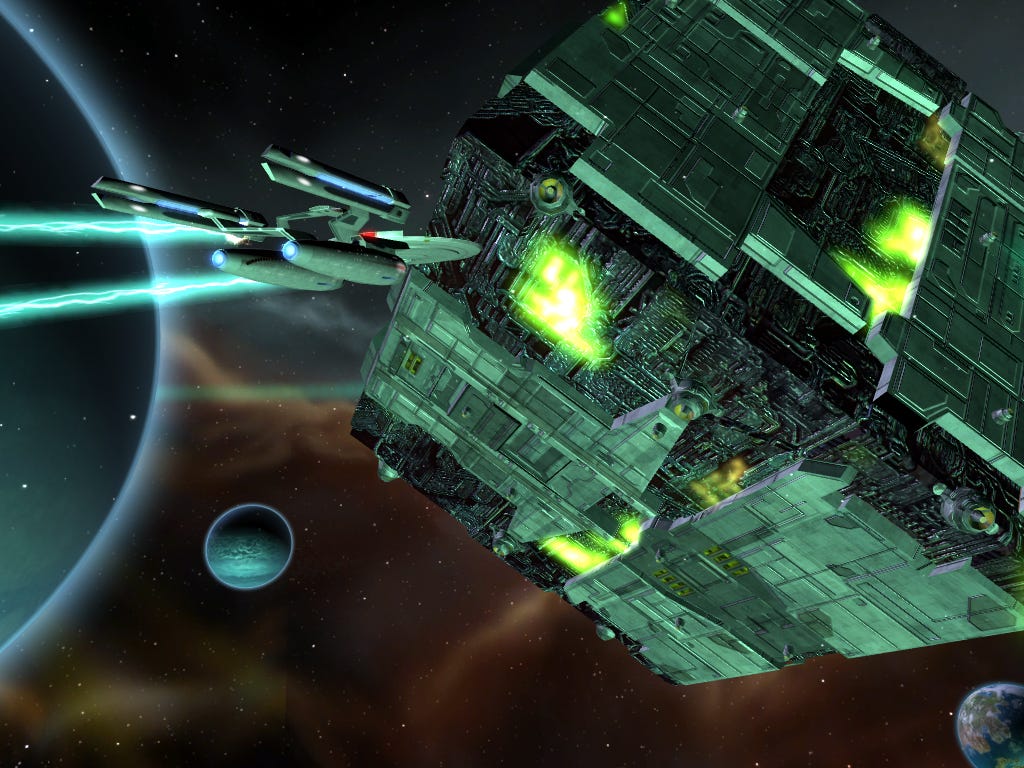
What do you call the most serious Borg of all? Earnest Borg 9.

The game starts off on the wrong foot right from the first level, simply because it follows the Star Trek timeline chronologically. This means the first five missions take place in the pre-Kirk era, with Scott Bakula's impossibly dull Captain Archer and the bland early years of Starfleet. Although the orchestral soundtrack is appropriately grandiose, Bakula's droning and stilted voiceover is in danger of killing the atmosphere stone dead before you've even got started.

Sadly, the disappointments don't end there. Starting out with just the Enterprise at your command, you're walked through some early challenges, learning the ropes of galactic navigation and combat along the way. You soon pick up additional craft for your small fleet, and can purchase additional "wessels" by trading in any Command Points earned during your missions.

Star Trek, of course, doesn't have many small fighter craft so the emphasis is firmly on giant cruisers, destroyers and battleships. As you'd expect, these are not the most speedy or nimble modes of transport, and movement is therefore sluggish, with wide turning circles and lumbering acceleration. This wouldn't be a problem - and would, in fact, be a rather interesting challenge - if the game itself made allowances for this different style of engagement. As it is, combat takes the form of long, drawn-out dogfights between enormous spacecraft that are woefully ill-equipped for such manoeuvres.

The sight of the Enterprise, slowly twizzling around on its arse as it tries to keep a Romulan enemy in sight, isn't really in keeping with what we see of Starfleet warfare on the TV. It looks ridiculous - and is teeth-grindingly irritating to boot.

The fanbase cannae tek it!

The control system seems equally torn between arcade-style joystick wrangling and a more strategic simulator set-up. Left stick moves your ship, right stick controls the camera and targeting reticule. Point it at something, and press A, and you fire up the impulse engines and start heading in that direction. Press A over an enemy and you lock the camera on them. Move the right stick, and the lock is lost. Pressing B brings the engines to a stop, while holding down B and using the d-pad allows you to choose full, half or quarter power. Pressing Y bumps you up to warp speed, but must be charged and cannot be used when near planets. So, already, simply moving around involves the majority of the face buttons, both joysticks and the d-pad. If the game had the depth of a simulator, this wouldn't be so bad, but as it's really a glorified shoot-'em-up, this complexity just gets in the way.

Combat isn't much better. Target lock requires you to be in range, and facing the right way. A white reticule shows your phaser lock, while a red triangular one denotes photon torpedo lock. Clicking the left stick switches on sub-system targeting, which allows you to focus your attacks on a specific facet of the enemy craft (say, weapons or engines) by holding down the A button and selecting the relevant system with the stick from a circular menu.

3

KHAAAAAAAAAAAN! (is not in this game)

Once again, it's all just convoluted enough to irritate - and, with enemy fire pounding your ship, it all takes far too long to get the hang of. You'll spend the majority of your early sorties trying to translate the minimal tutorial information into some kind of practical application, at the expense of becoming engaged in the story. It doesn't help that the camera is skittish, and your target lock often blinks on and off while you wrestle with the controls to keep the enemy in the right position relative to your ship. Even once you have mastered things, the battles are revealed as pitifully shallow. Each encounter simply becomes a question of circling round and round, wearing down enemy shields with your phasers, then destroying their hull with your (limited) torpedoes or continuing with the long slow phaser attacks until they explode. Rinse. Repeat. Warp to next objective.

Set phasers to "dumb"

Naturally, this is a considerable problem given that combat makes up at least 95 per cent of the game. Not only does your heart sink at the start of each battle, rather than your pulse quickening, it also keeps the feeling of Star Trek from ever taking hold. While some missions contain a heavily scripted and linear preamble - fly here, scan this planet, beam an away team to this station, OOH! ROMULANS! - it's always a short prelude to another whopping big scrap and, as these large scale battles were only ever an occasional feature of the TV shows and movies, the core of Trek's appeal is lost. Not once do you feel like the captain of a Starfleet cruiser, tackling situations using the full range of options available to you. You're never allowed to consider alternate strategies, or to think your way around a problem. There's only ever one way to complete each mission, and it always involves mass destruction, so the Enterprise is reduced to little more than a flying weapon, with blowing up evil aliens as your primary goal.

That whirring sound you hear is legendary peacenik Gene Roddenberry, frantically spinning in his astral grave.

The much-vaunted fleet dynamic is equally shallow. Following the traditional wingman set-up of four ships, each selected with a prod of the d-pad, there's some strategy involved in choosing the right combination of craft, but the actual control you exert over them is basic at best. You can issue orders to the whole group, and this is almost always your best bet - at least this way you have some idea of where they're going. What you can't do is issue any individual orders more complex than "go over there". If the "there" in question is an enemy, they'll attack it. If it's not, they'll simply hang there in space and wait for you to actively take the helm to carry out the more subtle tasks. Tasks like, you know, repairing that gaping hole in the hull.

Yes, the AI of your fleet is so advanced that they'll just keep taking damage until they explode without even initiating repairs of any kind. Instead you have to hop from craft to craft, manually selecting the Repair Hull option, during combat. This "if you want something done properly, do it yourself" ethos is true of any order that doesn't involve simply flying somewhere and blowing stuff up. Of course, flying and blowing stuff up is basically all there is to do in the game, but it's disappointing that it doesn't allow you to make actual strategic plans, to send one ship to protect vulnerable medical craft, another to scout ahead for enemies, and one to lure them away, without having to constantly check the map to make sure your tiny armada hasn't ground to a halt for no apparent reason. It's a blunt instrument of a game, a mindless blaster wearing a threadbare strategy hat, and fans can only weep at the missed opportunity it represents.

Tribble jump

2

Your mighty fleet. So noble. So powerful. So bad at doing as they're told.

It's not even as if the game has enough next-gen visual flair to distract you from these shortcomings. The ship models are decent enough, as you'd expect for a property where fans obsess over blueprints for fictional vehicles, but ugliness abounds elsewhere. Planets look OK from a distance, but just try getting up close. The ships slide around the planets, rather than colliding with them, and the sudden shift in scale destroys the illusion. What once looked like a majestic celestial body becomes a small crudely coloured sphere, dangling in the void.

And if that doesn't make you wince, just wait until you see what happens when you destroy an enemy ship. Breaking apart into large, angular shapes - like a Lego model dropped on the floor - it's a graphical effect that would have looked outdated on the original PlayStation. The pieces don't even have any physical properties. If you're next to a ship when it explodes, you'll feel nothing - not even as the enormous blocks of triangular debris float right through the Enterprise.

All these problems recur during the otherwise decent multiplayer modes, although fighting against a human foe does at least level the playing field with regard to controls. There's plenty of activity - after all, the day you can't find Star Trek fans online is the day the universe implodes - but there's no post-game lobby, so if you want to keep playing with the same group of friends (which would seem likely, given the Trek fanbase) you have to restart from scratch each time. Much like all the other issues the game has, it's the fact that the oversight is so utterly unnecessary in 2007 that makes it so unforgivable.

Captain James T. Quirk

Somehow, despite these niggling quirks, there's still just enough here to satisfy a Star Trek fan. They are, after all, used to making the best of a bad situation and you do get to fly around in the various versions of the Enterprise, listening to the TV captains issuing your orders. For those dedicated few, the attention to detail is impressive with plenty of references and cameos to tickle the observant fan. There's an undeniable sense of fun (and relief) that kicks in once you clear the Archer missions and finally get to hear William Shatner - even if his performance is somewhat lacklustre. Seeing the classic Enterprise hitting warp speed, and hearing The Shat waffling away, it's hard not to feel a smile tugging reluctantly at the corners of your mouth.

4

In Star Trek, the more green the spaceship, the more evil the inhabitants.

The same is true of videogame voiceover veteran Patrick Stewart and, while their place in the canon is less than iconic, the inclusion of Sisko and Janeway from Deep Space Nine and Voyager makes for a nice completist package. The absence of any other cast members leaves an awkward hole though, especially since the interplay between captain and crew is such a vital part of Trek. Where's the fun in a long range scan if Spock or Data isn't on hand to deliver the result? The generic (and repetitious) crew dialogue is a poor replacement for the camaraderie that glued together so many tense scenes on the bridge. Still, the game mostly delivers on its promise of a grand Star Trek story, and it manages to do so without coming off as too contrived. Fans can be happy with this aspect, at least.

However, the game has one last trick up its sleeve - and it's one that will turn off even the most forgiving Trekkie.

There's no way of saving the game during a mission. No checkpoints. No autosave. No quick saves. It doesn't matter how many objectives you complete, if you stumble at the last hurdle you do the whole lot over again. As even the shortest missions take at least twenty minutes to play through, while the average mission time is closer to three quarters of an hour or more, having to do everything again just because you couldn't get your allied ships to come to your aid is enough to evaporate whatever goodwill the Trek minutiae has built up. It's a mindboggling decision, and one that turns a clumsy-yet-bearable franchise outing into something tiresome and joyless.

Unless you already have an emotional attachment to the Star Trek universe, and feel a cheeky little frisson down there at the prospect of pretending to be Kirk, there's no reason at all to put up with the unresponsive controls, shallow gameplay and absolutely infuriating inability to save during an hour-long mission. With the game's appeal thus reduced to those faithful fans still willing to suffer in the name of brand loyalty, it remains an impossible game to recommend without serious caveats. There are glimmers of excitement, moments where narrative and music combine in such a way that your fondness is rekindled, but only the most fanatical devotee could claim it's an entertaining journey to reach them.

4 / 10

Read the Eurogamer.net scoring policy

Comments (67)

Comments for this article are now closed, but please feel free to continue chatting on the forum!

  • Loading...hold tight!