You can imagine the scene. A high-powered SEGA meeting, somewhere in a Tokyo high-rise. The brass is gathered, and PR and marketing representatives for each territory shuffle notes and try not to look each other in the eye. They're here for the internal announcement of a new Sonic title. Hopes are not particularly high.
Once a time for joy, celebration and the printing of money, recent years have seen the shadow of Sonic, and indeed the shadow of Shadow, cast long and dark across the minds and memories of SEGA fans worldwide. 3D has been the slow and painful poison which has laid low one of gaming's greats, relegating him to a supporting role in the games of his greatest rival. He has, rather sadly, become something of a joke.
So the presentation begins. The lights dim. The SEGA chorus rings out across the boardroom. And then something wonderful happens. Blue. So blue. 2D. Wonderful, crisp, high-definition, two-dimensional. No swords. No WereHog. No creepy supporting cast. Just Sonic, looking better than he ever has - amongst beautifully rendered green slopes, checkerboard hills and sky the colour of happiness.
A gradual rumble builds, becoming a cheer. Sonic is back.
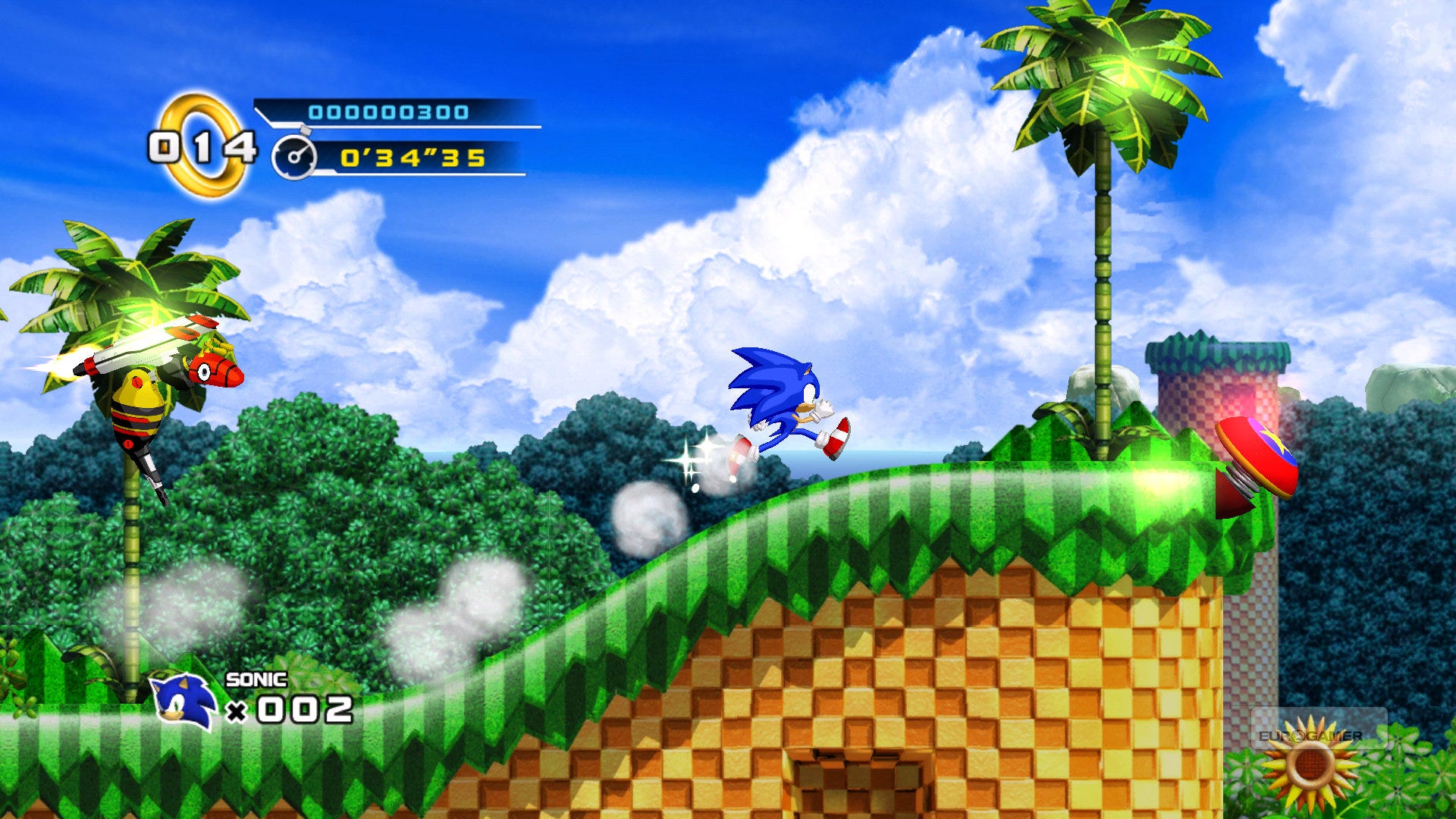
It can't be overstated how crisp Sonic 4 appears in motion. It's mesmeric.
Of course, it probably wasn't like that, and some of those experiments we dissed earlier have been quite successful. But Sonic 4 looks to be exactly what people have been asking for - a back-to-basics, pure platformer about speed, excitement and finding the perfect path.
The stages we see played, from the opening Splash Hill Zone, are classic Sonic, borrowing heavily from the Green Hills of the original. Each is a multi-level start to finish race, with different routes offering different levels of efficiency and toughness. We're told that generally taking the high road is the fastest, most dangerous option, ably demonstrated by the various finish times achieved by our SEGA demonstrator. Most levels will feature three or more basic layers, with multiple opportunities to switch track, either by accident or design according to your skills.
The Sonic hallmarks are fiercely evident in the opening stages - there are plenty of loops, bumpers, boosters and spikes, as well as the odd corkscrew section. Later, during Splash Hill Zones two and three, new mechanics are introduced through vines and zip-lines. Vines break the pace a little, forcing Sonic to swing back and forth to gain a little momentum, while zip lines are fast and direct, winging the blue blur across level sections in a straight line.
Both of these can be targeted with the new air dash move, which helpfully highlights its current target with a bold flashing reticule. These targets can also be enemies or bumpers, allowing Sonic to maintain momentum without sacrificing accuracy - vital for efficiently traversing large sections of levels.
For example, one of the areas of the second Splash Hill Zone features a large gap across some spikes, with four floating enemies above them. Bouncing across in the traditional manner is possible, but this will slow you down with each bounce. Using the targeted air dash is far quicker, and the game automatically picks out the next enemy in range for you, meaning that four stabs on the button sees Sonic slamming from one robotic critter to the next, maintaining his velocity.
It's a useful little touch, and one which focuses gameplay on slickness without detracting from the series' trademark twitch responses. Negotiating some of the trickier routes through the levels using this technique looked to be a real pleasure, allowing levels of speed which would otherwise be hampered by the reaction times of we mere mortals.
In fitting with Sonic 4's no-nonsense pantomime storyline, Dr Robotnik and the Chaos Emeralds return, blissfully bereft of cinematic exposition. Robotnik, or various hefty members of his mechanised henchforce, appear in boss battles at the end of each area, in incarnations apparently 'remixed' from the original Sonic games. We didn't actually see the eggy bounder in action, but we're promised some pleasingly refreshing takes on his old war machines.
The vine-swinging move disrupts the pace.
Chaos Emeralds must be picked up from the rotating maze levels which have always held them, accessed by finishing a stage with 50 rings or more. These are top-down affairs, with a pulsating, mandelbrotian pattern in the background. Sonic stays centre-stage, and in the PS3 version which we saw demonstrated, the maze was rotated around him using the SixAxis's motion control. Bouncing through these mazes is a matter of picking up rings on the way, with certain totals opening gates to allow progression. Right at the end sits the Chaos Emerald.
Each stage allows both score and time attack, with respective personal bests recorded to local, friend and global leaderboards. These promise some hot competition, fuelling the compulsive time-shaving which has proven such a popular backbone to games like Trials HD. In fitting with this, the restart time is extremely fast, allowing perfectionists to start runs again almost instantly should they take a non-optimal path. It should make for some satisfying sofa-based pad-passing, another old-school staple which we see so little of these days, and one certainly worth reviving.
We didn't have long with Sonic, but a little part of me has fallen in love with him all over again. Maybe it's the simplicity, or the lack of plasma rifles. Perhaps it's the incredibly infections music or the honest-to-goodness cartoon beauty of it all. I think perhaps that it's that incredible blue, a colour which seems to speak directly to the seratonin-producing areas of the hindbrain. The pervading sensation I'm left with, however, as the tinkle of rings and the whoosh of power-ups fades slowly from my consciousness, is that of being reunited with a dear old friend.
Sonic the Hedgehog 4: Episode 1 is due out for PS3, Wii and Xbox 360 this summer.
