Version tested: DS
Sonic Chronicles is interesting in many different ways, so let's tick them off. It's the first Sonic role-playing game, finally following in Mario's footsteps a mere twelve years after the plumber tackled the Legend of the Seven Stars on the SNES. Not only that, it's a Sonic RPG developed by the role-playing legends at Bioware, the company behind Baldur's Gate, Knights of the Old Republic and Mass Effect. And what's more, it marks the Canadian developers' DS debut, as they squeeze eighteen years of stat-juggling experience on PCs into the smallest console on the market.
Yes, there are many reasons to be intrigued by Sonic Chronicles, but the game itself is sadly not at the top of that list. Oh, it's nice enough - a colourful and accessible role-playing game that is never less than entertaining - but as you rocket past the finish line in a blue blur, the whole of the experience never quite adds up to the sum of its constituent parts.
Set a few years after whatever the last Sonic game to be considered an official part of the series canon was, we find our blue-hued hero summoned back into business as those bloody Chaos Emeralds have been stolen. Again. Except this time it can't be Eggman (i.e. Robotnik, here using his original Japanese name), because he's been defeated and driven into hiding. Nope, it's the work of Marauders - mysterious mechanical alien creatures who seem to harbour nefarious plans for the entire planet.
Of course, story has never been Sonic's strong point, despite what some scary obsessive fans will tell you (bonus challenge for the open-minded: Google "sonic passion"). Even so, for his first full-blown adventure game, it's a shame to see a narrative-driven company like Bioware falling back on the sort of plot that could comfortably pad out one of the hedgehog's platform outings. If you're looking for an epic yarn, you're in the wrong place. This is strictly a case of run here, grab this, go there, fight the bad guys. Drama is minimal, unless you genuinely care whether Sonic and Shadow will make friends, while any plot twists are either signposted far in advance or have already been spoiled by Sega's own pre-release revelations.
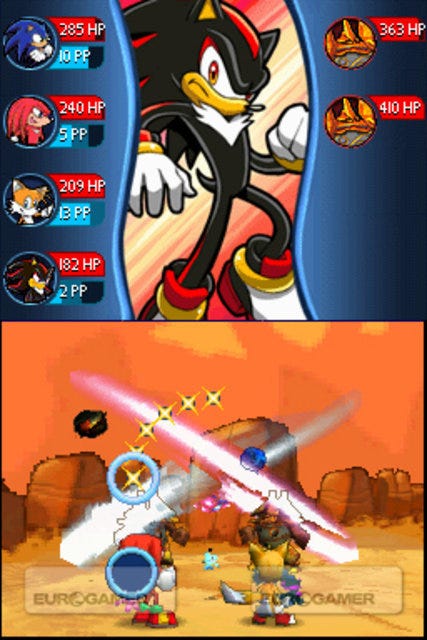
Trace the sparkly line with the stylus to access Shadow's brooding chaos-powered special moves.
Gameplay breaks down into two fairly distinct sections - exploration and combat. Exploration involves guiding your team, drawn from a steadily expanding cast of familiar Sonic characters, around a series of self-contained zones. To begin with these are based on the original games - Green Hill Zone is your starting point - but at the halfway mark the game shifts to an alternate dimension as you pursue the naughty buggers behind the Marauders to their home turf.
Control is entirely on the stylus, and you tap the screen where you want your squad (represented by the currently selected character) to go. The further the tap, the faster they'll move. But it's not quite that simple, and you'll often have to call on the specialist skills of different characters to access different areas by clicking on the icon that appears when you swap control to the correct hero. Sonic's dash can be used to zoom up and over ramps and loops, for instance. Knuckles can climb specific surfaces. Tails can fly from designated points. Some even double their skills, with Knuckles also able to smash obstacles - an ability shared with Amy. Rouge, the whorish bat, shares Tails' flight skills.
The main reason for this exploration is to find rings to spend on items, occasional chests of loot - although your characters can only equip one item at a time - and to obtain Chao eggs. There are 40 of these hidden throughout the game, and once found they're spirited away to your Chao Garden where they later hatch. One Chao can be bonded to each character to supply different status effects. Some simply add elemental damage to attacks or defence, but the more rare critters are extremely useful. They also provide the only wireless element of the game, since you can swap them with friends. This is actually the only way to level up the Chao, which seems a bit cheeky, even if the upgrades are far from essential.
Basic navigation to find these bonuses - and to simply progress the story - can prove troublesome, however. The rather lovely hand-painted scenery may look very enticing, but it's not always obvious where you can go. The flat perspective can also be misleading - sometimes you can walk behind buildings, other times their outline becomes an impassable barrier, even though you're technically behind them. It can also be incredibly frustrating to be able to be within eyesight of the place you're trying to reach, only to find that you can't actually get to it because the game has decided it's not an area you can jump, fly or climb to. It's a nice system for making you choose balanced teams, but the way it's applied in game feels ad-hoc, and as the game progresses, frustration with the fussy exploration rises.
This is largely due to the presence of respawning enemies, who patrol the map in set areas and will make a beeline for you should you cross their path as you scurry back and forth trying to find the one correct spot from which you can access essential areas. Combat is initiated upon contact, and once again, the stylus is all you need. It's all turn-based, using a system that borrows a little of its structure from Final Fantasy, its special moves from Elite Beat Agents, and its pacing from Knights of the Old Republic.
You choose your actions for each character from a standard RPG menu. It's the expected stuff with basic attacks, inventory use, special attacks or defending to recharge your Power Points, the game's equivalent to MP. Actions go into a queue, which alternates between the characters. This allows you to use one character to afflict an enemy with a status effect, and then have a different character exploit it later in the turn, even if you don't actually make the choices in that order.
Special moves require three types of stylus dexterity to pull off. Sometimes you'll need to trace a line with the stylus, keeping the nib inside a moving circle. Other times you'll have to tap on contracting circles at the right moment. Finally, you may have to tap frantically in one spot. The more effective special moves can use combinations of all three, but the movements always correspond intuitively to the move in question. Knuckles' Uppercut, for example, involves tracing an upwards curve. Amy's Low Blow is the opposite, following a downward arc. The same techniques are used to block enemy specials, and in both cases the more efficient you are at following the patterns, the more effective the attack or defence.
Rings are the game's currency, but getting to them can be more hassle than pleasure.
It's a fun system, and one that makes good use of the DS. It's also a very predictable and repetitive system, in which you'll soon master the art of delivering maximum damage while taking minimal hits yourself. Once you've memorised a few key attacks - Eggman's Bombardment, Big the Cat's Battering Ram - most encounters prove less than challenging. To put it in perspective, I didn't lose a single battle until three quarters of the way through the game, and that was only because I didn't have Cream on my team. With a few shrewd levelling choices, her healing and recharging skills essentially become infinite, making combat a recurring inconvenience rather than a thrilling fight for survival.
This low difficulty is a persistent problem, and it's the one that ultimately pulls the game down from the top tier to secondary status. Sonic Chronicles is phenomenally easy, and with a relatively short playtime for its genre and almost no chances to deviate from the linear story path, it leaves the whole feeling more than a little inconsequential. There's the occasional side mission, though these are little more than short fetch-quests, while the puzzle elements mostly involve using all four characters to activate buttons in sequence.
Sonic Chronicles is undeniably a nice-looking game, and its slick presentation makes for an enticing experience to begin with. The longer you play, however, the more the cracks start to show, and what seemed like a potential minor classic is soon reduced to just "pretty good". Sonic fans will get the most from its short-lived charms, but with so many superior RPGs on the DS, the blue hedgehog needed to provide a lot more substance to make his genre debut an essential offering.
7 / 10
