Sonic Chronicles: The Dark Brotherhood
He ain't heavy, says BioWare.

Sonic hasn't been himself lately, but SEGA will never give up. There's no need. The 20th birthday party went wrong, but SEGA Superstars Tennis wears the hedgehog proudly, Sonic and the Secret Rings sells strongly, and Mario & Sonic yoyos up and down the top ten even now - as Nintendo's DVD burners work their little lasers off just to meet demand. Sonic Unleashed - out in November - is another high-profile, high-cost multiformat outing. And why not?
Sonic Chronicles: The Dark Brotherhood is likely to do just as well. It's on the DS, which has an installed base roughly comparable to all the other consoles put together, and it's designed to make sense to everyone, targeting sub-groups in specific ways.
Almost completely stylus-controlled, it's played by tapping the touch-screen to direct Sonic and his interchangeable friends around an isometric world of familiar Green Hills and Mystic Ruins. Walking over to items of interest is as simple as it was in The Legend of Zelda: Phantom Hourglass, which reinvented the dungeon-crawling action-RPG for Nintendo last year. You can start up conversations with people, picking questions, answers and comments from a list. You can collect rings and eggs. You can even use familiar bounce-pads and send Sonic round a loop-the-loop. You can only control one character at once on this screen (as opposed to several in battle), but you can switch between them by hitting comfortably-positioned icons.
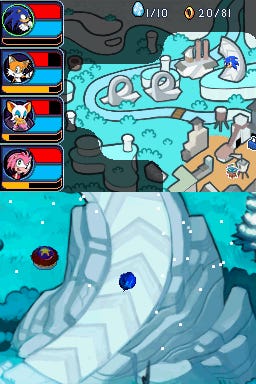
Environments are colourful, and cartoony. Sonic and his entourage, which includes Amy, Tails and Big the Cat, are small but striking cel-shaded efforts, set against homey, Disneyland painted backdrops of easy edges and unpretentious shading. Cliff-tops are tossed with carefree grass fringes, buildings and rocks are stacked and arranged simply. There's no vanity in the touch-screen graphics, and the top-screen map (greyed out where you haven't been) is a crayon approach; the stat screens that replace it in battle simple affairs in colours from blue to black.
Fighting's a bit different. Enemies roam the regular world, and give chase if they spot you, but you only engage on contact. The game then switches to another screen, where you have the choice of various battle options. Attack is a simple approach, and you can also opt to buff your defence instead, or use an item. Actions are stacked and worked through in rounds, giving you the chance to cancel rather than an immediate effect. Then there are Power Moves, which are as useful as they sound but lead to fatigue - you have a magic currency, in effect, and it dwindles. Power Moves rely on an Elite Beat Agents-inspired series of stylus taps and gestures to execute.
Sometimes your enemy flees, or you decide to make a run for it, and for this the game shifts to a side-on chase sequence, where your characters can be seen racing along. Crates and boost pads flash into their path, and you have to tap each character to vault crates and resist the impulse to tap when there's a speed boost available. With multiple characters in your party, the reaction game is tricky - the top-screen urgently tracking everyone's progress in the big chase. With success in combat, you then receive experience, which can be channelled into upgraded Power Moves: a low blow, an Amy tantrum. You also acquire loot, which can be used to improve a character's statistics.