Sins of a Solar Empire Review

Why not be a dirty sinner?

Version tested: PC

The bits where you order a fleet of a hundred or so cruisers, frigates and capital ships to line up in an epic formation at the edge of a solar system, and jump simultaneously to a neighbouring solar system? Where dozens of portals open up, and your vessels accelerate through them trailing hyperbright lights? Wicked. When you get a mob of Siege Frigates in orbit above a populated world and giggle as the planet's surface blossoms in what you have to presume to be nuclear detonations? Awesome. And when an enemy fleet appears in your solar system, and a dozen fighter and bomber wings take off, closing the distance to the incoming ships while your big boys ponderously manouevre to join in? Hell yeah!

It's worthwhile to take a little time out to be shallow, because there's going to be precious little opportunity for that as we go on. Sins of a Solar Empire - and can we take a moment to applaud the name, too? - is a space-strategy epic whose stately games stretch out as large as the canvas of space itself. With such an epic game, so rich in mechanisms and with flashes of genuine innovation, how well it puts you in the enormous metal boots of a space conquerer can be overlooked in a rush to just get the fact downs. But, take it as read, if you've ever fantasised about leading a fleet to annihilate a planet full of everyone who's ever looked at you funny, this one's for you. And probably for people with a less vengefully sociopathic streak of space-emperor fantasy too.
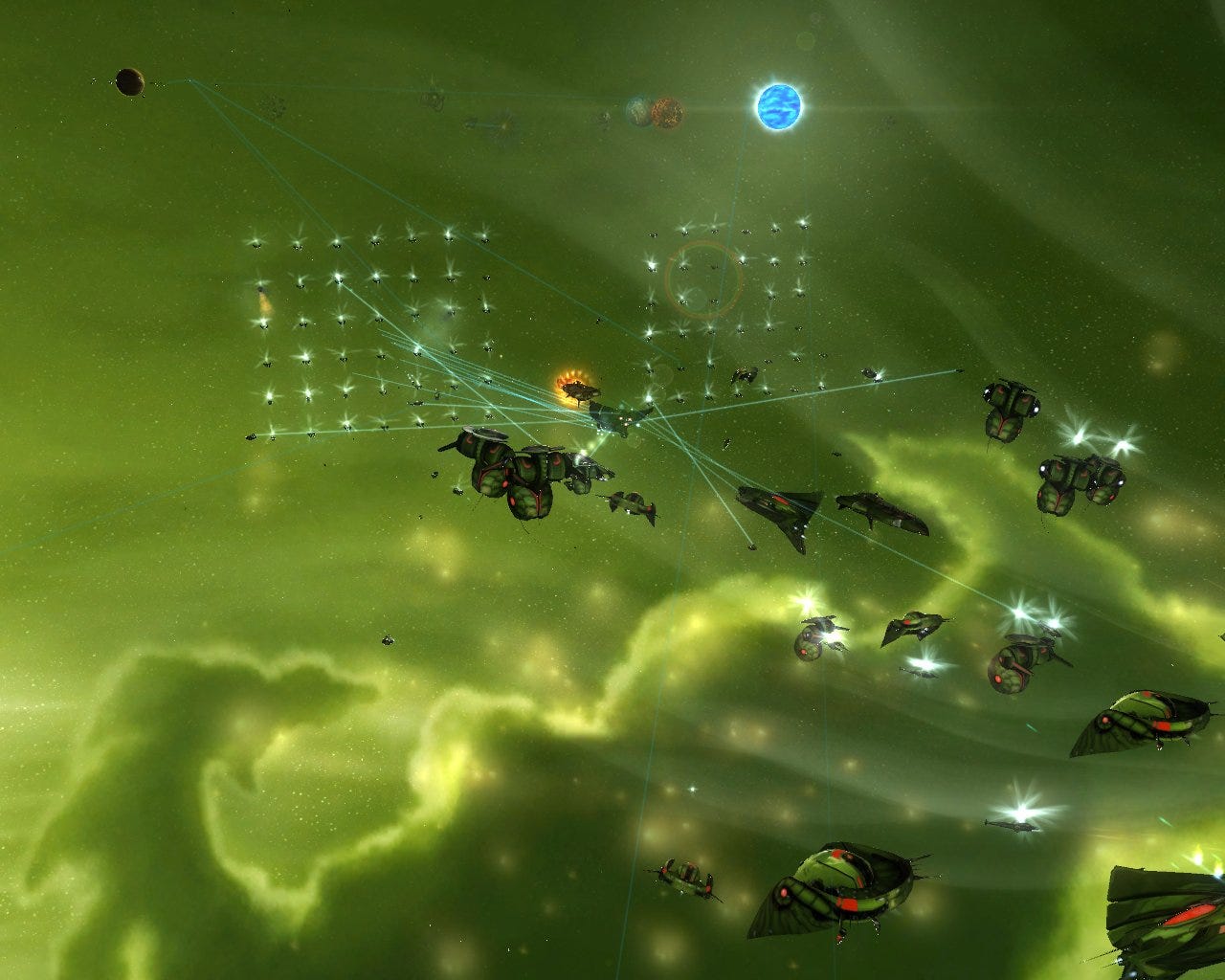
1

A fleet preparing to jump to hyperspace in a tactic I like to call 'Running Away'.

While it's from Ironclad, made up primarily of veterans of the Homeworld: Cataclysm team, the easiest way to describe Sins of a Solar Empire is to take publisher Stardock's previous game, Galactic Civilizations 2, and imagine it in real time. It's reduced, clearly, to save human brains liquidising under the strain, but there are parallels to almost everything you'd get up to in GalCiv. At the start, the map is hidden beneath a fog, forcing you to explore. Out there, you'll locate planets and asteroids, which can be colonised or otherwise exploited. Each planetary structure gives you a number of slots to fill according to your strategies, weighing up a research base against another space dock, a repair station against a fighter-base. All of these have to be researched, with separate tech-trees for military and production-style bonuses (plus another one for alien artifacts you uncover on your own planets, and another for increasing your maximum fleet size and number of capital ships). More indirect routes to conquering and control are made possible via the broadcast centres spread insidiously across the maps. Diplomacy is wrestled with, and it's possible to forge trade agreements and treaties.

So, a 4X game (Explore, Exploit, Expand, Exterminate, in some order or other), but in real time. It's a neat idea. It could work. And - phew! - it does.

The "real-time" thing may be confusing. This isn't something that moves with the pace of Command & Conquer. Even the small maps are a couple of hours' play. If you want to deal with a multi-star galaxy with ten races looking to be the winner, you're looking at the sort of commitment of time that matches many entire single-player games (or two or three Losts). You can have slower games by reducing the speed, or speed them up instead, but this is a game where the relative ponderousness of what you're controlling is absolutely the point.

More than any other real-time strategy game of recent times, it's a game where choosing when to fight becomes the key issue. Fleets take a while to get where they're going. In terms of effective fleets, you can only be in so many places at once. The AI is especially evasive, refusing to fight and commit its resources unless it's convinced it's a battle worth fighting. Where to strike, how to strike, how long to push - these are the questions it asks, married to everything you'd be worried about in a normal RTS game, like the make-up of your fleet, and which Capital ships you've purchased (the latter are basically analagous to heroes, gaining XP and abilities as they continue). It's compulsive, massive and a genuine challenge, and essential for anyone with an interest in progressive strategy games.

Reservations? The main one is the complete absence of a campaign mode - despite the ripe background material inherent in the game world, it's not actually presented to you in a string of scenarios. This isn't a problem for me, personally, but others will want a structured way into the game's intricacies. As it is, the extra effort Ironclad has put into the skirmish mode, including the random maps, makes it clear that its peers are more the Civilizations and GalCivs of this world than Company of Heroes. Hell, if you're playing on one of the huge maps, I've played RTS campaigns that could be over before a single map is fought to victory, at least before you get the hang of it.

2

I can scroll back even further, just to impress you with how big my brain is. I'm losing.

Which is my second main reservation, and a somewhat weightier one. This lengthy game works perfectly offline, but for multiplayer it's hard to find people who are willing to play a game without dropping out. A save option - which also auto-saves - means that if you want to re-arrange a continuance you can, but this is clearly more useful for friends waging solar war rather than random people on the electric internet. This is basic logistics of human time, and not really fair to critique a game over, but you should be aware of it. There's another side effect of the game's sheer length, too. Almost every RTS has as stretch where it becomes obvious who's dominant and then proceeds to crush the opposition in a tiresome slog to victory. The game's won, and you're just sweeping up. The difference is that since Sins takes longer, the sweeping-up period is proportionally longer. In multiplayer, this is actually less of a problem - players realise when they're a smear on a wall, but the AI that fights to the last can be a bit more tiresome.

It's worth noting though that this will be changed in a future patch. As with Stardock's GalCiv 2, Ironclad is impressively responsive to the desires of the fan-base. Since the release, it's already tweaked the game to make the Siege-Frigate-rush less tenable, reducing Pirate-raid frequency as well as adding the ability to speed up and slow down the game through hotkeys in single-player, so you can speed past periods that you consider too sedate.

3

LASER! LASER!

Which is nice to have but, ultimately, a minor issue. I'd have recommended the game highly with no changes from the release code whatsoever. Yes, it's a little difficult to get into, but the only really bewildering thing about Sins of the Solar Empire is why it hasn't got a European retail distributor. It's well worth the digital download. It's one of those rare strategy games that actually has its own view of how the genre should work, which is entirely separate to what the rest of the industry is considering. You can file this next to the Total War games, the Ground Control/World in Conflict lineage, Defcon, and all those other glorious individualists who are implicitly against the tank-rush rush. Not that it's anything like them which, surely, has to be the point?

Space, famously, is a really big place. Sins of the Solar Empire lets you make it yours.

9 / 10

Read the Eurogamer.net scoring policy

Comments (54)

Comments for this article are now closed, but please feel free to continue chatting on the forum!

  • Loading...hold tight!