Shogun 2: Total War Preview

Returning Japanese.

Moonlight bathes the rolling hills and forested glades, glinting off our serried rows of troops. Up ahead, a white castle gleams from the top of a steep hill, torches flickering distantly under the sloping eaves of its distinctive roof, a pale sentinel watching over the valley; our objective.

The wind whips across the battlefield, rustling trees, sweeping through the grass and carrying the distinctive red maple leaves of a Japanese autumn on its gusts. Between our troops and that castle lie our foes, ranged in their thousands to meet us.

Dimly glowing paper lanterns, carried by one man in each unit, swing in the breeze, and as we begin to push our forces forward, rain begins to fall on the battlefield. The black, lacquered armour of our troops glistens wetly under the downpour as pikemen advance steadily up the hill.

Then, from the forested glade to their right, a burst of light - a volley of flaming arrows, launched in ambush, arcs through the night sky and lands among our troops. There is an unmistakable hiss as the lethal, flaming darts find wet ground, wet armour and wet flesh, and our pikemen fall in disarray, weakened; easy prey for the cavalry who now sweep thunderously across the slick grass to finish them off, swords rising and falling in dancing curves.

"Oops," says the chap controlling the demo, rubbing his chin somewhat sheepishly, and jolting me back - momentarily - from a rain-lashed autumn night in feudal Japan to a gloriously sunny summer's day in the south of England.
1

SEGA has yet to release any screenshots for Shogun 2, but we hope to see some during E3...

It's in these unlikely environs that The Creative Assembly is returning to the scene of its first breakout hit, Shogun: Total War. In the 10 years (almost to the day) which have elapsed since Shogun appeared, the Total War series has grown upwards and outwards, embracing ever-larger conflicts spanning ever-larger geographic regions. For its next outing, however, the franchise returns to its roots, the feudal Japan of the Warring States Era.

The affection for the era pours from the game's creative leads. "It's one of my favourite periods, one of my favourite cultures," announces creative director Mike Simpson. "It's a rich mine that we didn't really have the technology to explore fully last time around."

"It's just the perfect time to set a Total War game," says the Total War franchise's lead designer, James Russell, picking up the theme with gusto. "It's the most turbulent period of Japanese history - central authority has completely broken down, so you have all these rival, powerful warlords, the daimyo, vying for control."

"Because of the breakdown of central authority, anything could happen. It's an era of completely decentralised society, where the clan and the local military power is all-important. That makes it a brilliant setting for Total War, where you rewrite your own history - because anything could have happened.

"It's also a period where you've got interesting changes happening, because you've got the first arrival of the Europeans, the introduction of very early firearms to Japanese warfare... That creates some really interesting dilemmas for the player."

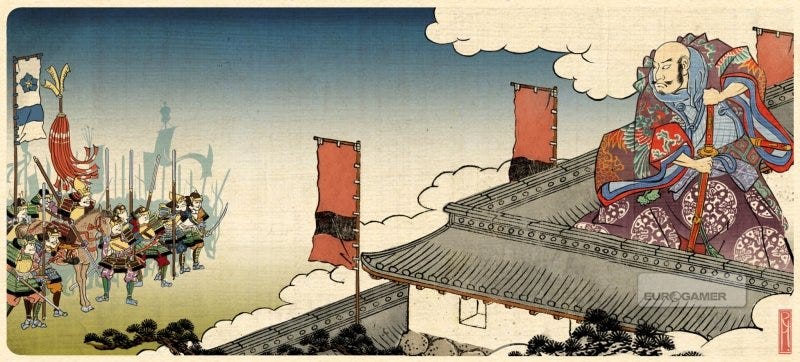
The love for the period runs deeper than effusive statements from the designers. One striking aspect of the game is the use throughout of stunning artwork in the contemporary style of medieval Japan - filling the screen with icons, menus, maps and paintings which wouldn't look out of place on a folding screen in a palace in old Kyoto. One of the team's artists, I'm told, spent a full year learning how to paint in this style.

The dedication shines through, even at this early stage - and it's a symptom of the team's other pressing reason for returning to the Sengoku Era, after its continent- and eventually globe-trotting adventures in later Total War instalments.

Homing in on Japan gives the game focus, the ability to explore the military history of a specific nation and era in extraordinary depth, rather than spreading the game across countless different nations and their different military approaches.

"We're focusing the gameplay down on a smaller landmass, but still retaining the epic scale of Total War," says Russell. "You get that sense of the vastness of Japan - it conjures up the feeling that you would have had in the medieval mind.

"We want to make the game epic, not in terms of geographic extent like in Empire and Napoleon, but in terms of gameplay depth and really drilling down to the beautiful depth you can within Japanese culture... Because we're representing one culture, we can really show it in all its glorious detail, instead of having to show lots of different cultures around the world in less depth."

2

"You're doing it wrong."

That much is apparent simply from the quality of the game's artwork and visuals. Each battlefield is a picturesque scene from an epic movie, each of the soldiers on it (56,000 is the extraordinary theoretical maximum number in any given engagement, I'm told) rendered in loving detail, right down to those rivulets of rain trickling down the lacquered plates in wet weather.

Yet in gameplay terms, too, the team is enjoying this newfound focus. The game boasts nine factions, each a historical clan of the era which starts out with its base in a single state of Japan, and which has certain unique strengths or weaknesses, as well as certain unique characters associated with it. The assortment of units, however, is much smaller than in previous Total War games - an as-yet-not-finalised number around 30 is bandied about in our conversation.

"We want every feature, every unit, to have genuine gameplay depth to it," says Russell. In a way, we want to do more with less. Obviously the Napoleonic wars had a frightening array of units, and we wanted to render that appropriately - that was part of the feel of the period, and we want to do what's appropriate for the setting. With Shogun 2, we want to make sure that every unit has a unique identity and feel, that they understand how to use it, and what its strengths and weaknesses are."

Jamie Ferguson, Shogun 2's lead designer, says that internally, the team calls this approach "the Zen of Total War" - admitting, before I can wince, that this does "sound a bit cheesy". It encompasses all of the team's goals, which he outlines briefly as "immersion, beauty, style, and doing more with less."

"So say you've got a guy like a nodashi swordsman," he explains. "He's piling through the enemy, and you can see where his strength is - which is on the offence - but at the same time you can see, just by looking at him and his fighting style, that he's very lightly armoured and doesn't wear much equipment, so as a result he's quite likely to go down in a hail of arrows. You get a really strong sense of the stone-paper-scissors for each unit."

The low unit count has also allowed the team to focus on customisation options, with each clan, and each unit, being open to a variety of player customisations. "The kind of variations which might have been different unit types in previous games end up being one unit type that you can choose a specialisation for," explains Simpson.

Meanwhile, certain territories in the campaign mode bring with them advantages for certain types of unit, ensuring that each force ends up radically different to that which another player might wield in his campaign.

Additionally, the team is introducing a variety of Hero units to the game - many of them real or semi-mythological characters from Japanese history, whose presence on the battlefield can turn the tide of war.

3

That horse needs to calm down.

Conscious of Total War's reputation for historical accuracy, however, the team isn't turning these units into total juggernauts. Each Hero will come with a group of disciples, making them into a war unit rather than an individual, and while powerful, they'll remain balanced in the game.

"On his own, against 20 units, he'll die - but he plays his part, and his presence makes the sum into more than its parts," explains Ferguson, noting that a crucial role for many heroes will be the buff they provide to troop morale by their presence.

Benkei, a legendary monk warrior who held a bridge against an entire army before dying, riddled with arrows, still standing in a defensive stance and scaring off enemy soldiers, is cited as one example of the archetypes on which Hero characters will draw.

Huge plans are afoot, too, for two other key areas of Total War's experience - naval battles, and castle sieges. The team is hugely excited about naval battles, which for the first time introduce the concept of a landscape to the engagements. Islands, peninsulas and reefs will provide texture to the battles, a strategic backdrop which allows much more planning and tactical thinking than the blank seascapes of previous games.

Additionally, Japanese ships - driven by oars rather than sails, and lacking cannons, focusing instead on archers and swordsmen for boarding - create a much more tactical form of gameplay than the swirling dogfights of 18th Century naval engagements.

Castle sieges, meanwhile, are radically changed from their European counterparts - not least due to the unique nature of Japanese castles. "In a European castle, you build walls, put a moat around it and say, right, come on, try to get over my walls," says Ferguson.

"With a Japanese castle, they look around, find a big mountain or hill with a clear view of the landscape, and chop the top off it. Then they build low walls on top of that - but what we'd regard as the castle walls are really just the sides of a mountain."

As a result, siege weapons become pointless. Instead, those inside the castle can be starved out (boring, if effective) - or, if very confident, they may actually open the castle gates and allow their attackers to enter, hoping to turn each courtyard inside into a death trap for any unwary enough to try their luck.

"The Japanese idea is to open the gates and say, come on in if you're hard enough," says Simpson. "You end up with courtyard-by-courtyard gameplay with different routes through, different traps to fall into - and for the defenders, lots of different options to choose from, too."

The game isn't due out until 2011, and although the team fidgets excitedly when I ask about multiplayer, they refuse to be drawn on their plans other than to say that it's "something very big and very cool, which we can't talk about yet because we need to make sure that it works before we go and blab about it." Wise words - take note, fellow developers.

Returning my attention to the screen, I note that a new strategy is emerging - perhaps a slightly more desperate one, in light of the corpses of our brave pikemen which now litter the muddy hillside.

The announcement trailer.

Across their bodies, the enemy's swordsmen charge, an unwavering line of thousands of samurai, swords aloft and glittering in the moonlight. Hastily organised rows of our own samurai brace themselves in a matching line, as more flaming arrows begin to arc through the sky towards us.

With a clash, the armies meet across a front almost a kilometre long. Untold dozens fall in the first moment, as striking distance is reached and blades fall - then utter confusion reigns, as the front lines fracture and samurai scrap with each other in the pouring rain.

Martial prowess on full display, the swordsmen dance around each other, flashing blades striking like steel cobras at arm's length. What seems like a disorganised melee from a distance resolves, closer to the eye, into a thousand individual duels, each seeming exquisitely choreographed in its deadliness.

It's not going well for us, though, as our foes' flaming arrows continue to do their work. Finally, the demo player reveals his trump card - an elite cavalry unit, which has circled around behind the enemy archers using the cover of a misty valley and a densely wooded hill.

Howling, they descend on the lines of archers, speed and height advantage leaving the bowmen defenceless. Stripped of their support, the enemy lines waver; moments later, our cavalry rush them from behind, slaughtering their back lines before plunging into the fray to claim more honour, more glory.

The battle is over. On the horizon, the castle looms. Beyond it, the entire Japanese archipelago awaits. The war is only beginning.

Shogun 2: Total War is due out exclusively for PC in 2011.

Comments (33)

Comments for this article are now closed, but please feel free to continue chatting on the forum!

  • Loading...hold tight!