Shin Megami Tensei: Strange Journey
Pokedemon.

Recently, a friend of mine asked me what the attraction was with RPGs, because as a devotee of Call of Duty and FIFA, all he could see was grinding drudgery. After half-heartedly conveying the usual arguments about tactical battles and general escapism and quickly deciding this was just another case of "each to their own", I got sidetracked, discussing the importance of Final Fantasy and Dragon Quest in Japan. What I didn't expect was his follow-up question: "what's the third most popular RPG series?"
Instinctively I said Pokemon, which in terms of sales figures could even be first, but straight afterwards my thoughts turned to Megami Tensei, a.k.a. MegaTen. Highly successful in Japan but not as popular in the West, this series slightly predates Final Fantasy and includes a staggering number of spin-offs, including Shin Megami Tensei, Devil Summoner, Digital Devil Saga, and Persona. A quick look at my inappropriately named "bookshelves" turns up seven English-language MegaTen games on the PlayStation 2 alone, which incidentally is the same number of incorrectly spelt Armored Core games.
Shin Megami Tensei: Strange Journey is the second MegaTen game on the DS after last year's Devil Survivor, but rather than being a tactical RPG set on an isometric 3D plane or an action-orientated RPG, Strange Journey harks back to the series' roots of first-person dungeon crawling. The story is also a substantial departure from the anime high-school shenanigans of Persona 3; rather than building relationships and attending class in between Dark Hour combat, you'll find a more mature and grittier experience in Strange Journey.
Essentially, we're in the realms of demonic science fiction, as the game begins with a team of soldiers, engineers and scientists being sent to Antarctica to investigate a strange anomaly called the "Schwarzwelt" which is gradually enveloping the surrounding area. After venturing into this purple-hued dome in hovering APCs everything quickly goes tits-up, as the four vehicles are forced to crash-land by some unknown force. The death toll then quickly racks up as the teams are attacked by demons.
The focus shifts to a nameless soldier on the Red Sprite command ship, who after mysteriously acquiring a Demon Summoning Program which allows him to see the otherwise invisible demons, quickly sets about cleaning house. What follows is an evocative traipse through eight dimensions as the military team search for a way to halt the impeding Earth invasion and ultimately return home.
The plot is fairly text-heavy, with static cut-scenes. The localisation from the original Japanese text has been handled well; the narrative isn't particularly original but is nonetheless absorbing.
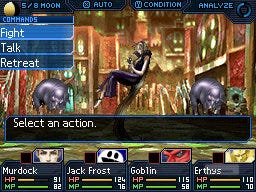
But everything in Strange Journey plays second fiddle to the combat system. On the face of it, this is an easy-to-understand, turn-based set-up where the player fights against different types of demons by selecting various attacks and buffs from an immediately familiar menu system. But Atlus mixes up this classic formula with the fusion and summoning systems.
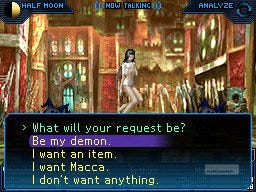
In battle, the player takes control of the human protagonist who, in addition to summoning a party of three demons, can go toe-to-toe with the demonic ranks thanks to his Demonica combat suit. However, getting a demon onto your team isn't a simple case of hurling an endless barrage of brightly coloured balls. Instead, you have to strike a bargain through diplomacy. So by selecting the Talk option the player will stop fighting and start conversing with the demon through two multiple choice questions, and if the demon likes your answers, things will progress to negotiations.
The key to the system lies in the fact that each demon has two inherent alignments: light, neutral or dark, and law, neutral or chaos. So if you're chatting up a demon with a light/law alignment it may be best to describe the Demonica suit as a research tool, whereas a dark/neutral may prefer a more combat-orientated answer. Your own alignment, which starts off as neutral but adjusts to reflect your in-game actions, also has an impact on which type of demons will talk to you, and although the system can sometimes feel hit-and-miss, it nonetheless injects personality into each confrontation.
Despite being less numerous than Nintendo's barrage of Pocket Monsters - whose tally now runs to 495 cutesy creations - MegaTen's back catalogue of otherworldly inhabitants is arguably more diverse and more evocative. With around 318 entries in the demonic Pokedex, Strange Journey has an impressive headcount including classics like the phallic Mara and Misaguji in addition to new creations like Grendel and Manticore. Every demon is also categorised into one of 44 different species. The sources of inspiration for these demons are also incredibly varied, and include everything from Shinto, Christian, Buddhist and Hindu deities, to entities from Greek, Egyptian, Norse, Balinese, Aztec, Babylonian, Canaanite and even Shakespearean mythology.