Shin Megami Tensei: Devil Summoner
Devil may cry.

Wait! Before you scroll semi-interestedly to the conclusion, check the score and alt-tab away (leaving us feeling yet more numerically exploited), hear this: Devil Summoner is best described as Phoenix Wright meets Pokémon meets The Exorcist . You might just like it.
Reviewing the latest game in the Shin Megami Tensei series poses an immediate problem. The off-putting, impenetrable Japanese title, the off-putting paranormal-based scenario and the off-putting kind of fans who surround and obsess over such grimy, otaku-ish RPGs, mean most readers are unlikely to stay past the first sentence in any critical rub-down. They'll need some introductory comforting videogamey point of reference to pique interest - preferably one beloved for its inherent and enduring merit rather than any LOL Japanese-ness.
Conversely, any such cheap referencing will likely irritate those few long-standing fans who'll claim it's misleading and ill-representative of their beloved series. Such geekier-than-thou readers, to be honest, probably don't really want you near the game anyway as the niche is all the charm.
But that's all a bit silly as Shin Megami Tensei: Devil Summoner Raidou Kuzunoha vs. The Soulless Army, Atlus' most tortuously-titled spy-detective-ghost-collector RPG, is neither off-putting nor cliquey in its enjoyable execution. It shares similarities with both orthodox RPGs and videogames' more avant-garde interactive thrillers while, in its unique mixing of genre and premise, managing to create a mostly inimitable atmosphere and experience.
Indeed, never underestimate the power of an interesting scenario. To look at Devil Summoner is hopelessly ropey, employing the kinds of static CGI backgrounds and overlaid polygonal characters not seen since early PSOne games such as Resident Evil and Parasite Eve. Its throw-back, formative 3D-guise presents character models which are chunky and inelegant, floating ghoulishly along pavements as they go about their daily urban routines. In cut scenes, characters lift blob-like hands to stroke awkwardly angled chins before misfiring animations to add to the consistently dated aesthetic.
But despite the budget-restrained execution of the visual ideas, those ideas themselves are brilliant, setting artist Kazuma Kaneko's distinctive designs against an immensely evocative and atmospheric backdrop. This is achieved by skilfully combining the setting of an early industrialisation Taishou Period Japan city - think a Nipponese Jack Nicholson Chinatown - with a traditional and strict Japanese social framework brimming with ghost stories. It's a potent mixture that feels very fresh to the action RPG genre - something greatly aided by the interesting and diverse gameplay.
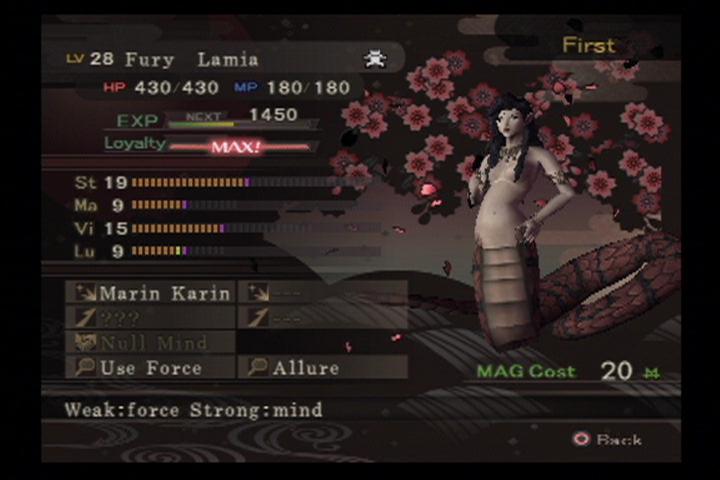
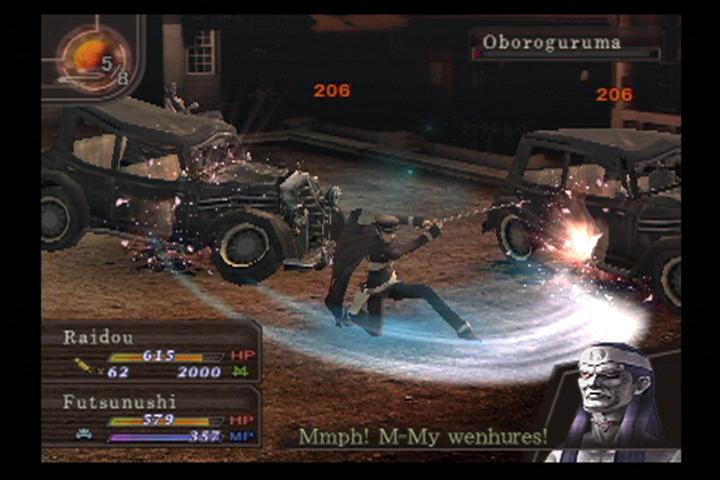
Nevertheless, the premise is ridiculous. You play as a young teenager Raidou Kuzunoha. The game opens with Raidou, stood alone by some remote underground shrine being coached by glowing spirits in the Pokémon-esque demon summoning technique that forms the basis of combat. These lessons teach the player how to fight enemies (in real-time within a confined battle area) using Radiou's gun and katana strikes, as well as how to capture enemies (by stunning them and playing a five second button-mashing mini-game in order to confine them to a test-tube). Much of the game's appeal is in collecting the various weird and wonderful demons ,and right from the off it's clear that this is a solid and enjoyable mechanic.
Once captured your new ethereal pets can be summoned into battle and used against their ex-brethren. One captured demon at a time can be summoned into battle, and each has a range of offensive and defensive abilities to back you up. You can assign direct commands to the demon or, more usually, let it handle itself. Demons each have their own elemental affinity and so picking the right ally to go up against the right enemy is crucial. Both Raidou and his demon gain experience at the end of battles and, by using a demon regularly, you can build up its loyalty.
Radiou has been given the task of watching over both the physical and spiritual dimension of Japan's capital city, and, the training complete, he begins work as a sleuth in a private detective agency. His office, headed by the feet-on-the-desk-so-don't-play-by-the-rules Detective Narumi, is very Sam and Max and, indeed, the game quickly slips unexpectedly into a case-solving detective caper. This adventure game-style gameplay is then punctuated by the more customary random battles and levelling of the game's RPG DNA. Radiou travels around town with his talking cat, Gouto (who reminds us of Kiki's Delivery Service's Jiji) and his entourage of pet demons searching for clues and following up on leads.
Your demons, while crucial to winning battles, can also be summoned into the field where they'll follow you around as you explore the city - invisible to those around you. Each demon has its own special ability when out and about - for example, one can mind read interviewees while another can calm people down using a 'chill out' command or even pass through spiritual gates. Often you'll need a specific demon's ability to progress and, when you're missing the required demon, your cat Gouto will let you know which one you need and whereabouts to find and capture them. This requirement has meant the developer has ramped the number of random battles right up - after all, it's only in random battles that you can find what you need to progress - and this will put some players off - although the fights are fun and interesting so, for us, it wasn't a chore.
The game begins with a faltering narrative pace - conversations are sparse and the translation a little awkward in its heavy-handed reworking of Japanese colloquialisms and regional idiosyncrasies ('we really screwed the pooch this time' - ?!). But after a few hours its more understated brand of Disgaea-lite humour begins to show as you carry out ridiculous sub-quests (fetch the big demon blocking your path a bottle of fine red wine or you can't get past) and the game's characters warm into their roles.
Indeed, Devil Summoner boasts and excellent story, broken neatly into 12 chapters (although these vary in length and breadth dramatically) and the promise of finding new team members on every street keeps pushing you onwards. It's a brilliantly pitched game that, while will inevitably turn many players off either by its reliance on random battles or by the generally low technical standard, is far more accessible than it sounds in synopsis.