Section 8

Burning in the multiplayer.

Hands up if you've seen much of the old military hospital comedy, M*A*S*H. You're probably around my age. Being as old as we are has its disadvantages. Forgetfulness and incontinence, for two - and it's terrible walking around having forgotten you've wet yourself - but we're slightly more likely to get the reference behind Section 8's bland title. One of M*A*S*H's long-standing characters was Corporal Maxwell Klinger. This hairy gentleman would constantly try to get discharged from the US Army under Section 8 - a provision which allowed mentally ill soldiers to be sent home. He'd demonstrate his insanity, mainly, by wearing a dress. Anyone in their thirties might be crushingly disappointed this isn't the world's first commercial cross-dressing shooter.

Far from it. The stars of Timegate's new multiplayer space-marine shooter are as generically butch as we all expect, demand, and roll our big jaded eyeballs at. They've earned the nickname Section 8 because they're volunteers. They risk their lives in suicidal spearhead assaults, and it's not for the cash. They do it because they love killing stuff, and they love the pioneering suits they get to wear. So it is about the dressing up - there are just fewer Laura Ashley prints. Their dressing-up box contains power armour that can withstand a 15,000-foot drop directly into the battlefield, taking flak from AA cannons as they arrive.

Timegate is taking the same approach with Section 8 that it did with its 2001 strategy game, Kohan. Their mission then was to take everything the developers didn't like out of the strategy games they'd obsessed over - the games that made them decide to get into development in the first place. The result was fairly excellent, amongst the first strategy games to reduce micromanagement and let you deal effectively with squads. Unfortunately, it was set in a slightly unspectacular universe. As good as it was, Kohan isn't really a game that jostles to the front of any pub conversations.
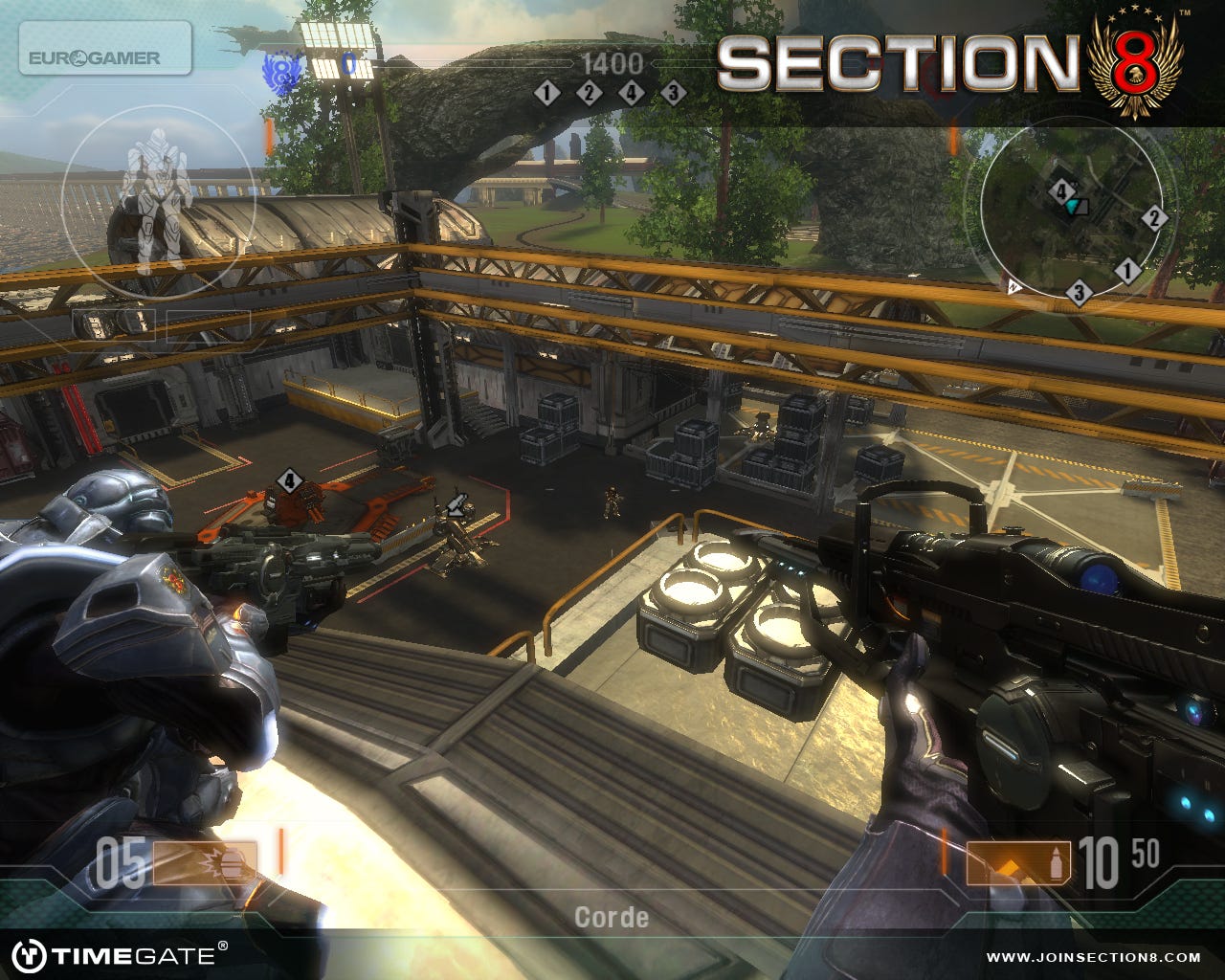
'Section 8' Screenshot 1

Remember how the teachers used to say "Kicking is for donkeys"? You're still a donkey.

So, Section 8 draws rich and unembarrassed inspiration from the games Timegate staffers now play in their spare time - the menu presentation of Battlefield 2142, the character hardiness of Unreal Tournament 3, the jet-pack surfing of Tribes - and they've attempted to tweak away the things that obstruct that quick, pure, multiplayer fun. This approach may leave them with something equally forgettable - a smoothed-out experience with too many inspirations to truly stick in the mind. But the hours we played showed it to be an accessible, familiar shooter with enough depth and variety of play to make it well worth following, even if it's with one suspicious, squinted eye.

The storyline, such as we're exposed to, is one of an expanding human race. With factions scattered across the galaxy, the aggressive and roguish Arm of Orion are creating problems for the official federation that you serve. So, you're being launched across space to kill them until you get enough points to declare victory. It's not something you're particularly inspired to believe in, and it's not even clear who the bad guys are - but that's the way it's been since World War II, so fair dos to Timegate for avoiding the good-versus-evil route. With character design good-looking, but hardly unique, the maps are more impressive.

"We want something on every level that people can easily identify it by," says Brett Norton, Section 8's turbo-talking and impossible-to-transcribe lead designer. The map we're looking at is bordered on side by the sea, and another by a huge wall of a dam. A pipeline connects this map to another, visible in the distance. You can't travel between them, but it's a thoughtful touch, to have one map visible from the next - like you're fighting on a planet, rather than squabbling on an isolated map.

'Section 8' Screenshot 2

Capturing things involves standing around looking mean. And occasionally being mean to people who disagree with what you're doing.

The tactical layout of a given map is familiar - numbered capture points defining the strategic areas where the conflict will naturally focus. But there're no red and blue bases in Section 8's multiplayer. The map starts off entirely neutral, and from your overview you can choose to "burn-in" anywhere. Burning In is one of Section 8's stronger selling points - it's a visually impressive aspect with good implications for gameplay. It's an attempt to move towards a more fluid battle, and to randomise the first stages in a way that'll make each game unpredictable.

So, the best tactic is to respond to the enemy, rather than camp out the same old sniping spot. That said, the opportunities to drop on a high area (inaccessible by foot or jet-pack) and snipe the oblivious lowlanders are definitely there, and a couple of times I was left with that hollow, helpless feeling that comes from being picked off by someone who gets their spunk out by staying still for the entire game. Timegate considered adding a killcam, showing you the location of your killer. But as you'll be choosing where on the map to burn in again within five seconds, they decided it'd cause too many instant revenges.

Once the battle's under way, the map starts taking shape. The next time you burn in, you'll notice red areas you can't drop safely into. This is slightly confusing for the red team, given that the red team has to consider red areas hostile, and blue icons friendly. That's part of the reason that the armour colour-coding has been toned down to dirty metallic shades, rather than the bold primaries of the earlier concepts. Anyway, red areas on the tactical burn-in map are those covered by enemy anti-aircraft guns, which are either earned by capturing bases, or built - anywhere on the map - using the requisition points that accumulate over the course of the battle.

So, your options become less open, your tactics less direct. You can get a squad member to infiltrate and hack the terminal. It takes a long time to capture, but not so long to briefly disable the AA guns. Or you could burn in an entire squad, suck up the casualties, and have the survivors overwhelm the defences. The trickle of points from capturing that station will soon recover those the other team gained for your deaths. Alternatively, you can hit your air brakes, and glide into range as you get under the guns. The automatic gun may hit you less hard, but anyone hearing you scream into the atmosphere might just look up and shoot off your feet. This happened once, during our playtest

Another way Section 8 tries to avoid the usual map hot-spots - not to mention another one of the team's pet peeves, which is team-killing in order to get in the driving seat of the best vehicle - is to let you deploy your own vehicles, heavy armour suits, and turrets. As you accumulate a personal stock of requisition points, you can spend them on fortifications, healing supply depots, and sensor arrays that place the enemy on your map. They're considering the option of sharing your points to buy some of the larger items - the four-man tank, for example - but nothing's firm, yet.

Obviously, it's not random - the map design creates sensible tactical areas for turrets and sensor arrays, but the hope is that there's enough possibilities for it to be unpredictable. The beauty of the multiplayer is that from the lie of the land and the buildings, everything is decided by the players.

'Section 8' Screenshot 3

Dropships in videogames always make me want to watch Aliens. Which is why I've seen it 48,000 times.

The combat itself is strong, with traditional weaponry. Both sides are human, so there's no alien technology; no pulses, energy blasts, or meganova polyshots - it's assault rifles, pistols, shotguns and sniper rifles for both sides. The suits - identical in all but cosmetic design for both sides, same as the guns - that can absorb a good amount of damage. Two soldiers squaring off against each other will have a good few seconds to strafe, exchange salvos and retreat. And the visual feedback of the armour disintegration means that even if he gets away, you at least be able to teabag his pauldrons.

Another aspect of the game that adds to the battle - but urgently needs a name-change - is the Dynamic Combat Missions. These objectives, apart from sounding like they were named by a committee of civil servants, can be triggered during a game. Triggered by a team, they act like a slap-in-the-tits challenge. Triggering an assassination mission will warn the other team of an escort mission beginning; a base-capture mission will warn your opponents to defend their capture point. To make it more interesting - and to take into account the fact that the other team might have to pull out of whatever battle they're fighting at the time to answer your challenge - if the DCM fails, the responding team will gain a slightly more generous reward. So it'll pay to pick your battles wisely.

Over the course of a battle, teams earn requisition points by killing the enemy, capturing points, and completing DCMs. These can be spent on deployables that I've already mentioned - turrets, sensor arrays, heavy armour suits - and the eventually four-man tanks, giving both teams a chance to acquire stronger weapons, and bend the map into one whose layout favours them. The issues of balance are, of course, immense - but they've done a few RTS games, they're used to those.

'Section 8' Screenshot 4

Shoot out the floodlights - perhaps they'll postpone.

There's not much on parade from the single-player campaign at this time - certainly nothing playable - but there will be a story-led campaign, detailing the extended story behind the battles between the Arm of Orion and the Section 8 soldiers. You'll also be able to take part in the multiplayer maps on your own, with both sides fleshed out by AI. In any other game, that'd be a slightly depressing prospect, but with all the different ways a battle can play out, a gifted AI could make this a decent experience.

What hints there were at a single-player storyline - a soldier's flashbacks to childhood, immediately pre-battle - were lost, as soon as the helmet visor came down, and the first knife was slid into a face. But Section 8 doesn't feel like it needs a story. It's a big, honest, unspectacular premise with enough interesting elements and beefy gunwallops to make it worth keeping an eye on. As long as the whole thing isn't rendered invisible by the ignorable title, and the generic space-face marines.

Section 8 is due for release later in 2009.

Comments (19) Latest comment 3 years ago

Comments threads automatically close after 30 days, but please feel free to continue chatting on the forum!