Scribblenauts Preview
Word up.
One of the most dependable joys of writing about videogames is hearing the implausible claims made by developers regarding their latest titles: "hundreds of separate light sources", "the frame rate will be locked at 1600fps", "it's basically interactive storytelling", "this time, you'll really care about Falco Lombardi". But Scribblenauts tops them all. This mild-mannered DS game has a premise so staggeringly unlikely that when you first hear it you may find yourself trilling with dainty laughter at the very thought of somebody trying to pull it off. "Yeah," sighs lead designer Matt Cox, the very somebody in question. "We tend to get that reaction a lot."
The premise is this: Scribblenauts is a platforming puzzle game, in which Maxwell, a chirpy cartoon boy who appears to have had a be-quiffed television set jammed over his head, has to collect Starites by completing a variety of challenges - dislodging one from a high tree, for example, or winning one as an award for helping an old man pass an eye test. "WarioWare is the best analogy for the way the game plays," says Cox. "It's different kinds of situations, one after the other, with a wide range of challenges." And the implausible bit? To beat each level, the player summons objects to help Maxwell, by writing their name on the bottom screen.
Yes: any object.
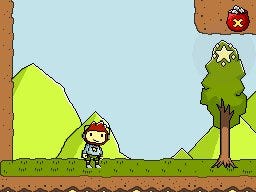
Scribblenauts' graphics are a mixture of 2D backdrops and 3D models - a little like New Super Mario Bros.
Well, any object within reason. Proper nouns and anything grotty have been ruled out, but these are just about the only limits to what you can conjure up. The game's trailer, which features that Starite stuck in a tree, offers three different examples of the system at work. In the first, a ladder is summoned, and Maxwell simply climbs it to get his prize. In the second version, he calls up a football, and kicks it to dislodge the Starite. The final playthrough sees him conjuring up a beaver to gnaw through the trunk. Presumably, you could also blow the tree to pieces with nuclear weapons, ram into it with a New York City taxi cab, or even dislodge it with a passing swoop of a Sopwith Camel.
As the beaver example suggests, everything summoned into the world will act appropriately. "A lion behaves like a lion, and a frying pan behaves like a frying pan," says Cox. "It's all realistic, and it has to be: it's not like you write 'oven' and you get a magic oven that you can fly around on." There's another dream of ours cruelly dashed.
Unlikely as all this seems, 5th Cell, the developer of Scribblenauts, does actually have previous form with this kind of game. Drawn to Life, its breakout DS title, featured a similar user-generated premise, albeit one a lot more contained, as players sketched in their own artwork for the game's main character and much of the environment, before embarking on a simple platforming quest.
But Scribblenauts is a lot more ambitious, and the team has spent much of the last year trying to make the concept work. That's no easy task, since every word in the game's dictionary not only needs a corresponding graphic, but a set of believable attributes and behaviours as well.
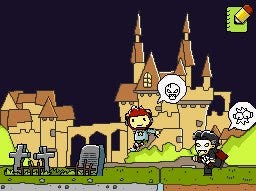
5th Cell has taken the unusual step of developing the game without a publisher attached, so that they could have complete control over the direction it takes.
To help them with this frankly insane task, the developers have created a database called Objectnaut. "The way it works is we've started with the qualities rather than the objects," explains Cox. "We've started with categories and sub-categories, like flammable, electrical, heavy, organic, and then we place each object within this framework. That means an object already inherits loads of qualities as soon as it's put into the system: we don't have to say fire would burn this wooden ladder or this boat. We simply say fire would burn everything that's flammable, and anything made of wood will already be marked up in the database as flammable. And when someone slots in a bird, we know from the start that it's organic and it flies, and it has AI properties and that sort of stuff, right from the word go. We don't have to go through thousands of objects one by one, assigning properties." So with Objectnaut in place, it's just a case of filling up the database. With every single object players are likely to think of. Simple.
So that's what 5th Cell is doing right now, with a team of around twenty people. "We're all going through dictionaries," says creative director Jeremiah Slaczka. "We have people coming up with the words, people coming up with the art, people coming up with the database entries." And, crucially, how big will the finished database be? Slaczka laughs. "If you can write it, it will be in the game."
"It's hard to give people a sense of the scope of the game," admits Cox. "And people are sceptical: they think we'll use the same assets for lion and tiger and leopard, say, but we won't. We've got different art and different properties for all of those. People are going to be genuinely surprised by how deep the dictionary goes."
It feels like a trick of some sort, particularly given how confident the team seems, but 5th Cell assures us they're not procedurally generating content - how could they be? - or outsourcing the whole process to some slave labour camp in China, where orphans spend their day leafing through encyclopaedias and dictionaries, suffering paper cuts and early-onset tendonitis for a dollar a day.
However they're doing it, it seems to be working. As a test, we ask if Scribblenauts' dictionary has something as obscure as a chafing dish in it - as you'll know from Hot Shots, that's a traditional serving piece used at brunches to keep food warm. Within minutes, Cox has emailed us a screenshot of it. "The chafing dish has been in for a long time," he laughs. "We're into the specialist area right now - if you're a palaeontologist and you know some ridiculously obscure kind of dinosaur, that's what we're putting in at the moment, as we've done all the main ones."

Handwriting recognition is crucial to the success of the game - the developer is currently working on its own system.
Of course, even if the dictionary is as good as 5th Cell says it is - and the developers are winningly confident on this front - won't the game be a nightmare to balance? How do you create challenges in which the player can respond by doing absolutely anything at all? Rather than fearing such an eventuality, Slaczka seems to actually relish it. "We're well aware that people will be able to do things we hadn't even thought of. Just the other day, in the tree level, somebody wrote 'anvil', which doesn't seem like much help. But then they wrote 'glue', and stuck the glue to the anvil, and then stuck the anvil to the Starite, and it pulled it down out of the tree. I would've never thought to do that before, and we didn't program it, but because the objects all have physical qualities that make sense, the game can decide whether a solution's going to work. The system works by itself, and we don't have to worry about it."
With two different types of challenge available - simple casual scenarios with a single goal, and then more involved hardcore puzzles which feature enemies, platforming, and larger maps - Scribblenauts should provide plenty of thoughtful distraction to go along with its astonishing premise. "You'll have to contain things, escape from things, maybe cook things, and that sort of stuff," says Cox. "The fun of the game lies in interaction: spawning a bicycle and riding around on it is cool, but then you put a ramp up, and then put a rocket on it. That's cooler."

One of the unexpected side effects of Scribblenauts may be a spike in teenage literacy - and the frequency of rocket-powered bicycle experiments.
But there's no point hiding the fact that as much as Scribblenauts is a game about increasingly complex puzzles, it's also about the eternal simplicity of magic: of coming up with the most obscure object imaginable, and seeing if it's actually lodged somewhere inside that tiny game card - and then, of course, seeing how it behaves when you shove a rocket onto it. That's the player's real long-term challenge, perhaps: reverse-engineering 5th Cell's database, and sounding out the limitations of the system, trying to find that elusive something the developers didn't expect you to think of. And if that sounds like your kind of thing, you can start by crossing beavers, footballs, ladders, chafing dishes, and all the more obscure dinosaurs off your list already. Cox and Slaczka already have them covered.
Scribblenauts is due out for the DS in autumn 2009.
You may also like...
-
Why Devs Owe You Nothing
-
Digital Foundry: PS3 Skyrim Lag Fixed?
-
Face-Off: The Darkness 2
-
App of the Day: Sir Benfro's Brilliant Balloon
-
Sony admits "dropping the ball" with Demon's Souls
-
Ultimate Marvel vs. Capcom 3 Vita Review
-
CD Projekt: Witcher 2 intro cinematic "the most expensive asset we ever created"
-
Who Killed Rare?
-
One Piece: Unlimited Cruise SP Review
-
Grand Slam Tennis 2 Review
-
Kingdoms of Amalur: Reckoning Review
-
Skyrim patch 1.4 performance tip: make a new manual save
-
Gotham City Impostors Review
-
Mass Effect 3 FemShep trailer debuts
-
The Darkness 2 Review
-
Valve admits hackers accessed Steam transaction log
-
Epic's Sweeney on graphics tech: "the limit really is in sight"
-
Double Fine Adventure passes Day of the Tentacle budget
-
Skyrim patch 1.4 now live for Xbox 360
-
Next Xbox has tablet-like touch-screen controller - rumour
-
App of the Day: Superman
-
Sony: The Last Guardian is making "slow progress"
-
EA announces starry Syndicate voice cast
-
King Arthur 2 Review
-
Blizzard legally opposes Valve's Dota trademark application


Comments (50) Latest comment 3 years ago
Comments threads automatically close after 30 days, but please feel free to continue chatting on the forum!
Comment below viewing threshold Show
Brilliant concept and brave execution, hope it turns out well for everyone.
Comment below viewing threshold Show
It just seems great but ludicrous at the same time.
I will be buying a copy though
Comment below viewing threshold Show
Colour me interested, even if it isn't invoking Penny Crayon Magic.
Comment below viewing threshold Show
Why is it so far away??
Comment below viewing threshold Show
pfft. if i can't play every level using penises and penises alone, whats the point?
Comment below viewing threshold Show
Nouns only, no adjectives
Comment below viewing threshold Show
It's black magic I tell you.
Comment below viewing threshold Show
well since its touch screen you can play it with your own penis
Comment below viewing threshold Show
I would have missed out on a lot if I wouldn't have picked up my cousins one out of boredom. Now I'm loving it.
Comment below viewing threshold Show
The game is already programmed to know how those properties work, so as long as it has been given enough of the right kind of properties, it should act like an elephant. So all that's left to do is for the artists to make the sprite. In order to save on assets, they are animated using a ragdoll style 3d thing, and there you have it, instant elephant - it's just a collection of properties with a graphic and some basic animation. As you can see the art style is sketchy so it doesn't take long to make the art for the game, so I can imagine that they can knock out dozens of these objects a day while still maintaining quality. Maybe more. They've been working for it for some time, and they have most of the year left, so I can see how they'll manage it.
The test won't be how many objects they can include - that's not so hard, just time consuming because of sheer numbers needed. The real test will be how well these various properties work, and the early signs look good.
Comment below viewing threshold Show
First, while the object itself doesn't change between languages, the terms will. For example, the English "nut" means two things (and more, yeah, but let's stick to non-grotty). In every other language, there are multiple words for this. Now how are you going to differentiate? Also consider the opposite case: The German "Schloss" can mean "castle" or "lock". What now?
Second, Many languages have a larger or (in most cases) smaller vocabulary than English. You cannot simply re-map the existing database entries to other languages without re-assessing the elements' importance to the game. Stuff would likely need to be dropped from the game, and the developer would need to choose exactly which items to keep.
Third, and most crucial: If I'm not totally wrong, the developers have stated that another rule would be "only one word", i.e. you couldn't write "fuzzy apple" or something, which would render this already difficult task all but impossible.
Now remember two things: First, many languages rely on determinators in order to express English concepts, like the Italian "mazza" (club) and "mazza da tennis" (racket). This is really the only clear way of saying "racket" in Italian, but completely gets shot down by the one-word rule.
The other thing is that speakers of the teutonic language have basically every freedom they want to actually amalgamize words into new ones. Example? Videospieletestermonatsgehalt. Created on the spot, perfectly understandable and 0 google hits.
In my opinion, the only way to localize this would be to re-develop it from scratch in each language. Oh, and not release it in Germany.
Comment below viewing threshold Show
I don't know. Nintendo is supposed to be the one with all the innovative games, but I'm seeing Sony come up with a lot of innovative titles for a while now too. Patapon, Locoroco, Eye of Judgement, LittleBigPlanet.. I was kind of annoyed for a while that I got a DS, and then saw all the quirky, innovative thinking-outside-the-box games come out for the PSP while the DS games didn't seem to get any further than "You have to blow in the speaker!!!"
Comment below viewing threshold Show
You're totally wrong. They haven't said you can only write one word, they've said you can only write nouns. In your example, fuzzy is not a noun and therefore isn't allowed, no problem with that.
As for "nut" having a few meanings, I'm sure there's a simple enough solution to that, involving choosing which type of nut you want on the touchscreen before it appears up top.
As far as localisation goes, I'd be more interested to see if it's localised to proper English, to be honest. Are we going to be stuck with "check" for "cheque" etc.
Comment below viewing threshold Show
Maybe I'm really blind, but I don't see anything 3D in this game. Maybe you're confused by the characters made up of rotating sprites?
Comment below viewing threshold Show
That's what I said, only nouns are allowed, as in, no adjectives. That's not even remotely the same as "only one word." Straight off the top of my head, Tyrannosaurus Rex, I imagine, will work.
Nikanoru:
Sprites would take up waaaay too much memory, so all the things are made in 3D, but to look 2D.
Comment below viewing threshold Show
In my opinion, the only way to localize this would be to re-develop it from scratch in each language. Oh, and not release it in Germany.
But every German will easily be able to differntiate between a basic noun and a composite noun. We're talking about "elephant", "ladder", "bottle" here. I have a hard time coming up with an idea of a composite noun where the basic noun that would work isn't immediately apparent.
First, while the object itself doesn't change between languages, the terms will. For example, the English "nut" means two things (and more, yeah, but let's stick to non-grotty). In every other language, there are multiple words for this. Now how are you going to differentiate? Also consider the opposite case: The German "Schloss" can mean "castle" or "lock". What now?
Just ask the player what he meant? If you type "mouse", the game could ask you whether you mean the animal, or the computer device. The game could also simpy show you the different objects, and you pick the one you meant.And this could certainly be automated - after the word-for-word translation of the dictionary, the game (or the devs/localisation team) just looks for double entries with different meanings, and link it with a query of the game. So in your "Schloss" example, they will find after the translation that they translated "lock" and "castle" with the same German word - problem pretty much solved. I really don't see the problem.
Comment below viewing threshold Show
Where did you pull that "fact" from? Look at the video. Those are characters made up of a bunch of rotating sprites.
Comment below viewing threshold Show
"Infinite Polygon Engine"
Comment below viewing threshold Show
Just look at it, there is no 3D movement, it even shows the typical texture artifacts you get when you rotate a flat image on the DS.
Comment below viewing threshold Show
I was going to find you the quote, but then you made that absolutely absurd analogy, and now I'm not going to. I don't think I need to explain why it's so stupid, do I? Go to the back of the class.
The quote's on IGN, find it yourself.
Comment below viewing threshold Show
So I started looking up the quote and I KNEW it was gonna be something people would misinterpret. And surely, what do I find:
"Our art style is very minimal, and we did that on purpose just because of the nature of the game, and all the animation is 3D. It's still a 2D game of course, but they're all basically "doll" animations, so that made things a lot easier."
Do you know what he means by "doll" animations? That's right, a bunch of rotated 2D drawn sprites for limbs, like I said. It's just so immediately obvious. It's the same thing they use in Aquaria and other games.
It's only "3D" if you count anything that's a texture mapped to a quad as such (apparently he does), but then there would be countless so called 2D classics that you would suddenly have to classify as 3D. For instance, every single 2D game ever made for the PSX (that's right, Alundra was all polygons underneath).
So humour me, why was my analogy stupid?
Comment below viewing threshold Show