Rune Factory Frontier
Agricultural revolution.

Rune Factory is a deceptive little bugger. It's a Harvest Moon spin-off, and to the casual observer it must resemble a pretty little farming game with a bit of colourful monster-bashing, which means it frightens away most of the audience who would really appreciate it before they even get it off the shelf. By flashing its schmaltzy anime portraiture and pastoral plumage, Rune Factory disguises a hugely complex and extensive RPG, which just happens to orbit the binary stars of market gardening and playboy romance.
You're probably dimly familiar with legume propagation sim Harvest Moon already. Rune Factory's main departure from that series is the addition of dungeon-crawling, rendered in the same cheerfully Arcadian style as the events in town, but adding another huge layer of potential complexity to the already bewildering crop-farming and local-girl-schmoozing.
It starts just like every single other Harvest Moon or Rune Factory basically does, with a sweeping epidemic of amnesia, an excuse for relocation and the convenient availability of a deserted but potentially profitable ranch. Two minutes in and you're settled into a spacious home in the expansive town of Trampoli, with a pocketful of turnip seeds and a cheap hoe on your arm. Then you're left to your own devices.
It's one of Rune Factory's defining characteristics that, while there's an almost endless array of activities, jobs and pastimes to partake in, you're never really given any kicks up the schedule. Everything putters by at a gentle, easy pace, despite the fact that every ticking second represents a minute on the game's clock, making each day 24 minutes long. This clock is paused whenever you enter a non-dungeon building, allowing the player to shop and visit at leisure, also providing time to experiment with the three different strands of crafting available once your house is equipped with the right domestic apparatus.
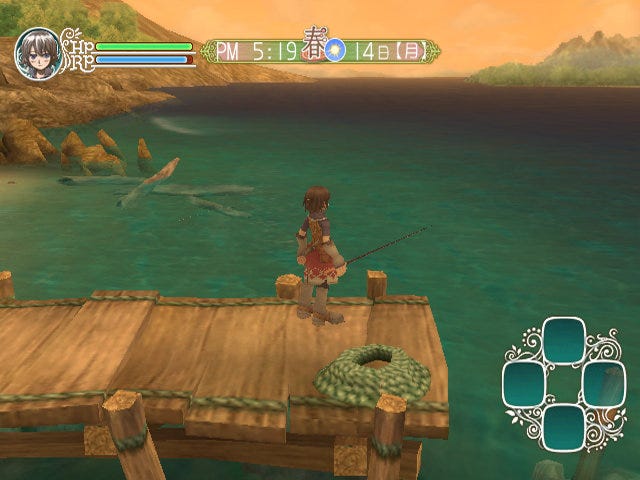
Staying up too late or running out of energy or health means a late start to the next day and a stat-draining head cold. Because every action costs energy points, replenished through certain foodstuffs or a once-daily dip at the local bathhouse, this forces organised prioritisation, usually a case of early-morning chores followed by a bit of exploration and expansion later on. Get up, water the turnips, clear some of the timber and stones which accumulate overnight, tend to the animals, then take a little stroll around Trampoli, shooting the breeze with its residents to learn more about what you're actually supposed to be doing.
The cornerstone of it all is agriculture. Farming brings income, allowing you to buy better tools, domestic appliances and equipment, making your day more efficient and giving you time to expand your repertoire of seasonal vegetables and chat-up lines. You'll learn to cook, too - gradually more complex recipes that restore more and more energy, letting you do more with your time. Soon you'll be taming the monsters you come across in dungeons as well, training them in the mundane work of farming so they'll tend your crops while you're out killing their families and stealing their skins to help butter up the local ladies.
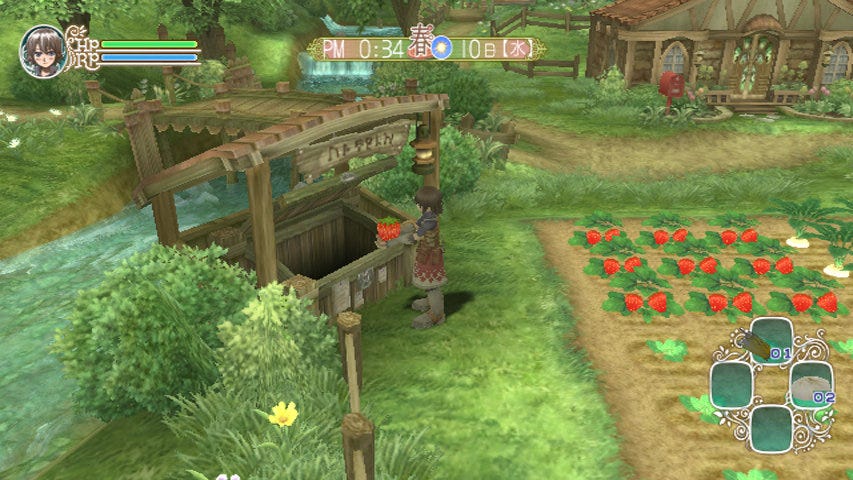
These shortcuts and efficiencies are balanced by an ever-swelling list of ways to spend your time and energy. It's possible to completely suspend your farming activities, saving up enough crop money to set you up for an extended period of dungeon-delving. Likewise there's the option of agricultural pacifism, focusing on the production of crops and ignoring the underground seasonal dungeons and the caverns of the floating Whale Island completely.
In many ways it's completely cyclical, a play on the drip-fed incremental rewards of new objects, toys and activities which fuel games such as Animal Crossing so successfully. And like those games, it's also maddeningly compulsive.
Despite the sedate progression - dropping hints and equipment as you stroll around town chatting to shop owners, post-girls and dotty professors - it's a very difficult thing to put down. Doing so, by saving your progress in the bedside diary and turning off, feels like abandoning a living, breathing world - a world where your crops will shrivel and die without your care and attention, and where you friends and potential suitors will gradually lose interest if you don't go and visit.