Rock Band Unplugged Review

Plug in, baby.

Version tested: PSP

Now that rhythm-action gaming is synonymous with peripherals, it's easy to forget that for ages all we had was buttons. Ordinary buttons, on an ordinary, non-amusingly-shaped controller. Going back feels terribly strange, as your fingers struggle to work their way around the PSP at speed, but after a while you get used to the controls, a fuzzy nostalgia sets in, and Rock Band Unplugged starts to become a quiet obsession.

That nostalgia is largely down to how closely Rock Band Unplugged echoes Harmonix's first titles, FreQuency and Amplitude, in terms of the way it's played. It's not just a straight transposition of the grown-up Rock Bands to a portable format, which would probably have been the easier option - instead it's a different gameplay concept, one that's a bit more old-fashioned and decidedly single-player, demanding concentration and precision as opposed to bluffing through solos and band camaraderie. In its way, though, it's no less entertaining.

Notes scroll towards you on the screen on a vertical plane, as will be familiar to anyone who's played a rhythm-action game since 2005. But instead of playing along to one instrument and matching as many notes as you can, like in Rock Band proper, you switch between all the instruments in a track with the L and R buttons, hitting all of the notes in a phrase with d-pad left, up, triangle and circle buttons before moving on to the next.

Usually the notes come one at a time, but as you work your way up the difficulty levels the game introduces three and four-button chords as well. It works perfectly well once you get your fingers around it - the only button combination that's undeniably awkward is trying to press up and right at the same time on the fiddly PSP d-pad, but the developer seems to know this - you're only asked to pull off that chord on two of the high-difficulty songs on Expert.
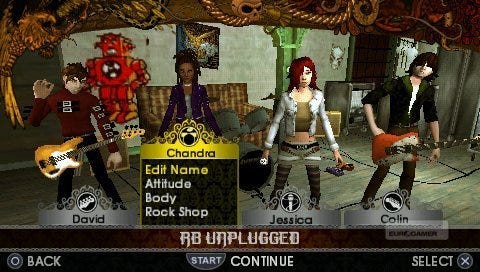
1

You can dress up your wee band members, as always. Mine have trenchcoats and bowties.

If you don't hit a sequence of notes perfectly, you fail the phrase and that instrument drops further and further into the red. Complete a phrase, and that track turns off for a little while, leaving you to move on to another instrument. It's about balancing all of the tracks, taking care of the easier instruments so that you have enough time for a few goes at a complicated drum track without some other instrument dropping into the red and failing.

When a solo happens, you're snapped automatically to that track, so there's no avoiding Offspring drum solos or the endless minutes of guitar-squealing in the middle of Judas Priest, and the rest of the song goes on hold for a while until it's finished. In solo sections things revert to the ordinary Rock Band system, where you just try to hit as many notes as you can. It gives the tracks a bit of structure, and consistency too - you're rarely struggling with a stupidly hard part of the song whilst easier tracks slip slowly into the red.
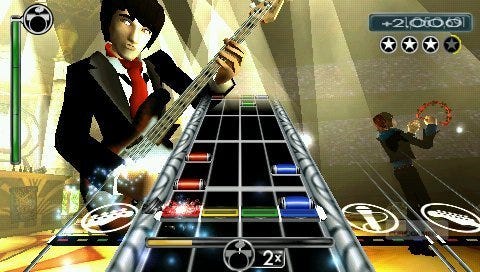
2

It was all going well for Betrayal Burger's career until bassist Kris donned a trendy blazer and caused a terrible schism in the band.

In place of FreQuency and Amplitude's helpful items, we get Overdrive power as a reward for hitting tricky sequences. It's easily activated with a press of the X button and serves the dual purpose of more than doubling your score-multiplier if you're doing well (from 5x to 11x), or rescuing a failed track if you're struggling. And, naturally, it makes the notes and tracks go all shiny and bright and the music that bit louder, which feeds addictively into a classic rhythm-action sensory feedback loop of light and sound that can keep you locked into the game for hours, eyes an inch from the screen.

Score-chasing is a much more essential aspect of Unplugged than its bigger brothers - you build up a streak by hitting consecutive notes and get a bonus for every successful phrase you complete on top, and you've no hope of getting four or five stars on a track without clever use of Overdrive to maximise your score on a long streak, no matter how well you play. The added franticness of switching between tracks at the end of a phrase in time to continue your multiplier makes it more of a zone game than most modern rhythm-action - you barely get a second to catch your breath between phrases and constantly have to think ahead.

Mechanically, then, the game is a perfect piece of rhythm-action design. The difficulty levels are distinct and appropriately pitched, and there's good consistency within each - there's not much of a leap between particular songs within the same difficulty level. For advanced players this is one of Unplugged's chief weaknesses; there's no Buckethead here (the closest is Freezepop), no giant leap between the songs at the beginning and the impossible challenges to be faced at the end of the setlist. As in the home console games, Rock Band's ultimate challenge (the Endless Setlist) is more a matter of endurance than pure skill.

The 41-track selection of master recordings is impressive, and there's a DLC store to expand it well into the future if you're willing to pay. The tracks in Rock Band Unplugged aren't necessarily here because they're good pieces of level design, but rather because they're popular tracks (most of them are RB1 and 2 favourites), and though that makes them fun to jam along to, it means that this isn't a game as precision-engineered as Amplitude. Still, the music is unquestionably better, so it's a more than acceptable trade-off.

Annoyingly, there's a lot of repetition in the tracklist thanks to the World Tour single-player system, which is identical to the previous games'. You'll have heard Livin' On A Prayer, Aqualung and Drain You so many times by the end of the first three hours of your band's career, you'll want to kill someone, like Bon Jovi, Jethro Tull or Kurt Cobain (oh, wait). The tracklist itself may be good, and varied, but because only a small selection of them are available at the beginning and Rock Band has always been hellbent on artificially lengthening the setlist by making you play the same songs in different gigs across the world, you'll be hearing them far too often.

3

Losing my streak when I've only just deployed Overdrive gives me a jolt of physical pain. I'm not sure this is normal.

This isn't so much of a problem when you're only playing the game for 15 minutes at a time, of course, rather than driving through the entire tour in three days for a review. The real problem with Rock Band's tour system is the way that it encourages you to stay within your comfort zone, punishing failure by robbing you of fans and stunting your progress rather than letting you play at your upper limits.

Outside of Tour Mode, Rock Band Unplugged offers very little. There's no multiplayer, which seems very odd indeed, and no online scoreboards either, so your rock achievements are for you and you alone. There's an unlock-all cheat built in for Quickplay, which is thoughtful, and a warm-up mode that lets you play in a no-fail setting and without phrases (if, for example, you want to go through a whole song playing just the drum track).

4

Cute animations, but they're not enough to distract you from the note tracks, like GH World Tour's sometimes are.

There's also Band Survival Mode, which removes phrases from the equation entirely and has you switching between tracks at random trying to keep them all in the green. It's more of a fun extra than a real alternative mode. The lack of multiplayer and other modes is dispiriting, but for most of us a 41-track selection in Quickplay and fully fleshed-out World Tour mode is probably enough to fit our needs for a portable music game. When the main gameplay mode itself is so thoughtfully constructed, the absence of extraneous modes doesn't smart for long.

Rock Band Unplugged is a lovely-looking, unique and tightly designed rhythm-action game built of equal parts FreQuency and Rock Band. The track selection's good, it's far from a lazy port, and its similarity to Harmonix games past makes playing it an unexpectedly nostalgic pleasure. Multiplayer might have made this an essential PSP purchase, but for 25 quid or so it's worth the money regardless.

8 / 10

Read the Eurogamer.net scoring policy

Comments (58)

Comments for this article are now closed, but please feel free to continue chatting on the forum!

  • Loading...hold tight!