Retrospective: Robotron: 2084

The soul of a new machine.

For a few months after its release, he kept a close eye on his creation. Perhaps he would wander around Chicago on those serene, silver-skied early evenings they have there, checking in at the chattering, buzzing arcades, the smoky dives, the pizza places where locals - kids and adults back then - would gather around the tall black machines in the corner, while a polite line of quarters stretched across the cabinet tops.

He was a pro by this point, which meant that he was looking for some very specific signs. Adoring crowds were nice enough, but that wasn't what he was truly after, and he wasn't checking the leaderboards, either, to try and get a sense of how much traffic his game was getting. Instead, he was looking for abuse: footprints where the cab had received a dusty shoeing in a wordless moment of blunt frustration, joysticks torn off in anger, tiny cracks in the screen, cigarette burns that seemed a little too deliberate.

I imagine he found plenty of what he was searching for. Modern games may flatter their punters, but arcade classics were always more likely to taunt them. The very best would be openly hostile - and Robotron: 2084 was the very best. It made people furious. It made them feel cheated, even, because it took their money and gave them, what? 15 seconds? 20 seconds? And that time was mostly spent in abject humiliation, struggling with the controls, hunting around for, like, a button - there must be a button somewhere, right? - before expiring in a gaudy fizz of light, leaving nothing but the feeling that players were expected to know how to pat their heads and rub their stomachs at the same time with this one.

Inevitably, though, it made them come back, too. Again and again. The abuse was simply the first sign of love.
1

Eugene Jarvis had wanted to make pinball games. He loved pinball, with its brutal simplicity, its ball-bearings, fairy lights and bells. He loved its sense of street-smart engineering: all screwdrivers, twills of wire and lumps of chrome. Pinball was pretty sexy for a while - in Foucault's Pendulum, Umberto Eco writes a slightly sweaty love letter to it, having watched a girl grind her hips against the cabinet as she played. But Jarvis was born 20 years too late to catch the trend in its prime, so he mostly had to make videogames instead.

He did. He made Defender - and the advance buzz said that Defender was a big fat bomb. Too many buttons, too many objectives, too many different things to remember. Defender just had too much for the human brain to learn, and it killed you too often. It killed you all the time, actually, and in ways that players, groomed on the polite, entirely mechanical, armadas of Space Invaders, struggled with. It was chaotic and mean-spirited and a bit garish. Maybe there was a personal insight hidden in there somewhere: photos of Jarvis from that time depict a lanky character with a Unabomber approach to haircuts and a look in his eyes suggesting that every day was Halloween.

Naturally, Defender was a gigantic hit. Even Martin Amis liked it, and he hardly liked anything. Jarvis and a fellow developer named Larry DeMar formed a separate company and produced Stargate, an enhanced version of his breakout success. But for the first proper follow-up, the duo knew they had to do something really unexpected.

Eager to please, Jarvis promptly had a car accident - I'm sure I remember reading that he was driving something hilarious like a Ferrari or an old garbage truck, but I may be wrong - and he wound up with a broken hand. Ha! It turned out to be the most valuable broken hand in the short history of videogames. If he'd broken a leg too, who knows what he might have eventually accomplished?

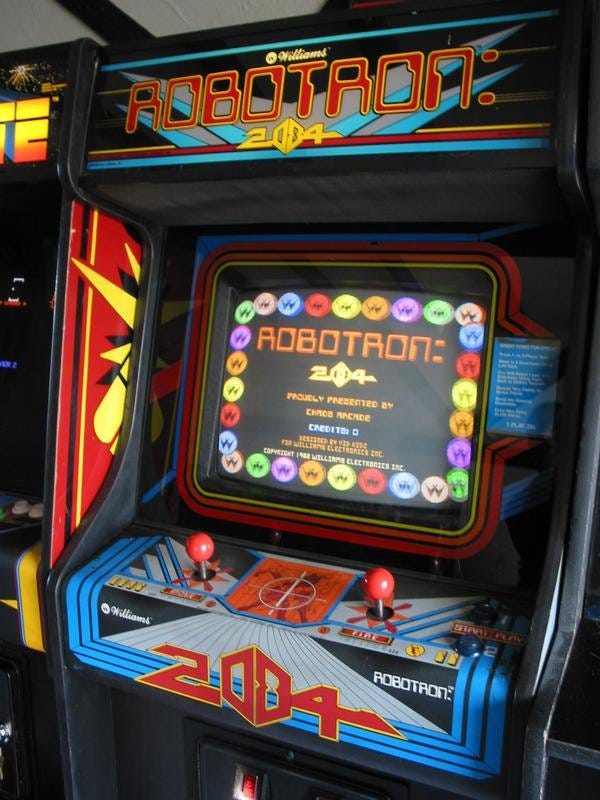
Simplicity is hard to plan for, apparently. You have to just let it sneak up on you, like old age, bankruptcy or a real thing for cricket. After a lot of over-complicated designs, fumbling around for a control scheme he could test while his hand was in plaster, Jarvis ended up bolting two joysticks together and taping his cast to one of them. It wasn't the first time anyone had experimented with the layout - Taito had tried a similar approach the year beforehand, and stunk the place up - but now, something clicked between designer and hardware. It turned out that two joysticks - one to move, one to fire - felt pretty good after a while. You had a lot of manoeuvrability, a lot of options. And to Jarvis and DeMar, that meant only one thing: it meant they could afford to throw a lot of trouble your way.

How much trouble? Experimentation began, and it turned out that the whole thing was largely a numbers game. How many sprites could the chip handle on screen at any one time? What was the point at which it became fun? What was the point at which fun turned to bedlam? Hey, and where did it balance out? Where did slowdown kick in, and where did the AI suffer? And did any of that even matter?

Most games would give you a handful of enemies at any one time and that would be enough. Space Invaders amped things up a bit, granted, but most of those advancing crab monsters were actually just lumpen targets to whittle away at - bland nightmare machines who were born only to die at a distance. For the game that was becoming Robotron, a mere handful of enemies was actually pretty boring. You needed dozens and dozens of the little mofos, flocking towards you, racing in from all sides, and then, suddenly, you were under its spell.

The game was most fun at the point when it was actually becoming slightly terrifying - it worked best as a deranged and entirely one-sided kind of warfare, with the player zapping into the middle of the screen to find himself totally surrounded by hordes of brightly-drawn killers. It's 2084: the robots have taken over, you've been deemed "inefficient", and they've got you cornered.

That was part of the magic - that energising claustrophobia, heightened by the simple colours and stark borders that hemmed in an otherwise completely empty screen. The other part was variation: the robots who were coming to get you were all coming to get you in their own way.

2

GRUNTs, the stylish little red ones with the bright green visors, were just caught up in a headlong dash to connect with your frail human body. They chugged after you wherever you moved and died by the half-dozen.

Hulks, meanwhile, pretty much ignored you, but couldn't be killed, only knocked gently off course by your shots. Spheroids buzzed around the screen in nasty, sweeping diagonals, inevitably winding up in the corners, and if you didn't get to them in time they would spawn Enforcers, who Hoovered around the place unpredictably and showered you with spiky little bullets. Brains could fire guided disco missiles at you and turn innocent humans into zombified Progs, while Quarks may have looked like the kind of harmless visions you get if you stand up too quickly after a long bath, but they spat out Tanks.

Tanks were probably the worst thing in the world that could ever happen to you, trundling back and forth in blocky clusters, and letting loose with squash balls that would bounce off walls, punching through your lives in no time at all. Finally, there were always Electrodes to take into account, too: the deadly little bits of furniture that Jarvis and DeMar pinched from another game and then scattered randomly across every room.

And all those pieces, obeying their own little rules, created something that was pretty fascinating - just as long as you weren't playing it, in which case it was a lot more emotional than that. Strange behaviours emerged, things that hadn't really been coded into the game, like the fact that Quarks would fling Tanks together in little nodes of death, or that Enforcers got themselves stuck on the edges of the screen, so their arcing shots would criss-cross the play area at 45-degree angles.

The addition of wandering family members - the last human family on Earth after the Robotrons took over - only added to the brilliant parade, giving you something to collect for points (which translated, naturally, into extra lives) and making you play in a murderously schizophrenic manner. Even when you knew you shouldn't, you would find yourself lured to your death again and again by Mommy, Daddy and little Mikey. They were like digital sirens, tempting you towards trouble.

I interviewed Jarvis a few years ago, and, even after two decades, he remains mesmerised by the Petri dish world he created back in 1982, comparing its shifting, drifting, sprawling waves of enemies to time-lapse footage of coral, and talking about his favourite bugs - the very best being wave five, where all the Brains are fixated with catching a single Mikey, meaning that, if you can keep him alive, you can score massive points by picking up the wandering swarms of mommies. This is also excellent dating advice, obviously.

Jarvis admitted that the Robotron machine that lurks down in his basement gets a once-a-month kicking from him (although often it's him who gets the kicking). He's not alone. Wherever you look in the industry, Robotron seems to be waiting for you. The team at Ruffian Games, currently piecing together Crackdown 2, light up when you mention the old Williams classic in interviews, Archer Maclean never moves to any studio without installing his own cabinet, and there's even one standing next to a Feeding Frenzy machine at PopCap's Seattle headquarters.

Yeah, PopCap. That's revealing: even the kings of casual see the appeal of such a brutal game. (Apparently, there's one employee who's really, really good at it, but works up a completely disgusting sweat when playing. The cabinet has new joysticks, incidentally, suggesting that it's seen some action over the years.)

And although it wasn't as much of a hit as Defender, it's been causing ripples ever since. There was Smash TV, of course, cementing Jarvis' reputation as the Paul Verhoeven of videogames, and Total Carnage, which is still one of the great white-trash pleasures of the blaster genre. Jeff Minter got in on the action, too, which is never a bad thing, and as soon as control pads started having two sticks, two-stick shooters had a welcome Indian Summer, with Geometry Wars and Mutant Storm and Super Stardust HD leading the way until, finally, everyone was making them and it all got a bit passé.

3

The 360's controller, with its irritatingly unaligned layout, was never the most ideal way of playing the game, but XBLA's workmanlike Robotron port at least had global leaderboards - and still does, if you nabbed a copy before all of Midway's old games mysteriously disappeared. J Allard's on there and everything, though he probably gets the intern to play for him.

Elsewhere, you can see the game's influence even in titles that aren't as pared down and unforgiving. BioShock 2 turns to Jarvis and DeMar a little bit whenever there's ADAM to gather, Crackdown 2's new range of differently-weighted mutants and impromptu Freak Breaches have clearly been influenced by regular trips to the year 2084, and any time people talk about emergence you can be sure that a Robotron reference, like an ice-cream truck jingle-jangle in a very old summer memory, is never far away.

Of all the games I've played over the years, it's probably the one that I know the best: I have tactics for mastering each of the first 10 or so waves, which I'll be passing on to my children one day, and I was once riding pretty high on the XBLA global rankings, until age, and the fact that most people were actually better than me, knocked me back down into the late hundreds. I like to delight my friends and loved ones with unexpectedly loud interpretations of the key sound effects from time to time. Zoorb-zorb-zub-zbzb! BRAAAANG! It's mostly a special occasions thing: Christmas, Easter, Wednesdays.

Oh yes, and the only proper stranger I've ever chatted to at length over Live was a 40-year-old Italian I met playing co-op Robotron. He was the Robotron king of his village growing up, playing at the laundrette, I think, and while the Xbox belonged to his son, he'd downloaded the arcade game himself. I cut him loose after he broke the million barrier, but I still think of him now and again.

Everyone who writes about games - and everyone who just plays them regularly, or even reads about them enough - has their favourite designers, I guess. I know people who get misty at the mention of Ron Gilbert, or Charles Cecil, or Pajitnov - that sad-eyed, ever-huggable bear - and Miyamoto makes almost everybody a bit wobbly of course. But for me, there's only ever been Eugene Jarvis and Larry DeMar.

And, if I'm honest, there's only ever been Robotron.

Comments (33)

Comments for this article are now closed, but please feel free to continue chatting on the forum!

  • Loading...hold tight!