Rhythm Paradise Review

Tap tap revenge.

Version tested: DS

It's easy to forget in these days of plastic Les Pauls, colour-coded drum kits, flashing dance mats and wireless microphones, but the very first music game had little to do with pretending to be a rock star. Instead, you tapped buttons in time with some Sesame Street hip-hop, in order to make an awesome, beanie-wearing dog rap his paper-thin heart out. And, if you performed well enough, you'd get the girl who, in this case, happened to be a sunflower. It was imaginative, leftfield, cute, weird and beautiful: everything that videogames should aspire to be. And yet, PaRappa the Rapper's wildly creative approach to interactive music has almost no legacy in contemporary videogames.

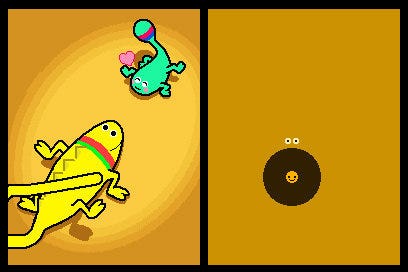
Rhythm Paradise is a game that appropriates the spirit of PaRappa, if not his format or musical style. Here you'll find yourself shaking the guiro-shaped tail of a female lizard in time with the roll of a rumba in order to attract a mate. You'll assume the role of a Russian military stork, triumphantly flicking your beak into the air on the command of your feathery captain. You'll croon a stream of a capella notes in a young male voice trio, echo the lines of a J-Pop star as a besotted fanboy monkey, and stomp the ground as a hook-backed farmer harvesting turnips.

What you won't be doing is pretending you're Kurt Cobain, Slash or Lars Ulrich. At least, you can pretend you're Kurt Cobain, Slash or Lars Ulrich, but only in the unlikely scenario that they've secured a job in a factory assembling kickass robots in time to the clunk of machinery, or as fighter pilots shooting down spaceships with hot lasers to a chiptune drumbeat.
1

You'll need to play through a brief tutorial before being able to grasp what's expected of you in each game: these aren't quite the three-second micro-games that defined WarioWare.

It'd be lazy to describe Rhythm Paradise as a musical WarioWare, but it'd also be exactly true. The 40 mini-games (50, if you include the remixes) are longer than those the developer created for WarioWare, but each one takes a similar approach, squeezing gameplay challenges from the unlikeliest of everyday situations. The physical interactions in each mini-game are constant: you either tap or hold the stylus down on the screen or, alternatively, slide or flick it in an upwards motion. This limited palette of interactions is spun out into a hundred different creative applications, the actions always mimicking the on-screen visuals.

For example, in the farmer's mini-game, you tap the stylus in time with the beat to stomp the ground and cause vegetables to fly up from the soil. Then, on the immediate offbeat, you must flick the stylus upwards to knock each turnip into the basket on his back. The placement of the turnips in the ground acts as a sort of abstracted set of notes on a musical stave, the challenge then shifting from the on beat to the off beat and back again to build up the level.

Of course, in WarioWare the visuals were the primary signifier to the player; very often you'd have to time inputs based on what was happening on-screen. But in Rhythm Paradise, the visual cues are secondary to the audio cues. Success and failure in the game is very much based on timing, but it's a timing measured in beats, bars and phrases, rather than through reacting to on-screen prompts. For that reason, the visuals, however delightful they may be, can be a barrier to success.

In one micro-game you play the AI at a game of table tennis, sweeping the stylus upwards on the screen to bat the ping-pong ball back at your opponent in time with the music. If your opponent lobs the ball it takes a whole bar of music to reach you, if it's a normal strike it takes half a bar and if it's a fast strike, just a beat. Trying to time inputs based on visual cues will have you tripping up, as perspective distorts the rhythm of the ball's moment. In this case, it's far easier simply to close your eyes and listen out for the audio cues, and for this reason, the difficulty can be inconsistent, peaks and troughs of challenge failing to form an elegant learning curve.

The structure of the game is linear but also ingenious. You must clear a stage to unlock the next one, with each batch of four mini-games followed by a 'Remix', a challenge that mashes up both the audio and visual elements of the preceding tasks. After each mini-game you're given an appraisal of your performance. Anything less than a perfect performance in which you miss no beats will be awarded with an 'OK' or 'Just OK' rank, with 'Superb' reserved solely for the flawless.

At set points in your progress you'll be issued with a challenge: to score a perfect grade in a particular mini-game. Unfortunately, if you've already perfected that game, you'll still have to do it again, meaning that it's best to attack levels sequentially, only returning to perfect a stage when the challenge is explicitly set. During these runs for perfection, the lack of an instant restart option in the menu is frustrating, the game instead returning you back to the main hub if you quit out.

2

Rhythm Paradise is known as Rhythm Heaven in the US. Obviously targeting the bible belt.

There are plenty of aspects to Rhythm Paradise that were inaccessible to non-Japanese speakers who imported it as Rhythm Tengoku Gold last year. There's a bar area where you can chat with a friendly waitress (who will unlock the next mini-game for you if you've failed three times in a row and you ask her nicely). Similarly, scoring 'Superb' ratings earns medals that, in turn, unlock neat 'sound toys' to play with, as well as additional endless-mode games to tackle. As with WarioWare, a lot of the humour derives from the visuals, but Nintendo's ever-solid localisation team turns in an amusing script, one which does little to justify the mini-games' ridiculous scenarios, but lots to enhance them.

When John Walker reviewed the game on import he pointed out quite rightly that it lacks some of the succinct brilliance of its predecessor. While the GBA game (which was available only in Japan) met the simplicity of its hardware with raw ingenuity, here on the DS, with a multitude of control options, Nintendo has been given freedom to slightly over-think things.

Nevertheless, the game has an elegant simplicity when set against the intrinsic fussiness of the Guitar Heroes and Rock Bands of the world. It is a videogame that has no aspiration toward being anything other than being a videogame, but one which still tests your rhythmic competence every bit as stringently as Harmonix et al. It's the kind of thing that Nintendo rarely makes these days, and the kind of music game that's almost never made these days. A joyful, exuberant celebration of the rhythms that underpin our existence, Rhythm Paradise is as demanding as it is creative, and as beguiling as it is bonkers.

8 / 10

Read the Eurogamer.net scoring policy

Comments (40)

Comments for this article are now closed, but please feel free to continue chatting on the forum!

  • Loading...hold tight!