Version tested:
Released within weeks of one another, Final Fantasy XIII and Resonance of Fate present two fiercely independent visions of the contemporary Japanese role-playing game. The former is a retreat into the formative traditions of the genre, a linear trek along narrow interactive lines that link endless CG cut-scene pitstops.
Its orthodoxy may be cloaked by an advance into dazzling new technological stomping grounds, but with character designs focus-tested to within an inch of their personality and a celebrity endorsement from Leona Lewis, Final Fantasy XIII's populist approach is a concerted attempt to appeal to the everyman gamer.
Gone is that lilting arpeggio signature theme that soundtracked every preceding game in the series, a shrugging off of the trappings of convention, despite the fact that the underpinning mechanics are often as old as videogame time.
Tri-Ace's latest, by contrast, appears orthodox at a glance, with towns filled with jabbering NPCs, eager merchants, and fetch-quest assignments and an overworld peppered with random battles, dungeons, treasure chests and boss battles.
But beneath the surface, Resonance of Fate eschews convention at every turn, withholding the basic structure of its lineage but changing almost every one of its details to create a radical, fascinating departure from the norm.
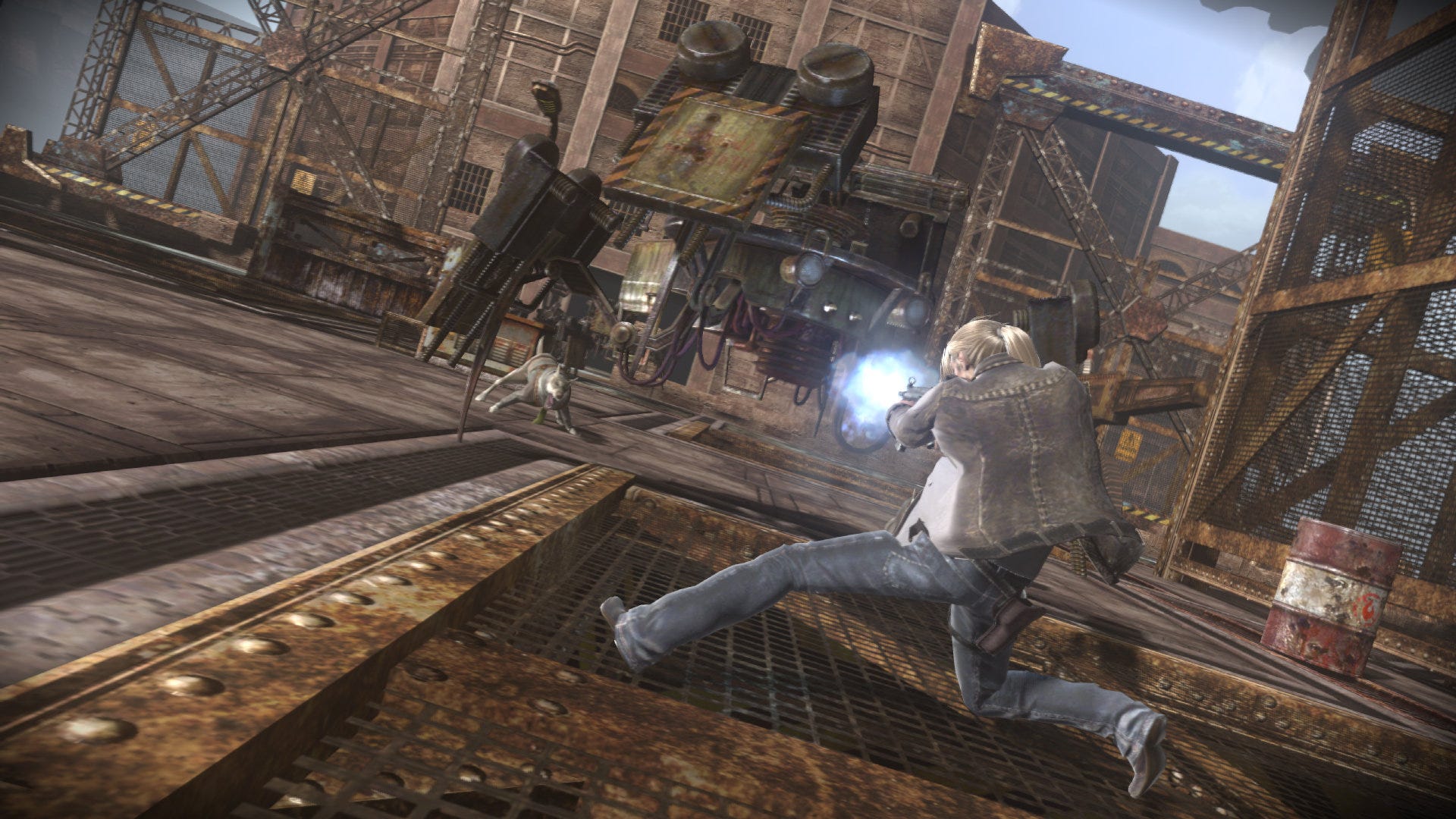
Later in the game you begin to access Terminals in the world map, hexes that produce a special effect, such as increasing the item drop rates in that area.
In this world magic and swords are discarded in favour of Victorian firearms and John Woo-esque acrobatics. Characters wheel and dive in kinetic, semi-real-time gun duels overlaid by all manner of tickers, timers and statistical readouts.
Meanwhile, cut-scenes are pared back to the bone, the world primarily revealed through expressive character and environment design rather than reams of dialogue and supplementary encyclopedic text.
Even the geography of the traditional role-playing game is upturned, the traditional hero's journey from pastoral village out to the ends of a troubled earth rotated to a vertical climb up a decaying steampunk tower of Babel.
Likewise, while Square-Enix's refined blockbuster reveals its battle system in painfully small increments, tri-Ace presses almost every one of its mechanical complexities into your palms from the off. Not only this, but the game demands prompt mastery, punishing any gap in its players' understanding in no uncertain terms.
For gamers mollycoddled by gaming's general trend towards lenience in recent years, and the specific tendency of RPGs to demand perseverance over proficiency, it's a rude awakening. Indeed, this is one of those few games in which you must pay in-game credits to continue from a Game Over screen, with tiered payment plans depending on how much of your party's energy you wish to restore.
The story focuses on a group of three housemates, Leanne, Zephyr and Vashyron (voiced by the ubiquitous Nolan North, best known for his turn as Uncharted's Nathan Drake). The trio work together as 'hunters', freelance mercenaries who carry out odd jobs for the tower's aristocracy, who are housebound thanks to the bandits and rogue robots who roam the overworld.
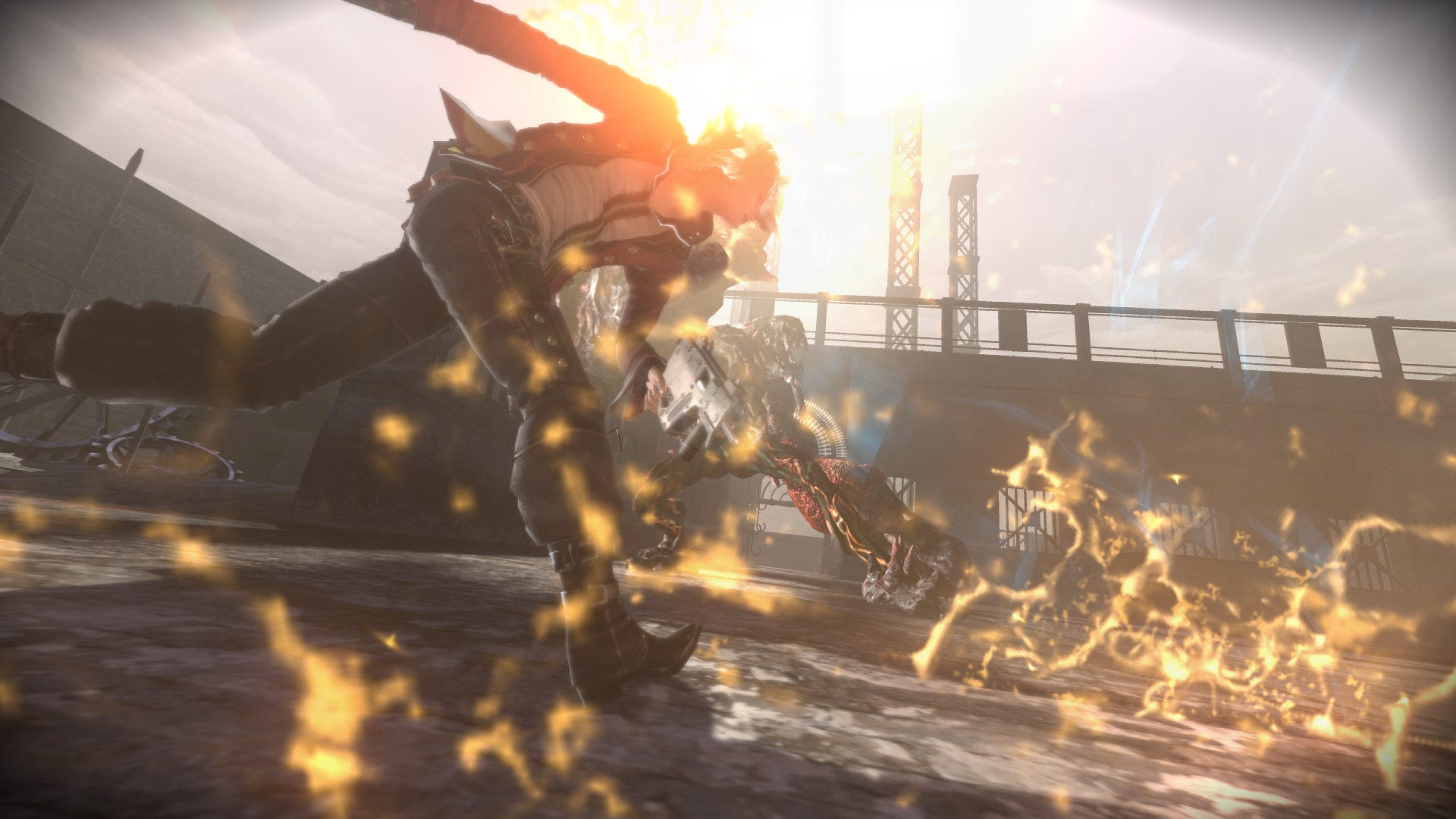
While battles in the game are technically random, they only occur on certain types of hexes and at an extremely low encounter rate, so players put off by capricious interruptions needn't be put off.
Towns, built on the various tiers of the game's gargantuan tower (an air purifier upon which entire communities have sprung up), are explored in a similar style to those in tri-Ace's Valkyrie Profile series. While built in intricate 3D, your character generally moves along a 2D horizontal plane, perspective on the rusty walkways and Elizabethan-style houses shifting as you move left and right.
A world of cogs, candles and clockwork, the aesthetic is one of steampunk precision, all dainty streetlamps, nostalgic frocks and cobblestones rounded by decades of footfall. A John Williams-esque orchestral score swashes through the streets, combining with the de-saturated colours to create a haunting effect of second-hand nostalgia.
The world map is composed of hexes, the vast majority of which are closed off at the beginning of the game. To unlock frozen hexes you must rotate and lay 'Energy hexes' on top of the area you want to unfreeze, rather like laying Tetris blocks onto a gridded map. These come in various shapes and configurations and are won by defeating enemies.
As you unfreeze new areas of the map, so new locations are opened up to your team. Some areas can only be unlocked with special coloured hexes, won from NPCs or by taking on key missions. This mechanic allows the game's designers to stagger access to the tower, while still allowing the player some freedom to explore those parts of the world they want to explore.
It's a neat system and, with bonuses for clearing all of the hexes on a tier of the tower, introduces a gentle puzzle dynamic in trying to find the correct shaped energy hexes to unlock those hard to reach corners.
Despite its strengths, the hex system plays second fiddle to the game's most innovative and idiosyncratic feature: its battle system. Complex and with many rules and quirks, this has you controlling your three characters in sequence in a semi real-time tussle.
As with SEGA's Valkyria Chronicles, moving and attacking share an action point gauge. A character's turn ends when either the action gauge depletes or they attack. In the game there are two types of damage that the player can inflict on opponents: direct damage and scratch damage.
The type of damage inflicted is dictated by the type of weapon they have equipped, 'direct' from handguns and thrown weapons and 'scratch' from machineguns. Direct damage drains an enemy's health irrevocably, while scratch damage deals a greater amount of injury, but recovers with time and does not destroy the enemy when reduced to zero.
Much of the game balance comes from inflicting a large amount of scratch damage with one character, and then turning it into direct damage with another before it has chance to replenish.
Attacks can be dealt in one of two ways. Standard attacks simply require you to lock on to a specific target and charge up a standing attack. Hero Actions, by contrast, allow you to plot a course across the battlefield, before running along that line while repeatedly attacking enemies, only stopping if you collide with an obstacle or reach the edge of the play area.
There's a day and night cycle as you traverse the world map too, with townsperson behaviour and enemy conditions changing by day and night.
Hero Actions use up what quickly reveals itself to be the most important resource on the game: Bezels. Initially you have three bezels with a Hero Action costing one bezel per use. Run out of bezels and your team is critically wounded, with hugely scaled-back abilities. In most cases, you won't recover from this state and it's game over.
Bezels are replenished every time you defeat an enemy or part of an enemy (an arm, leg or shield, for example). The strategy then comes in balancing those crucial Hero Actions with how close you are to defeating an enemy or enemy part.
Be too conservative in your use of Hero Actions and you won't take enemies down quick enough. But conversely, be overeager and you'll find you'll find yourself in a critical condition before time. Learning when to push forward and when to hold back takes time, but when you nail to balance, is extremely satisfying.
The system is granted a final tier of complexity by way of the Tri-Attack, a combination attack that can be triggered under certain conditions. Running between the other two characters during as Hero Action earns a Resonance point, which can then be spent on activating a Tri-Attack during your next character's turn. During this attack the three characters race along the sides of the triangle their positions form, each character blasting away at the targeting enemy and dealing dizzying amounts of damage.
The battle system has a steep learning curve and, while it's possible to bluff your way through encounters with standard grunts, as soon as you face a boss character with multiple armour segments you'll need a good handle on how everything works if you're to have any chance of success.
The game's broken into chapters. Advance a chapter without clearing side quests and those side quests will be lost.
Yet more time is to be sunk into customising the game's weaponry, which, rather like piecing together guns in Resident Evil 4, has you attaching scopes, new barrels and all manner of add-ons and mods to create ever more fanciful weaponry.
Again, this is an ingenious upgrade to the rote-RPG system of purchasing new and better weapons to match the tougher enemies you face as you progress, increasing the sense of player agency and introducing just the right amount of non-linearity to your characters' progression.
At times you'll have no doubts that this is the best JRPG of the generation, a fast-paced, interesting and creative detour from a stagnant mainstream. At other moments, usually when facing the tenth Game Over screen during a difficult boss battle, you'll wonder whether the game suffers from poor balance, born from its developer's stubborn insistence on novelty for the sake of it.
Either way, by the end of the adventure you'll be certain that Resonance of Fate's approach is a one-time affair, unlikely to inspire any copycats. Its ideas are simply too leftfield, and too fully realised to be closely imitated.
Nevertheless, this is a hugely interesting game, as fascinating as it is frequently frustrating, as engaging as it is eccentric and, for those who are hooked by its quirky charms, it will provide one of the most inspired approaches to the JRPG seen in a decade.
8 / 10
