A few hours after disembarking the dusty train that winds into Red Dead Redemption, reformed bandit John Marston meets a smart young journalist from Manhattan. His assignment? To observe life on America's final frontier and dramatise his findings in an article for the well-to-do ladies of New York. His pressed clothes and clean-shaven jawline contrast with protagonist Marston's facial scrawl of stubble and scarring, but beneath appearances, the men share a common purpose: to find gold in the sun-baked Wild West.
The meeting mirrors the wider context of Red Dead Redemption's release. Liberty City with its buffed taxis, resolute skyscrapers and air of affluence may appear a world away from this arid, adverse wilderness, but peel back the skin and the framework is identical. Red Dead Redemption is GTA: Wild West, a sandbox most familiar, albeit one that, for once, is filled with sand.
Set 50 years after the events of the more light-hearted Red Dead Revolver, Redemption's frontier has become a cat's cradle of political interests, stretched taut by moneyed men in bed with federalised government. The Wild West has grown mild in its old age, and grizzled gunmen with their brutish ways are growing obsolete.
In setting the game in the twilight days of a cliché, Rockstar provides an overarching tension beyond the immediate lives of its inhabitants. Where Grand Theft Auto IV's Nico Bellic was desperate to escape his heritage, Red Dead Redemption's John Marston clings to it, a man in search of purpose and redemption in a world slipping from relevance.
Nevertheless, it's a world that Rockstar San Diego paints with flair and an abundant appreciation for the Western in cinema. Parched canyons give way to tousled plains across which steam trains puff their way, heading off into purplish horizons. A hangman's noose swings in the breeze from a giant rock. Carts teeter along thin cliff paths, while drunks are spat from saloon swing doors into the arms of waiting hookers squeezed tight by corsets and puffy knickers. Campfires flicker, coyotes howl and droves of wild horses gallop to a melancholy whistled melody or the splang of a banjo. A buzzard squawks, a shadow in the noon sky. Videogames can offer windows on forgotten vistas; Red Dead Redemption is a vivid rebuilding of a world lost to time and technology.
You can save your game anywhere in the wilderness by building a campfire wherever you pull up your horse.
But Red Dead Redemption's world exists for more than mere observation. Marston has a score to settle. A reformed bandit, the stoical gunslinger arrives in the Border States hunting a former gang associate who now terrorises the vicinity. When a bid for reconciliation fails, leaving Marston bloodied and half-dead, you must begin to job of reacclimatising the man to life on the frontier, nursing him back to health and gathering a team of hapless characters to help you take down your enemy. As with GTA, you take on smaller errands and targets en route, building fame, notoriety or honour, raising your status in the world as you gather power, weaponry and a posse in anticipation of the endgame showdown.
As ever, Rockstar gives you freedom to roam far and wide from the word go (although you won't be able to cross the border to Mexico until the halfway point), but limits your immediate objectives to a small geography. The borders of your missions expand at a slow pace, hour by hour, ensuring you grow familiar with the dirt paths and settlements and begin to build a memory map of the world and its sights. In the same way, details about Marston's past and mission are drip-fed. As your territory expands, so too does your knowledge of yourself, as the typically reserved, early-20th-century gunman builds trust and slowly confides in those around him in an incessant stream of cut-scenes, both long and short.
Missions are, as in GTA, assigned by key characters you meet in towns and outposts. These boast the same simple inventiveness that has always marked Rockstar's work out - and for those wearied by years of delivering drugs and stealing cars, the chance to herd cattle in a thunderstorm, act as an accomplice in a snake oil salesman's scam, or shoot rabbits as they try to steal a friend's carrots at night makes for a welcome, often creative change. Of course, as the game progresses, so the brutality scales with it. High-speed horseback shoot-outs in which you can either choose to take out the rider or the animal have never felt so dynamic, and even the simplest of objectives is made interesting by the emergent chaos that ensues.
Key story missions are buffered by a seemingly endless clutch of side-quests and playful distractions. Some of these, such as the games of poker, five-finger fillet, and horseshoe throwing, or the bounties you can take on, exist simply to swell your bank balance. But very often, you'll be hailed by strangers in need at the side of the road. Stop to inquire as to their predicament and they'll send you on an errand (or spring a trap), one that can often be approached in different ways, and which affects your standing in the community. These might be to convince an old man to part with his property, or may require a more immediate response (such as the hooker set upon by an angry client - "I'm gonna cut you a new hole") but either way, they help to pepper the world with distraction and break up the linearity.
With meta-challenges for hunting and skinning particular animals, collecting herbs and plants and finding treasure, each traipse across the landscape is littered with interactive potential. Where GTA's cities are densely packed with life and story, the wilderness could easily have been too empty in its expanse. By punctuating every journey with side-quest offshoots, Rockstar ensures the game world is just as packed as Liberty City, while still maintaining that visual sense of isolation and loneliness that is so crucial to the Western.
Visit a town's picture house and you can pay to see a silent movie, a proto-Disney animation soundtracked ‘live' by a creaky piano
Your primary mode of transport across the world is by horseback, the animal fast proving itself to be a far more flexible and dynamic mode of transport than a hi-jacked car, able to comfortably negotiate any type of terrain. When you gain access to a lasso it's possible to harness any wild horses you come across by chasing alongside them and hurling your rope over their neck. What should, by rights, be a fiddly task is made straightforward, as simple as lining up a moving headshot with your reticule, and then easing the animal to a standstill. Once reigned you can mount the horse and, following a short mini-game of sorts in which you attempt to ride out the horse's bucking by altering your balance, the animal is yours to ride.
Despite the temptation to chop and change between horses (different breeds offer different levels of obedience, speed or stamina), there are benefits in sticking to a favourite, as in time you build loyalty which results in stamina bonuses, allowing you to run at full pelt for longer before tiring the horse. As you begin to clock up the miles together across, hill, canyon and stream, you form a bond - and this relationship between protagonist and transport, the kind alluded to in the great Westerns, is undoubtedly one of Red Dead Redemption's greatest successes.
The key characters Marston associates play with clichés in fun ways from the jittery, repellant grave digger Seth, to the loquacious conman West-Dicken.
Forget to tether your horse when stopping in a town and you need only whistle and the stallion will come running, the kind of convenience that even the most technologically-advanced vehicle in Grand Theft Auto must stop short of. Hog-tie a bandit and you can roll him onto the horse's hindquarters and carry him across the world. By the end of the game there will be no doubt in your mind: without the need to feed, water or rest your virtual animal, horses are better than cars.
However, by the end of the game you will be left with other, less enthusiastic feelings too. While Rockstar San Diego triumphantly matches the storytelling of Rockstar North, redacting their cinematic influences with finesse and imagination, there is still an occasional roughness to the ground-level interactions that can grate.
Marston runs awkwardly on the ground and, for all the fluidity of the horses, you only need to take a tumble off an unforeseen ledge for the game to come grinding to an abrupt, awkward halt. Combat, so often the weak point in Rockstar's output, is solid, with a Dead Eye bullet-time mode combining with the ragdoll physics to create the kind of iconic shooter-keeling-from-a-rooftop images that define the genre in film.
However, the cover mechanic, which sticks Marston to the nearest rock or wall, feels sticky and outdated, while the expectation that you wrestle with the camera, reticule and steering during horseback shootouts is simply too tall at times. Problematically, once your sense of curiosity at what lies over the next hill dissipates, you'll find every 10-minute gallop across the landscape tiresome and over-familiar, and so will begin to rely heavily on the game's various fast-travel options (via train, carriage or campfire teleport).
The very best Western films enjoy a rapid fire of crisp, purposeful scenes to link the action. It's a format that works well when packed into 90 minutes of imagery delivered at 24 frames per second. But stretched out over 50 hours, the intensity of the Western form is necessarily diluted, resulting in pockets of intense excitement, linked by long, meandering treks across - admittedly wondrous - scenery. Red Dead Redemption has fully subscribed to the Housers' vision of a blockbuster videogame: a string of cinematic set-pieces and flawed yet endearing characters nestled within an orthodox narrative structure, seasoned with generous pinches of extra-curricular tasks.
Red Dead Redemption's soundtrack is standout, mixing banjos, harmonicas and winsome whistles with the odd song to mesmerizing effect.
Rockstar's skill in creating a believable, functioning world with a distinct, coherent and consistent atmosphere is peerless. The broad-brush vision is masterful. No game has done sunsets and fiddles, stirrups and stubble with this assuredness. And while the script may fall short in its cinematic inspirations - the comedy of Butch Cassidy and the Sundance Kid or the gravitas of Unforgiven, for example - the gap has been closed. Yet in the details, there's a roughness that niggles, the execution lacking the grace and fluidity of contemporaries who perhaps reign in the ambition and scope in favour of depth and polish.
The result is an exceptional Rockstar game, one that successfully re-clothes the Grand Theft Auto framework in an exciting, distinct and expertly realised scenario. But just how satisfying the formula remains after the exuberant destructiveness of Red Faction: Guerrilla, or the joyful, ad-hoc player stories born in the freedom of Just Cause 2's playpen, is increasingly under scrutiny. And even within Rockstar's own canon, there is little here for that smart young journalist to inform Liberty City about that it didn't already know. A magnificent eight, then.
8 / 10
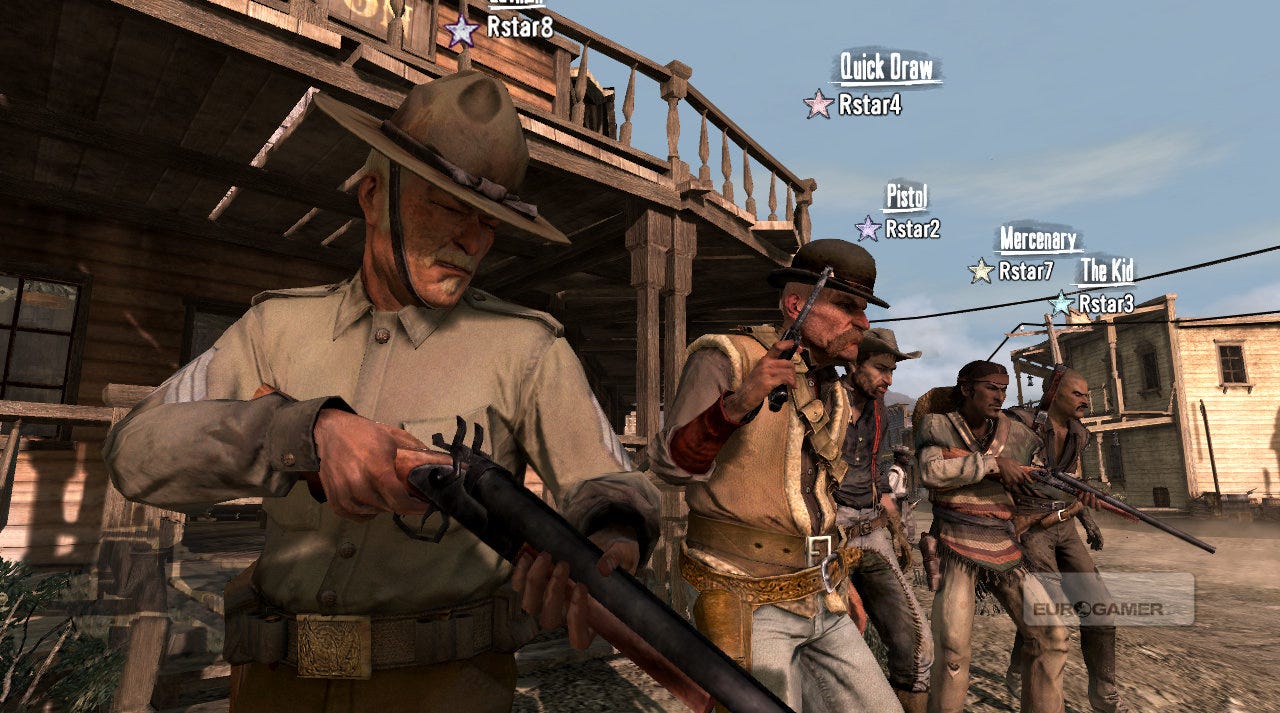
A note about Red Dead Redemption's multiplayer: a free-roaming mode allows up to seven other players to join your game, saddle up as a posse and take on other player- or AI-controlled groups in a similar way to GTAIV's multiplayer modes. Additionally, a slew of deathmatch and capture the flag variations are available for up to 16 players, each opening with a Mexican stand-off, the survivors of which can then position themselves strategically ahead of their foes' respawning. Modern Warfare-style leveling overlays all multiplayer modes, gradually unlocking new guns, horses and costumes provided as added incentives. Unfortunately, we weren't able to test any of these modes in the version of the game supplied for review. You can read more about them in our recent hands on.
