Enchanted Arms Review

Grabs you.

Version tested: Xbox 360

Yes, they literally mean he's got an enchanted arm.

The titles of Japanese games are meant to be entertainingly mental, possibly carrying a certain broken-English charm. They're not meant to be literal - that's cheating. Just as Final Fantasy and Shadow Hearts featured remarkably little in the way of terminal wet dreams or occluded cardiac organs, and Elemental Gearbolt wasn't, er, whatever the hell that even means, so Enchanted Arms was originally assumed to be simply another collection of nice English words that some well-meaning Japanese chap had liked the sound of and stuck together for no apparent reason.

The last thing I expected, then, was that Enchanted Arms would turn out to be the Snakes On A Plane of the Japanese RPG world. It states its case up front, with no bones being made about its content - aside, possibly, from a humerus, a radius and an ulna. It's about a bloke with an arm which is enchanted. An enchanted arm. Do you see?

Actually, that's not the very last thing I expected. To be entirely accurate, the very last thing I expected was that Enchanted Arms would be any good. A Japanese role-playing game developed by a company better known for headache-inducingly hardcore stompy mech games, released early in a console's lifespan - and most of all, released on the Xbox 360, a platform which currently sells about as well in Japan as souvenir mugs with Pope Benedict's face on them do in Islamabad? A game destined to be still-born, surely? Perhaps not.

Two Short Planks
1

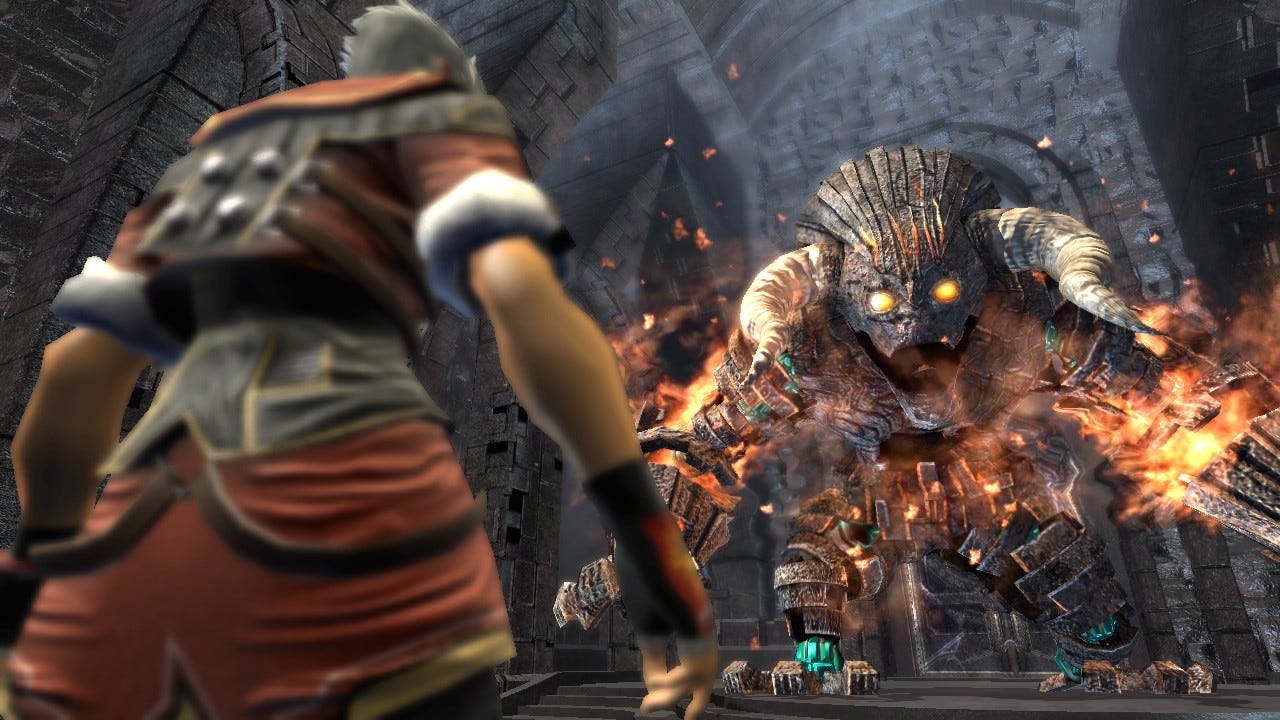
As previously and somewhat incredulously mentioned, Enchanted Arms follows the adventures of a young man with an enchanted arm, which actually isn't remotely as much fun for him as you'd imagine. You see, his arm actually has the mysterious power to remove enchantments from anything it touches - which, given that he attends a school for enchanters and lives in a city filled with machinery which works on the basis of enchantment, makes him somewhat unpopular. What also makes our hero Atsuma unpopular is the fact that he's absolutely, unremittingly stupid - with even his closest friends acknowledging that while he's quite handy on the practical side of things, he apparently doesn't have two brain cells to rub together.

Alarm bells should go off at this point. Are we really about to spend tens of hours following around some lunk with a brain cavity filled entirely with houmous and cream cheese as he bumbles from one situation to the next, ignoring the obvious and driving the player to towering heights of frustration with his inability to find solutions which are staring him in the face? Um... Sort of, yes. However, to Atsuma's credit, he's a likeable lummox, lacking the emo angst of many RPG protagonists - a lot of whom would seem more at home on LiveJournal than on the deck of an airship heading out to save the world. To the credit of the game script writers, meanwhile, Atsuma is largely bolstered by a supporting cast of intelligent characters who point out those obvious solutions quickly enough to alleviate much frustration, and whose eye-rolling at Atsuma's stupidity helps the player to identify more readily with the cast. There's even a running joke early in the game where the rest of your team gives you detailed instructions on how to use items such as chests, ladders and buttons (all of which just involve pressing A), while Atsuma enthusiastically celebrates learning these tricky new skills.

Central character aside, the storyline is fairly standard Japanese RPG fare; it's set in a post-apocalyptic world where, thousands of years after the destruction of a magical war in which autonomous ultimate weapons called Devil Golems were unleashed, civilisation is recovering under the protection of a number of great cities built using the power of enchanting. This, of course, is boring, so it's important that a Great Threat (the resurrection of the Devil Golems) should pop up for the Unlikely, Reluctant Hero (that would be Atsuma) to fight against, but only after coming to terms with his own Dark, Hidden Secret (his enchanted arm and the mysterious powers it unleashes). It's all quite nicely written, and features a number of sub-plots involving various characters you'll run into (all of whom have Dark Secrets of their own, although obviously not as exciting as Atsuma's enchanted arm) - all of which plays out in an astonishingly linear fashion, with sub-plots being dumped into the game such that you'll actually need to complete them before the main plot continues, rather than being in any way optional.

By The Nose
2

Whether this prospect sounds interesting or downright awful to you is really what separates fans of Japanese RPGs from the rest of the world, since those in the former camp accept that to a greater or lesser degree, the vast majority of the JRPG pantheon is really more interactive visual novel than role-playing game. Enchanted Arms is an extreme example of this, with the most involved side-quest you'll have the option of doing being to take a deliberate wrong turning, finding an optional golem boss (more on those in a moment) or chest full of items at the end of your short detour. Then it's back to the main path, and off again down the clearly signposted street.

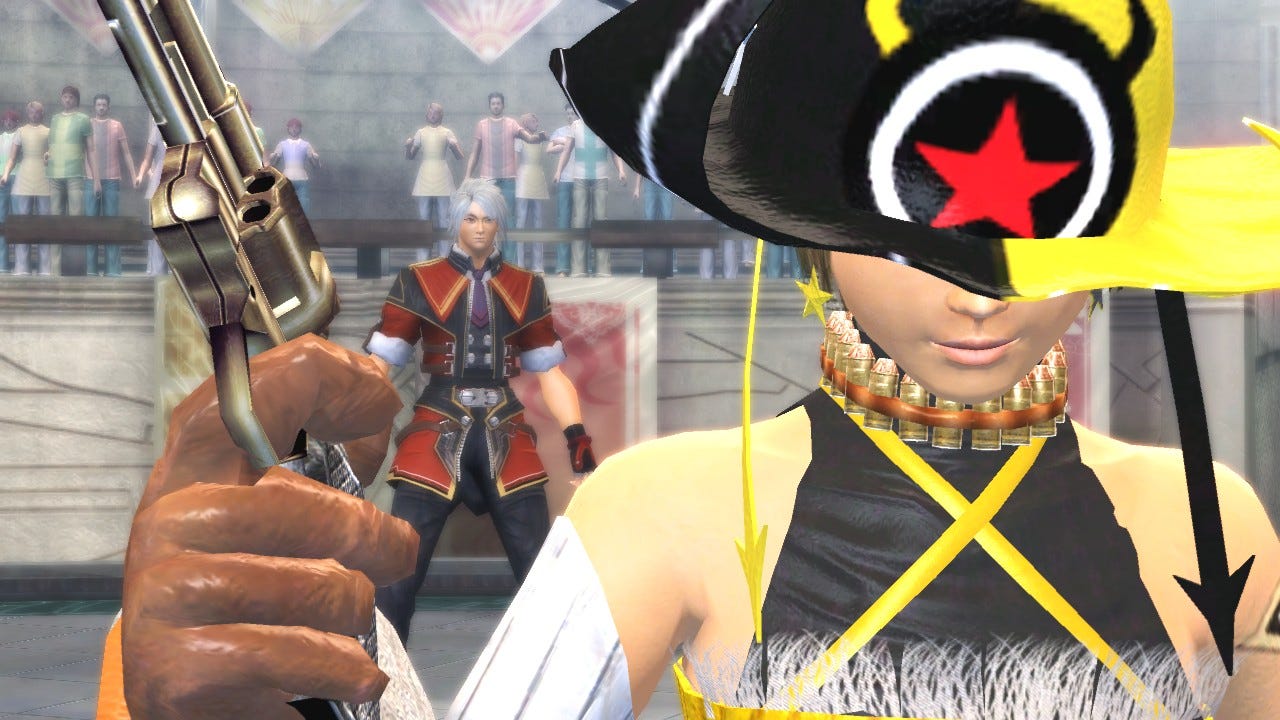
Thankfully, though, it's a very nice street. Graphically, From Software has pulled out all the stops and created one of the best-looking early Xbox 360 titles, with truly stunning world environments, creative, interesting looking characters and creatures, and superb special effects in battles (all of which can be fast-forwarded if you're getting sick of watching the animations, which is a nice addition that makes the game much more pleasant to play). The world environments in particular are worthy of note, because this is one of the first Xbox 360 games where there were regular moments of standing around gawping at the world - especially in the opening segment of the game, which is set around an academy not dissimilar to Balamb Garden in Final Fantasy VIII. The comparison is useful, because Enchanted Arms, running in real-time, looks better than the computer-generated backgrounds and pre-rendered videos used in that game - and From Software hasn't been afraid to throw showy special effects into its environments either, such as fountains and waterfalls which refract and distort the scene behind them realistically.

The game also largely eschews rendered scenes, and manages some truly stunning cut-scenes in the game engine - which really adds to the drama of the scenes in an unexpected way, since there is no longer a clear line between watching a movie scene and viewing an in-game scene. It's only with the removal of this division that you realise just how jarring that transition has been for the last two generations of Japanese RPGs, because we have become so accustomed to rendered scenes indicating really dramatic story moments that we've come to treat them differently to the rest of the game. With this distinction removed, the whole game feels more coherent and the experience as a whole is improved - a significant plus point for Enchanted Arms, and something we hope to see become the norm in next-gen RPGs.

However, not all is well on the graphical front - and the fact that Enchanted Arms was a relatively early title on the Xbox 360 shines through as you get to later stages of the game, where environments become more drab and less populated with interesting architecture and characters. There's a strong feeling that much of the development effort went into the early stages of the game, and while the storyline continues to belt forward at a fast enough pace to be satisfying as the end nears, the environments are definitely disappointing, with a somewhat unfinished feel.

Square Deal

The other aspect of the game which supports the visual novel style storytelling is, of course, the combat system. In this regard, Enchanted Arms takes the interesting approach of merging traditional RPG turn-based play with a more tactical system, where character placement and the composition of your party are both very important. While your party does include several "story" characters - humans, basically - it is also bolstered by the addition of golems which you collect and build as you move through the world. These creatures, although limited in terms of their range of abilities, can be extremely powerful - and you'll often find yourself swapping them into your main battle party to tackle specific types of foes, or to cut through waves of grunt enemies, thus leaving your core party members fresh for boss battles.

There's a certain Pokemon feel to the golems, too - From's designers clearly spent a long time working on the design of these characters, and they range from the comical to the very dark and threatening, each with a unique set of animations. Collecting all the golems is the most entertaining sub-game on offer in Enchanted Arms (the others are mostly simple clones of normal gambling games, and don't really have much to offer), and building your collection of them will definitely provide hours of fun - especially for the borderline obsessive-compulsive types in the audience.

Battles play out on two facing four-by-four grids, one for your characters, one for the enemies - and each character has a range of attacks which hit a certain arrangement of squares, with the simplest being attacks that simply fire forwards in a straight line, while more complex manoeuvres might attack in an X shape or be able to hit only the square directly in front of the character, requiring them to be in your front row (and their target to be in the enemy front row). Each turn, you move and then attack (or heal, another action which is executed based on a grid pattern) with each of your characters, then the enemy does the same - and positioning matters not only to make it tough for your foes to hit your characters, but also because of the shielding effect which occurs when a straight-line attack hits one character, and then another.

This makes for a very interesting battle system, albeit not because the game itself presents any major challenge. In fact, Enchanted Arms is very easy as games of this genre go - the difficulty curve is fairly level, and you'll never have to hang around an area fighting enemies just to level up in order to progress. Even for newcomers to the genre, the Game Over screen will be rarely seen - but that doesn't mean the battles are uninteresting. Instead, the challenge lies in working out the optimum way of defeating your enemies, with the ideal strategy usually yielding a way of beating them without allowing them to take a single turn. This is important, because Enchanted Arms has dumped the traditional concept of hitpoints being carried from battle to battle until you heal up - instead, your characters are automatically revived and restored to full health between battles. However, if the party has taken damage, a different gauge called VP depletes, and this cannot be restored until you find a heal station on the map. It won't affect you in battle - until a character's VP gauge depletes entirely, at which point they cannot be used until you heal them, and you'll need to swap them for another character.

Random Choice

3

It's a nice step, and one which removes one of the chief annoyances of many RPGs - namely having to run around with countless healing items just to keep your party in shape. This appears to have been one of the main objectives of the development team, in fact - and while we're on the topic, we could cover a few other RPG niggles which disappear from Enchanted Arms. Equipment, for example, is gone - with the exception of weapons, your characters don't change their equipment at any point during the game, which tones down much of the complexity of the genre. In a western RPG, that would be a complete castration of an important element of the game - most Japanese RPGs, however, relegate equipment to the simplicity of a single escalating scale of power for each item type, so why not just build it into the level-up system and be done with it?

Another welcome departure is the farewell we bid to save points. Instead, Enchanted Arms allows you to save anywhere in the game - just open the menu and select save. This is an excellent decision on From Software's part - it doesn't remove any of the tension from the dungeons, because it's still vital to reach heal points in order to restore your party's VP, but it removes much of the frustration associated with having to reach that far-off "next save point" before being able to turn off the game and do something else - or, indeed, with having to clear a final tedious section of dungeon over and over again if you're having trouble with boss battles.

Given this determination to rid the game of many of the daft, annoying problems with JRPGs, Enchanted Arms' biggest single flaw is all the more unforgivable. Wait for it, folks - it's 2006, it's over ten years since the PlayStation, it's god knows how many years since Chrono Trigger (I could look it up, but I'm not crediting Wikipedia for a third review in a row), and From Software's latest RPG creation, running on a six-core PowerPC system with half a gig of memory and a four-point-five gigabyte DVD disc, features... Random battles!

Yes, random battles. Industry legend suggests that the concept was invented on ancient console systems because of the overheads involved in putting all the enemies on the world map - and whether this is entirely true or not, the fact remains that random battles should have died when technology became good enough to put enemies on that map. Enchanted Arms can simulate refractions through running water, it can provide real-time geometry that makes PlayStation-era rendered video look lame, but apparently it can't put some bloody monsters on the world map so that players can see them coming. To add insult to injury, in places the encounter rate is incredibly high - bringing back sad memories of the first time I ever smashed a console controller in an uncontrollable rage by flinging it at a wall considerably more solid than the pad's flimsy plastic casing. The console was the Dreamcast; the game was Skies of Arcadia. Enchanted Arms never quite reaches those levels of frustration (not least because the battles are comparatively simple and easy, albeit lacking the elegant charm of the seminal Skies of Arcadia's battle system), but nonetheless - this issue drags the game down like a millstone around its neck. A millstone made of depleted uranium.

Bewitched Appendages

This significant irritation is all the more annoying because it leaves a bitter aftertaste on what is otherwise a somewhat clichéd, but very solidly executed and extraordinarily pretty JRPG. It also makes the player focus on other flaws - such as the horribly miscalculated character of Makoto, one of Atsuma's school friends, who is flamboyantly gay and has an undisguised crush on another of Atsuma's companions, Touya. Unfortunately, he reflects the worst of every possible gay stereotype, making what was telegraphed as a bold move for a videogame into a weak parody - and while nobody in their right mind is actually going to get offended by Makoto's camp, bitchy persona, it's still a disappointing reflection of the storytellers' unwillingness to move beyond cliché with their characters. Another irritation is the English language voice acting, which is a singularly unpleasant example of what happens when you skimp on your dubbing budget - although thankfully, Microsoft does not have Sony's wrong-headed insistence on hiding Japanese language options from European audiences, so you can flick over to the much more bearable, albeit less comprehensible, Japanese language track with subtitles.

In considering a final score, it's hard not to take into account all of these various problems - but fans of Japanese RPGs should bear in mind that behind the problems lies an extremely competent, if not terribly imaginative, RPG which will certainly fill a couple of dozen hours of your time in an entertaining and involving manner. More than that, however, this is an extremely promising sign for the Xbox 360 - whose predecessor wasn't exactly noted as being a haven for Japanese RPGs. If the graphical quality of Enchanted Arms and its willingness to drop RPG bad habits of the past in favour of a leaner, more entertaining game system can be replicated by more accomplished storytellers working on other titles - and if the random battle element can finally be laid to rest, preferably in a grave with a dancefloor on the top - then there may be a real future for this genre on Microsoft's latest console. But lay off the literal titles, please - Atsuma's actual enchanted arm was just too much of a shock.

7 / 10

Read the Eurogamer.net scoring policy

Comments (128)

Comments for this article are now closed, but please feel free to continue chatting on the forum!

  • Loading...hold tight!