Version tested: DS
Chronos Twin
- Developer: EnjoyUp Games
- Publisher: Oxygen
Look at us, praising Portal for its brevity. Life's too short for games these days and when a great one comes along that we can polish off in a few short hours, hey, we'll readily celebrate its existence. Trimming off the excess is one solution for saving time, certainly. There is, however, a rather trickier alternative, and one we can apply here, and that's to get two games on the go at once. An impossible task for the human brain, you might well think, but, ahh, surely the direction things will be heading once you see Chronos Twin's neat party trick.
It's a platform game, yet its forte isn't in using the handheld's dual screen for extended vision or a redundant map. Instead you've been chronologically split in two, controlling the same character in different eras. The premise is that you exist simultaneously in the past and present, trying to stop a time-based catastrophe. While each character moves and jumps at the exact same point, each timeline varies in layout, and what you need to do in one affects how you get by in the other.
At a basic level, standing on a platform in the past, for instance, will cause you future self to occupy that position too, even when there's nothing there, and vice versa. Blocks, lasers and other obstacles also impede progress in either timeline, forcing you to navigate a path that spans both eras. Hence you'll be constantly flicking your eyes from one screen to the other, trying to watch what's going in both at the same time. Not as easy as it sounds.
Additionally, you also gain the ability to freeze any one timeline, allowing you to go off and solve puzzles that clear the way for your other self. The game clearly dictates these times, but it's a welcome respite from all that vigilance.
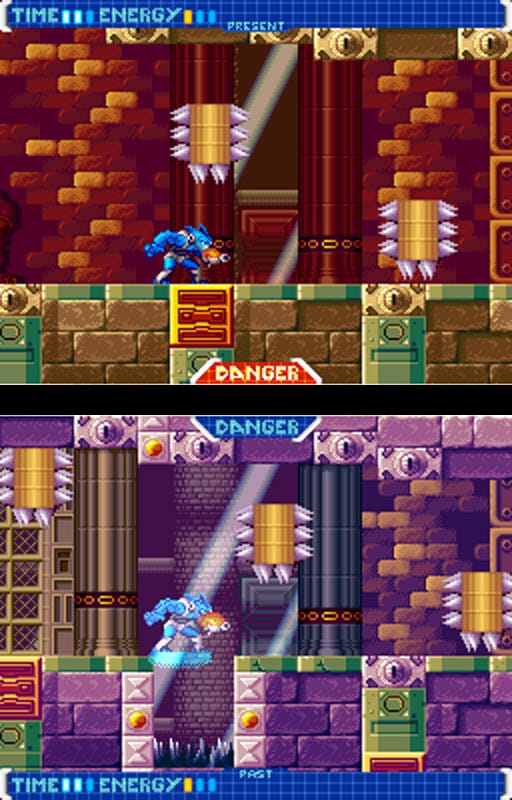
There are not many platform games that leave you as confused as a dog does when you pretend to throw it a stick.
With the best intentions, Chronos Twin would be a relatively straightforward, average platformer were it to lack its gimmick. With it in place, however, it ups its game considerably. It's a dextrous challenge; the equivalent of patting your head and rubbing your tummy at the same time. Yet it's been purposely designed to work on that novelty, coming together as a coherent whole, with you hopefully becoming deft enough to avoid falling blocks in the past while concurrently hopping over energy balls in the present without a second thought.
Though having said that, with its deliberately confusing premise it's all too easy to overwhelm the multi-tasking part of your brain. When you factor shooting or avoiding enemies into the platforming equation, you'll often find yourselves in a fluster (although sound cues do help a bit). Unlike movement, each character's weapon acts independently of the other, and figuring out which screen to shoot on when the bullets start flying is a challenge in itself. Mess up and the irksome way the game freezes you in place for a second or so each time you receive a hit, or takes its time restarting the level, doesn't really help matters either.
Overall presentation is a little basic. Graphics are akin to a less polished version of the GBA Metroid games, the story is poorly translated from its Spanish roots ("A thing came out from nothing. He didn't know who was him."), and the less said about the odd blue man pouting on the box the better.
Still, it survives on the strengths of taking an innovative approach. It latches on to one of the DS's inherently unique capabilities and takes it as far as it can go. It can be a frustrating and arduous game at times. Death is frequent, and it doesn't readily do much to sustain its appeal when - or if - it clicks, but it's a neat idea worth checking out, especially at its budget price point.
7/10
Luminous Arc
- Developer: Image Epoch
- Publisher: Rising Star Games
People are prone to calling Japanese turn-based strategy RPG titles like this an obscure niche. Perhaps we should be re-evaluating that statement because it seems to me like there's a new one popping up every other month. Honestly, you turn your back for a second and another one shuffles onto the scene with a loud mouth and a bundle of Action Points to beg for our love. They'll be toppling first-person shooters before we know it.
Currently, Disgaea and Final Fantasy Tactics are the pick of the crop, but for the uninitiated they can be a relatively daunting experience, particularly with the former and developer Nippon Ichi's kitchen sink approach to battles. Luminous Arc is a lot simpler, whittling away a lot of the genre's indulgences for something a little more straightforward: fights are easy to comprehend, the level up fanfare sounds without fail every time you earn just 100 XP, customisation is limited to buying the newest weapons and armour, and the non-random encounters that make up the game's story are plotted along a thoroughly linear path. Battle-wise, you can attack and move, or move and attack with nothing in between, and no character is every lost for good.
A rotate map feature would have been handy, particularly when characters bunch together.
In fact, it's a bit of a relief to play something like this that doesn't need you to endlessly grind your characters up to a suitable fighting level for the next chapter, or to juggle the complexities of a job system, even if the end result is a game that's a little shallow on the strategy side.
But while the battles themselves are relatively short and non-taxing, they're sandwiched in between a lengthy plot told via interminable dialogue bandied back and forth between the facing stills of two interchangeable characters. The amount of voice acting on offer is an impressive touch, but the story's your usual fantasy manga clichés, full of prepubescent boys with weighty burdens, big-breasted girls in skimpy attire, and cute mascot blobs.
For anyone overwhelmed by Nippon Ichi's efforts to stick OTT turn-based battle anywhere they please, Luminous Arc does have its benefits. Although some may find it lacking, its undemanding level of play and overall polish may endear it precisely to those who want to dip a toe in the water before swimming with the big boys. If you can stomach the story, and the isometric viewpoint giving you occasional trouble when trying to select your desired unit with the stylus, it stands as a decent bite-size alternative. Anyone else, though, would be better off waiting for the DS's next turn to see if it spits out something more meaty.
6/10
Honeycomb Beat
- Developer: Hudson Soft
- Publisher: Rising Star Games
You know, back in the pre-millennial Gameboy days this might well have turned out differently. Back then, we'd have expected nothing less than a bright and breezy puzzler to entertain us as we lounged about in our Fruit of the Loom jumpers, knocking out solutions to a tune of bouncy J-Pop while smiley animals in front of sparkling backgrounds egged us on with positive words of encouragement. It's a different world now. Puzzle games are growing up. Now it's all stark minimalism and techno beats and lifestyle games, with cheery bumblebees nowhere to be found. How depressing. Not like in my day. Grumble grumble.
If you can't get this one, you might as well give up now.
Putting looks to one side, the hook to this particular puzzle game is to flip over hexagons (i.e. honeycombs) on the grid by tapping them with the stylus in order to make them all one colour. It's not that easy, because turning over one also flips its neighbours. The trick, in that case, is to tap the right ones in the right order. Do so within a limited number of moves (i.e. beats), and you'll earn your merit.
The 200 challenges on offer range from the obvious to the obscure, further complicating matters with direction-changing arrows and hexagons that only flip properly after a certain number of taps. Beyond this there's a rather unexciting endless mode in which lines need to be cleared before they creep to the top of the screen, and that's your lot.
There's stuff here to keep you occupied for a short while and it does enthral to a certain extent, yet the DS isn't exactly starved of puzzle games, and this one in particular doesn't do enough to draw you in completely. All things considered, Honeycomb Beat just isn't as addictive or substantial as it needs to be to make it a classic.
6/10
Real Football 2008
- Developer: GameLoft
- Publisher: Ubisoft
A bit rich calling this Real Football, since this big league wannabe features neither the ability to belatedly collapse at the goalmouth, screaming like a girl after receiving a light tap, or, indeed, anything in the way of official licensing. Worse, there's not even the ability to edit names so, as is the tradition with unlicensed football fodder, Raanay, Fertinond, and Naville of Manchester Red are here to stay.
As for the 'real' on the pitch, it plays an alright game, with a smattering of fancy footwork in the exhibitions and prescribed cup and league games, though nothing ever approaching incredible - like any realistically-styled DS footie game, it could do with some decent analogue controls in order to really make it flow. Off the pitch, managerial decisions are limited to picking formations and making substitutions, while graphically the players are particularly blocky and bland, and the stadiums a tad dreary.
Perhaps Real Football's silliest feature, though, comes when being booked by the overzealous ref for yet another ill-intentioned sliding tackle. You're meant to influence his punishment decision by bellowing protests into the microphone. Not something that particularly appeals and a rather ineffectual tactic when it came to spewing my own embarrassing invective. Thankfully, it's cleverly bypassed by tapping loudly on the microphone itself, so problem averted.
To coin another sporting term, it's all par for the course for Real Football. It's blatantly stepping on both FIFA 08 and (fingers crossed that it's better than last year's) PES's toes (even managing to homage a couple of the latter's features). So when you take into account the lack of Wi-Fi, and that multiplayer requires a card each for a match, you're best giving the underdog a miss this year and selling your soul to the perennial stalwart of your choice instead.
5/10
Cookie and Cream
- Developer: From Software
- Publisher: 505 Games
Be warned: Cookie and Cream gets two strikes against it straight off the bat. Firstly, it's a PS2 port, something that Nintendo are needlessly plagued with right now. And secondly, it involves blowing into the microphone, a baneful DS experience that inevitably ends with us hyperventilating on the floor after one ineffectual puff to many.
You'd have an angry face if your job was to hang around while the other person got a move on.
The huffing and puffing we can't forgive readily as there's no getting away from it. Its PS2 origins, though, we can since Cookie and Cream is sourced from one of the better, more overlooked games from the console's early era. You might recognise it better as Kuri Kuri Mix, a co-operative obstacle course challenge in which one of the two titular rabbits must help the other one get to the exit at the top of the scrolling path.
As Cookie hops along the top screen, he'll come across buttons preceding impassable barriers. By jumping on top of these, it gives Cream, positioned on the bottom screen, the opportunity to operate a simple device via the stylus in order to clear the way. Each one offers up something from a variety of different methods, from button pushing, rope cutting, dial turning and the hateful mic blowing, etc., constantly mixing them up to stop things getting too stale..
Each stage is set against the clock, with penalties in place for dying or hanging around in one spot for too long. It's perfectly easy to finish a level and unlock the next by just steaming through, but that's not the point of the exercise. You only get a good score if you do it without your time limit running out, so some measure of efficiency is needed to get a good run. Those points eventually unlock your usual array of bog-standard mini-games, but that's by the by.
Like the PS2 version it's designed with two players in mind, and full single card co-op is essentially a brilliant idea, yet the final result is slightly disappointing. By scaling it down from the original's joint adventure through the obstacle course, the touch screen player is now left with nothing much to do except stand there and knock back the occasional ghost while the other character hops along to the next puzzle. Often it's more entertaining to tackle things on your own, giving you more to challenge yourself with. But for all its limitations, it's fun to play through with a friend or to come to the aid of a younger player. It may not last long, but it's entertaining while it does.
7/10
