Puzzle Quest Galactrix Review
A small step or a giant leap?
Version tested: Xbox 360
Developers of casual games usually relish the chance to de-nerd the hobby on whose periphery they operate. For example, PopCap litters its titles with unicorns and rainbows without apology. They feature characters and colours which rarely get a look-in when it comes to contemporary gaming's brown, bloom-soaked vistas. It's understandable. If you're going to design a game to appeal to as broad an audience as possible, why dress it up like something that just stepped out of Forbidden Planet?
By contrast, Puzzle Quest developer Infinite Interactive celebrates geekery. The first game may have had a straightforward colour-matching mechanic at its core, but the setting was pure Dungeons and Dragons. All giant clicking spiders and pointy wizard hats, it was as nerdish and traditional a gaming scenario as you could imagine.
Galactrix is just as content to settle into orthodox geek territory, with the sort of sci-fi set-up that's been familiar from Elite right through to Mass Effect. This time, however, it's more difficult to call the underlying game in any way casual.
At its core Galactrix remains a matching game. Sure, you travel an entire galaxy in a hulking space ship, taking on missions (up to four at a time), mining asteroids, trading resources, hacking warp gates and recruiting crew members. However, almost every action has a gem matching minigame at its centre.
The rules are simple: create lines of three or more like-coloured gems to make them disappear. Match red, yellow or green gems to harvest energy to power your ship's equipment; match white gems to earn experience points (‘Intel') to level up your character; match blue gems to add energy to your ship's shield, the buffer that protects your hull; and finally, match mines to inflict damage on your opponent. Reduce your opponent's hull HP to zero and you win the battle. So far, so Bejeweled-in-space.
The game's most obvious innovation is that the board and its pieces are hexagonal. This means pieces so can be swapped in six directions rather than Puzzle Quest's four. Also, as Galactrix is set in space, gravity is non-existent. The direction new gems flow onto the board is based on your last move, rather than the usual top-to-bottom movement. If you slide a gem upwards to complete a set, the gap they leave will be filled by gems flowing up the board, and vice versa.
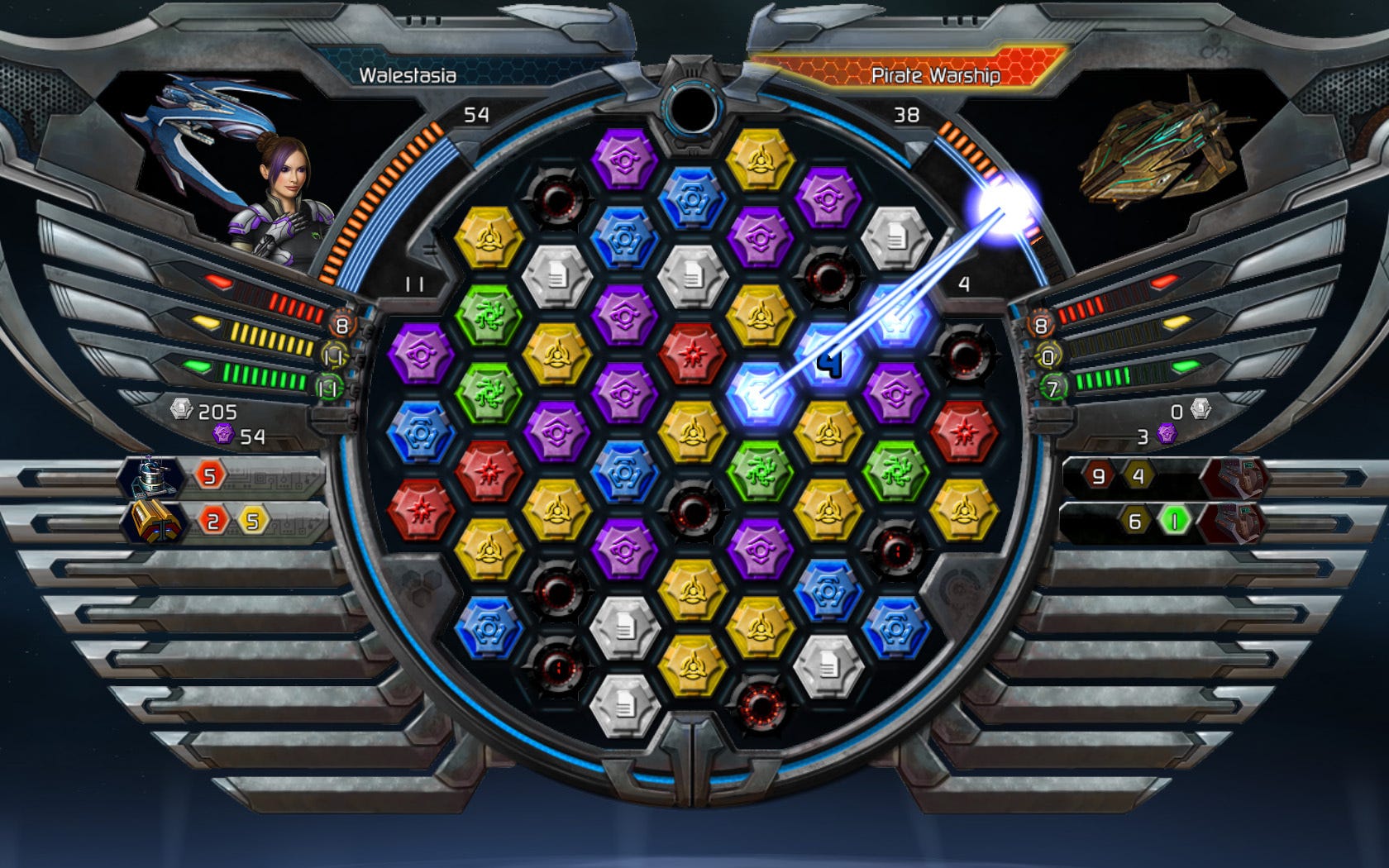
You still earn experience points even if you lose battles, happily.
The thinking behind these innovations is sound. Match-three style games are ubiquitous and, from Zoo Keeper to Bejeweled, the mechanics remain constant. Puzzle Quest may have married them with an RPG framework to add interest, but the core remained straightforward. Galactrix, by contrast, vastly ups the number of statistical possibilities for any given board, increasing the game's bedrock complexity.
Of course, an increase in complexity doesn't always tally with an increase in enjoyment. Galactrix's boards are far less readable than those of its predecessor. Whereas before you could foresee chains two or three steps in advance, this new cat's cradle of possibilities makes earning cascades about blind chance as much as careful planning.
Mistakes are also more common. Gems don't always swap with the neighbour you intended due to the new six way directional options, a problem that is exacerbated as the game progresses and you try to hurry through battles.
The object of your attacks is now the enemy ship hull's HP, which, like yours, is protected by a shield buffer. Attacks will deplete the shield before denting the hull HP and, as shields can be replenished by collecting blue gems, there's a neat risk and reward element to gem collecting.
Mines also come in four different strengths (one, thee, five and ten). The amount of damage dealt to your enemy is the aggregate of the values included in the chain. This is a good decision that helps add nuance to the offensive aspect of the game, although it's also now far easier to go from a win to a loss in moments.
Battles are an important part of gameplay as you fight space pirates and vie for control of a particular area of the solar system. However, a great deal of your time will be spent in other, non-combat minigame scenarios.
The galaxy's legion asteroids can be mined for resources, which can then be sold at space stations around the galaxy. The mining mini-game, like Puzzle Quest's item forge system, requires you to match a quota of specific gems. The solar system boats its own diverse economy so, if you want to get the best prices for your new cargo you'll need you travel to (and haggle with) those space stations that are offering the highest trade prices for a particular resource.
Mined cargo can also be used to build items and entire new ships if you have the relevant team member and plans. This economical underbelly to your quest adds both depth and breadth to the experience.
The character classes of the original Puzzle Quest are gone, replaced by the different ships your character can use. The shift, while at first looking like a simplification, soon reveals itself to be worthwhile. You can have up to three ships in your fleet at any one time, and their design changes the way the game plays out: a fast ship will help you speed past attackers in a hostile part of the galaxy, a slower, larger ship will offer lots of equipment slots for customisation.
Equipment replaces Puzzle Quest's magic system although it works in an identical way, granting various offensive and defensive abilities during battle. For example, the Bola Mines item doubles the number of mines on the board while Shield Matrix adds a +5 to your shield total. Choosing the appropriate ship for a battle is important and adds a decent high-level element of strategy to the game.

There's no more 'Heroic Effort' bonus, but a similar substitute.
Galactrix is a huge game constructed from various discrete areas. On the galaxy map each star system is represented as a node and there are well over 50 of them to explore. They are connected by way of LeapGates, and each contains eight or nine planets and asteroids to explore.
As such, unlocking the full run of the galaxy will take tens of hours. Unfortunately you can only access nodes whose LeapGates you've ‘hacked', another mini-game that requires you to clear a board within a strict time limit. This minigame fast grows tedious and, as a literal barrier to exploration, is one of the game's most enduring irritations.
Whether you feel as though Galactrix is a small step or a giant leap on from Puzzle Quest depends on a vast array of factors: whether you prefer the space setting, the new emphasis on economy, the focus shift away from battles to a more diverse range of non-combative tasks and, of course, the deeper but less accessible core gem-matching game. But for us, the result is a dilution, not a distillation of Puzzle Quest's relentlessly compelling formula. It's a game that drives the franchise too deep into niche territory, where it loses sight of the elegance and simplicity which turned the match-three genre into an everyman phenomenon.
7 / 10
The version reviewed was the XBLA code. PC and DS are available from the 13th of March, with PSN and XBLA to follow.
You may also like...
-
Ultimate Marvel vs. Capcom 3 Vita Review
-
Sony admits "dropping the ball" with Demon's Souls
-
Grand Slam Tennis 2 Review
-
Skyrim patch 1.4 performance tip: make a new manual save
-
One Piece: Unlimited Cruise SP Review
-
App of the Day: Superman
-
Who Killed Rare?
-
Next Xbox has tablet-like touch-screen controller - rumour
-
Gotham City Impostors Review
-
Mass Effect 3 FemShep trailer debuts
-
Epic's Sweeney on graphics tech: "the limit really is in sight"
-
Valve admits hackers accessed Steam transaction log
-
CD Projekt: Witcher 2 intro cinematic "the most expensive asset we ever created"
-
Sony: The Last Guardian is making "slow progress"
-
Double Fine Adventure passes Day of the Tentacle budget
-
Blizzard legally opposes Valve's Dota trademark application
-
Skyrim patch 1.4 now live for Xbox 360
-
Kingdoms of Amalur: Reckoning Review
-
EA announces starry Syndicate voice cast
-
David Braben discusses consumer Raspberry Pi release
-
Sony confirms LittleBigPlanet Karting development
-
The Darkness 2 Review
-
Namco Bandai to publish new Star Trek title
-
Cheapest places to buy Kingdoms of Amalur: Reckoning
-
Amnesia: The Dark Descent follow-up teased


Comments (31) Latest comment 3 years ago
Comments threads automatically close after 30 days, but please feel free to continue chatting on the forum!
Comment below viewing threshold Show
When's it due out?
Comment below viewing threshold Show
By no means a bad game, and worth a look if you like the previous one. But if you have played neither I would start with Puzzle Quest as I think it will give you the more rewarding experience.
Comment below viewing threshold Show
Which is a real disappointment.
Comment below viewing threshold Show
The gems fill the gaps based on the direction you move the gem to create the match. It's not as clear cut and easy to see as the first though, and that was my main problem with the flash demo. The core gameplay has been over complicated by moving to hexagons and spoilt the simplicity and hidden depth of the original. I've got three versions of the original but I'll be skipping this.
Comment below viewing threshold Show
I had exactly the same problem until someone pointed it out to me
Comment below viewing threshold Show
*sigh* Physics 201 wants you back in the classroom.
Comment below viewing threshold Show
I found that constantly losing the first couple of turns was primarily due to my own mistakes. Leaving mines available for the enemy to grab, not looking at his energy levels and preventing him from grabbing the gem colours he needs
Er are you having a laugh there? Seeing mines and being able to trigger them are two different things entirely. Usually the random tile cascade that occurs when you make a match will drop new mines that the computer then gets to use against you in it's turn. Stealing a colour the computer needs usually leads to the computer still getting a chain that actually makes those colours for free (happen a lot in this game).
Lots of the mini games are simply frustrating and until you tech up your ship, you are going to be loosing a hell of a lot!
I played my friends review/promo copy and nearly threw the damned thing across the room!
Comment below viewing threshold Show
Ending is rubbish too.
Comment below viewing threshold Show