PSP Roundup
Some of the minor players on the PSP stage.
PaRappa the Rapper
- Publisher: Sony
- Developer: Sony
Kick! Punch! It's all in the mind! And now on your PSP! The paradigmatic rhythm action original is back, along with all its Saturday-morning kooky cool: PaRappa and chums PJ Berri, Sunny Funny, Katy Kat return, as do PaRappa's musical mentors Chop Chop Master Onion, Mooselini, Master Prince Flea Swallow, Cheap Cheap the Cooking Chicken, and MC King Kong Mushi. Indeed this is almost precisely the same game that wowed the videogame world when it was originally released ten years ago: six songs, the original rhythm-action button-tapping game mechanics, and a still-superb sense of style.
That does mean that the game's chief drawback remains that it is only six songs long - rhythm action specialists will complete this in an hour or so. But the six songs in question remain gleefully infectious and it's difficult not to want to play them again and again - not least because the PSP version allows you to download multiple remixes of all six after you've completed them once. Apart from that the only new addition is a rudimentary and pointless ad hoc mode.
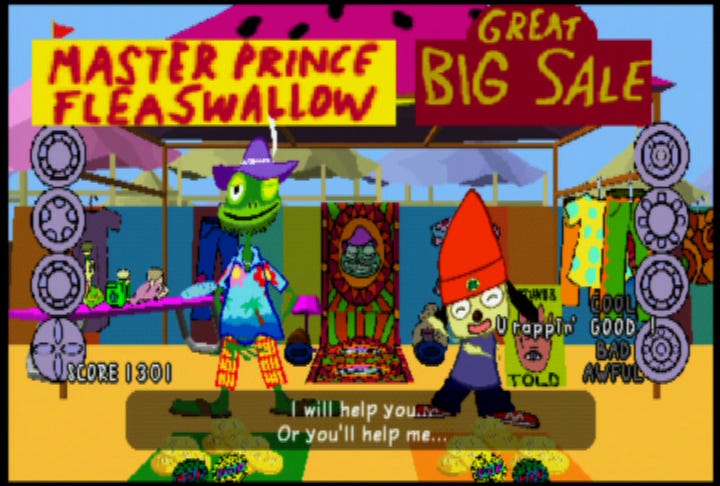
So it's a difficult game to review. It's difficult to divorce the game from its original context, and it's difficult to put a score on the sense of joy that the game effortlessly imparts. The great strength of the game back in 1997 was its originality and verve, which cut through a vast swathe of cookie-cutter similarity like one of Master Onion's paper-thin kung fu kicks. Now, though, it's been out-originalled by about a million other quirky music games, and its rudimentary rhythm action mechanics have been absorbed and evolved by an entire genre. It's still cool, and it's still charming, and it will still fill you with glee. But it somehow fails to make such a dramatic entrance as it once did.
7/10
Dave Mirra BMX Challenge
- Publisher: Oxygen Games
- Developer: Left Field Productions
Ah, Dave Mirra. You make reviewing games so simple. After all, how much easier it is to stick the boot in to a lazy cash-in, than to try to do justice to the intangible ingredients of videogame excellence. You barely even need to play the latest BMX title to bear his name to know that it will be another quickly-churned out pile of graceless dross. After all, this is the guy whose name graced the charmless BMX XXX, right? Right. Actually playing through Dave Mirra BMX Challenge confirms every woeful preconception you might have had.
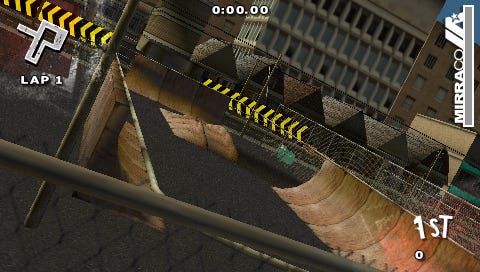
The game's career mode is divided across two modes: Race or Trick. You'll wonder why you bothered with either of them, partly because of the absurdly rudimentary track design, or physics-impaired trick mechanics, and partly because of the sheer, pointless ease with which you'll breeze through everything the game has to offer. Which, in case you're in any doubt, is not much. Your AI opponents are so idiotic that they can barely make it round the track, while the trick mode is beset by cheap exploits and hampered by boring and basic trick selections. The environments are an uninspiring selection of murky and sparsely furnished locations that do little to elevate the banal bike action.
This is an unfinished, utterly forgettable mess of a game. It can't possibly have been playtested, and everything from the horrible, unintuitive menus to the joyless game design is a dramatic statement of the low budget with which the game must have been developed. It's absolutely gob-smackingly disheartening to discover that BMX Challenge was created by the same company behind the amazing Excitebike 64. What a sorry squandering of such sublime talent. And what a waste of time it is to actually play the thing. Do yourself a favour and don't bother.
3/10