Prince of Persia • Page 3

Top of the POPs?

Ben Mattes, producer of Prince of Persia, can talk. Boy can he talk. But as one of the senior figures at Ubisoft Montreal, the studio responsible for the likes of Splinter Cell, Rainbow Six and Assassin's Creed, what he has to say is worth hearing - and there is a lot to say about what Mattes calls the "second reinvention" of Jordan Mechner's classic fantasy series, following on from the last-generation trilogy that encompassed Sands of Time, Warrior Within and The Two Thrones.

Ambition is a horribly overused term; inappropriately so by publishers, lazily by the press, us included. But as a collective creative force, Ubisoft Montreal's output, for better or worse, is a worthy recipient of the label. This is a studio genetically engineered to think big. It's the publisher's largest single creative force, 1,600 employees strong and counting with, according to a company rep, "20-something projects" in the works.

But thinking big, of course, doesn't always equal best. And Assassin's Creed, for all its astonishing technical achievements, was ultimately undone by its own vaulting ambition.

Yet, in spite of its failings as a game, its contribution to the collective has been crucial. Prince of Persia wouldn't exist without Assassin's Creed (and vice versa, if we're being pedantic). This is true both literally, in the sense that POP uses a modified version of the same engine, and conceptually, the Prince's latest caper representing the next link along in the evolutionary chain of the action-adventure.

1

He's back! And he's climbing things! No swearing this time. Princie.

So when we probe Mattes on the nature of Prince of Persia, he reels off at great length what amounts to the studio's thesis on the future of the action-adventure. He cites Capcom's Resident Evil 4 as a marker in terms of what he believes POP represents in this generation. "There's not really a single back-of-the-box feature that anyone will say 'that's what defines that game'. What made Resident Evil 4 so spectacular was the respect they paid to every single combining element to that overall experience."

It's not hard to guess which title Mattes might be thinking of when he adds: "We don't want to sell it as 'crowd' or 'open world' or 'great combat system'. All of those things wear off really quickly. This is a game where the full experience is so much more than any of its individual components. It's a unique, mature gaming experience."

Well, he would say that. But his argument hinges on the belief that Prince of Persia will deliver what, in the team's eyes at least, no-one else yet has: an experience that combines the freedom of an open-world game with the focused action and narrative development of a traditional third-person adventure.

Assassin's Creed, for instance, fails because its freedom is too daunting for the casual user. "The really advanced players get great flow, but casual players jump, stop, look. Jump, fall, die, start over. They don't get the same flow and it sucks," he argues.

But where Assassin's had the luxury of being a brand new property, unconstrained by any particular precedents or expectations, Prince of Persia self-evidently does not, and the team's structural head-scratching stems as much from the need to satisfy gamers' expectations as its own creative urges.

2

The Prince does some jumping. This is correct, Ubisoft. Continue.

The starting point is straightforward enough. "Prince of Persia is a young, acrobatic warrior saving the world through his agility and combat prowess in fantastic environments against overwhelming odds," reckons Mattes. "That's Prince of Persia. Everything else is just a layer of paint."

He also acknowledges that POP "is a brand where people really care about the characters; really care about the story". Something that is "usually not a strength" in open-world games, where character development and storyline are "sacrificed in order to have more player control. That's not something we could do on Prince of Persia."

The team's solution, then, is a "world structure that allows the best of both worlds": a "hybrid". To help us understand what he means, Mattes asks us to "look at Europe from a bird's eye view and break it down to its most simple, basic elements. You've got major cities - London, Paris - then the highways connecting them, nothing else.

"What you effectively have is a network. If I'm in London and I want to go to Prague, I have to first go to Paris; then theoretically I could go all the way down to the south of Spain on my way. But once I've made the decision and I'm on that highway, it's linear, it's directed. Then when I get to Prague it's choice time: do I go left, do I go right etc."

That, in short, is how Prince of Persia functions. Multiple open-world regions connected by linear, tightly scripted routes in the spirit of its predecessors. "What that allows us to do is have this world with lots of choice, but we can make sure that even a casual player can have great flow."

Combat in the new Prince of Persia is also designed to stay true to the series' origins. "We wanted to hark back to the original Jordan Mechner Prince of Persia," says Mattes, "where you get hit and a third of your life is gone; you get hit a second time and you might get pushed against a trap that kills you and your dead. There's a sense of urgency that comes with that type of combat - every fight really feels like a boss fight, even if it's just a generic enemy."

This direction also serves as a mark of respect to the combat-heavy blockbusters of the genre. Mattes takes us back to 2004 and Warrior Within. "For about 30 seconds or so we were good, and then God of War came along. God Of War, Ninja Gaiden, Devil May Cry 4 - they all have mastered that combat system of a lone hero against tens of simultaneous enemies.

"And we thought, let them have it - that's not the type of fight we want to do anyway. What we want to create is a fight where you really feel the sense of danger - you don't feel like 'I am a god' slicing a path through 10,000 enemies."

Mattes cites the epic encounters of Namco's Soul Calibur as an influence here. And one side-effect of this focus on one-on-one combat is that it allows Ubisoft to go to town on the presentation. "Our inspiration was Final Fantasy Advent Children: really in your face camera angles during combat," says Mattes. "And it allows for some very interesting collaborative opportunities between the Prince and Elika, because the player is not having to micro-manage. There's the bad guy, mess him up."

3

Elika and the Prince duff up a naughty boss.

Ah, yes, Elika. Your AI companion is Ubisoft Montreal's Big Idea - and one, whether Mattes likes it or not, the marketing team is guaranteed to emblazon on the back of the box as a major feature. Revealed with a fanfare at UbiDays back in May, Elika is nothing less than a make-or-break feature. "I'm basically betting my job on this," Mattes acknowledges.

Partner AI is certainly not a new concept in the genre, but as far as Ubisoft is concerned, "we don't think it's ever been done well; including Sands of Time". Every other videogame example, to Mattes, has proved a hindrance to the player in some way.

"You're a superhero and you're babysitting this nag, who's getting lost, running into things, crying 'help me!' - it's so annoying," he complains. "We've created a support character who you will never be frustrated with. She's not going to piss you off, she never gets lost, she never falls behind, she never takes initiative that you don't want her to, she's only ever there to support you and make you cooler. Always there, always available, always ready."

That's a hell of a set of claims. Ambitious, perhaps [steady - Ed]. So how does it bear up under scrutiny? Well, despite being down for a Christmas 2008 release, Ubisoft is not letting us anywhere near it just yet: the E3 build is strictly hands-off. Instead, Mattes walks us through a demo section prepared specifically for the LA showcase.

Before anything actually happens, we admire the distinctive visual style. You may have read about this already; Ubisoft calls it "illustrative" - "Let's not just draw inspiration from the illustrations; let's make the game look like the illustrations."

4

The Prince: he's not afraid to stand on things.

It's yet another side of the game where Mattes is keen to draw a line between his title and Assassin's Creed, labelling the latter as belonging to the current "hyper-realism and super detail" trend that he feels would be inappropriate for a fantasy adventure like POP.

Mattes is surprisingly defensive about the artistic direction, particular in relation to it being described by some as cel-shaded. "We don't feel cel-shading is the right term for it, as we don't feel that does it justice," he insists. "The level of detail is every bit as high if not higher than a game like Assassin's Creed." Yet another comparison. "Our characters are the same number of polygons; our world actually has more granular detail in terms of how crafted every object is."

Anyway, he needn't worry: it looks lovely. The Prince and Elika begin the demo in a vast canyon, and straight away we see how she interacts with our hero. Whether leaping, climbing or running, she sticks close by, seamlessly catching the Prince by the arm in mid-air and hurling him forwards when a long jump is required, or swinging past him on a ledge climb when he changes direction. These animations look great, but more importantly are designed to meet the team's aspiration that Elika won't "piss you off".

Each area in the game is infected with something called The Corruption and it's your job to drive it out, literally healing the world as you go. The Corruption manifests itself as a black goo that's deadly to the Prince, and provides the substance of the game's monsters.

The E3 walkthrough is essentially one long, multi-part boss battle broken up by platforming sections. The Prince swings from poles, runs up walls and bounds around with all the grace and agility you'd expect. It contains all the familiar traits of the genre, with Elika's abilities finessing the experience with depth and variety.

The 'Elika button' - triangle on PS3, which the game's being demoed on - is the one-stop shop for all your companion-related needs. It's all contextual: bugger up a jump and she'll sweep to the rescue; press it when you're just standing around and you can have a nice old chin-wag. This is used to convey extra background on the story and characters for those who are about such things, in a similar manner to the function performed by the tapes in BioShock.

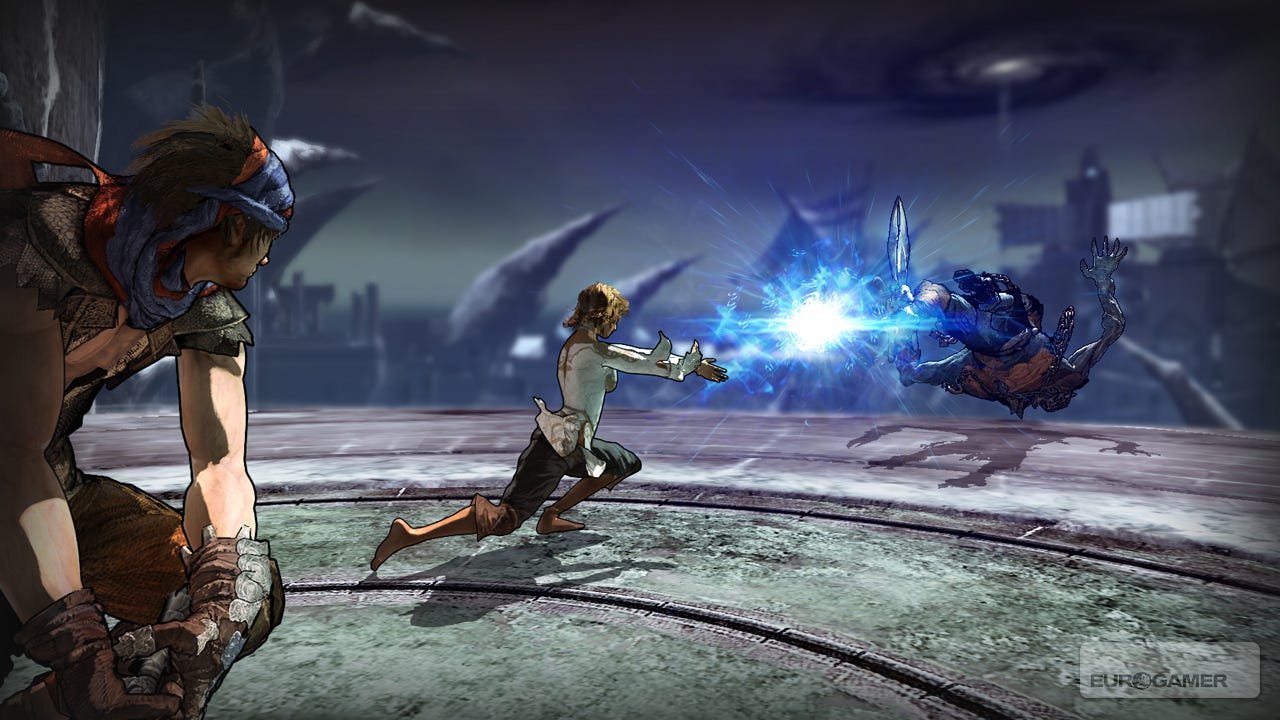
Elika's magical abilities are upgradeable. The two on display in the demo are a compass ability, which sees her shoot white light from her hands to show the Prince which way to go, and a rebound move, which enables jumps over vast and otherwise impossible distances, utilising specific areas marked on the environment.

You can upgrade Elika's powers in any order you like, and which powers you have will determine to a point where you can go. We're told progression will be "Zelda-like", where Elika's abilities will provide access to previously inaccessible areas as, say, the hookshot would in Nintendo's series.
5

Elika does some sort of fireball. We'll allow this.

But the main guy isn't without a few new tricks of his own. There's a slide move, for one, but more significant is the Grip Fall, where the Prince digs his gauntlet into a wall while falling to slow his descent and allow him to spring off elsewhere.

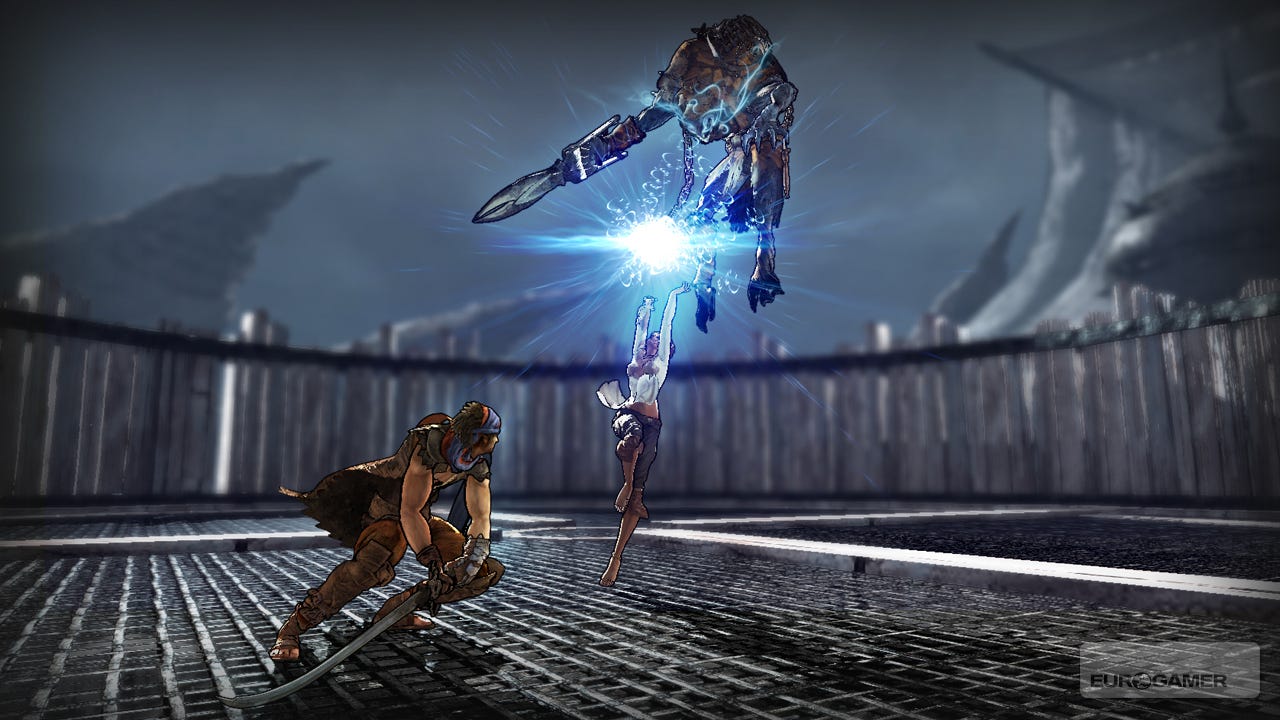
It's all very slick, but what really gets us going are the boss encounters. Here, the action becomes magnificently dramatic, aided by brilliant use of the camera, which dives in and out, seeking to give the most striking view of the battle. Here also, the glorious, pulsating beauty of the visuals is suddenly apparent - the giant beast the Prince is fighting swells magnificently with The Corruption, and the fluidity of movement is a joy to behold.

Each face button offers a different type of attack: sword, glove, jump and, of course, Elika. Since this is early on in the game, the bouts frequently pause to flash up single-line tutorials on how to block, counter-attack, escape grab attacks and so on. At one point the Prince and his massive foe lock weapons, requiring frantic button-bashing to avoid buckling under the pressure. The camera zooms right in for an extreme close-up, ramping up the tension. It looks awesome - as do the stunning vertical shots employed to show-off a meaty juggling combo as Elika wades in with her contribution.

Each time the enemy is overcome, it bounds off further into the level as the game switches back to platforming as you make your pursuit. Beaten for the final time, the duo gain access to the Fertile Ground, an area in which Elika's magical powers are spectacularly harnessed to force out The Corruption. Newly healed, the environment is transformed, with vegetation bursting from the ground and clouds breaking to reveal blue skies.

For all its current class, the code is clearly unfinished at this stage, with numerous bugs evident and a frame-rate that plunges dramatically in places. All things we'd expect to be taken care of before release, but one that does make us question the viability of a pre-Christmas release.
6

"I'm just going to stand over here while you sort that one out. My back hurts. That's it."

"At least in my conversations it's got to be out for Christmas," insists Mattes. "We want the Christmas market, we want a one year stagger with Assassin's Creed." But for a game of such importance to the company, clearly it won't be rushed out in time to be squeezed into little Billy's stocking.

"Obviously we're not going to release the game if the quality's not there, that's for sure," Mattes adds. But our goal is to make sure the quality is there in time." Given the extra time afforded to other Ubi titles (or, in Haze's case, massive waste of time), we won't fall off our chair if this one slips into 2009; but we are crossing everything that it does hit its date.

Either way, there won't be a demo. "Not planned," says Mattes. "Not necessarily convinced we need to; and doing demos of open world games is a technical challenge. It's a brand that has some history, some built in fan-base and we can benefit a little bit from that. There's just so many awful demos: you're doing your game a disservice by putting in players hands before it's ready. Nobody wants that."

What we see in our brief teaser is, according to Mattes, a "microscopic fraction" of the game's content (indeed, a sneaky glance at one of the monitors on the team's floor reveals a stunning-looking Mario Galaxy-style stage with the Prince scampering all over massive, rotating platforms in the sky).

Bursting with imagination and potential, Prince of Persia is surely up there with the most promising titles currently in development. One can only wonder how close the team will get to meeting its wild aspirations in the final analysis, but you can't help but admire the ambition.

Ubisoft aims to release Prince of Persia this Christmas on PS3, 360 and PC, with a DS title also in development.

Comments (41)

Comments for this article are now closed, but please feel free to continue chatting on the forum!

  • Loading...hold tight!