Retrospective: Police Quest III: The Kindred
Violation #395.7: Clicking on a review link without clear signal.
When you think Halloween you might not immediately think Police Quest III. In fact, when asked to name a classic adventure game there's a fairly good chance this would appear far down most people's lists. Further, I wonder how many people now even know that the long-running Vivendi SWAT series began as four point-and-click adventures?
Police Quest in fact reaches back as far as 1987, when the original parser-based adventure was made by Sierra in collaboration with ex-police officer Jim Walls. Aiming to create something more realistic the game followed Walls' own real-life experiences, as well as strict police procedure. Police officer Sonny Bonds begins as a traffic cop, but soon finds himself working a homicide case involving drug dealer Jessie Bains.
The second game followed the same motifs, with Bains having escaped from prison and after Bonds and his girlfriend Marie. (Scandalously, Marie was a prostitute in the first game who had aided Bonds.) This time the procedure and realism is ramped up to a ludicrous degree. By Police Quest III: The Kindred, Bains is dead, Sonny and Marie are married, and despite being promoted to Sergeant he finds himself back on traffic duty at the start.
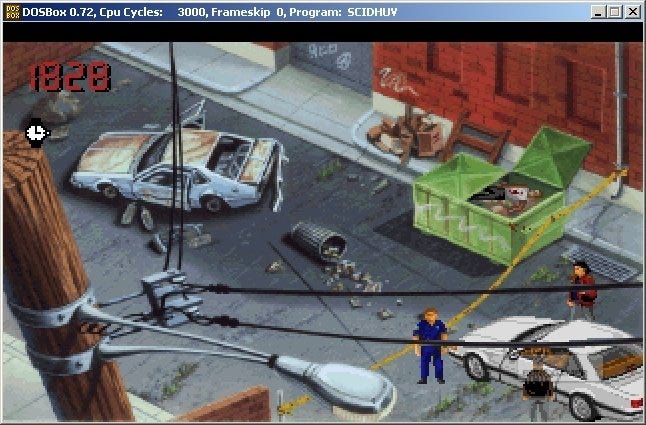
I'll say one thing for that alley – it's roomy.
You need to put PQ3 in context to understand its decisions. This was made in 1991, using Sierra's brand new SCI (Sierra's Creative Interpreter) language. Now fully mouse-controlled, it used the cycling cursors for interaction, and suddenly the designers felt free to try so many more ideas. Ideas that, arguably, the tech wasn't quite ready for. Such as the driving.
But even before that the game underlines its tone. The first task you must complete is filing the correct form with the correct person to receive your computer access card, in order that you can later appropriately file reports on your PC. While this may become a game about serial killers, stabbings and corruption, it's never not a game about remembering to do your paperwork. It's perhaps this that the Police Quest games are derisively remembered for today, but it's a reputation that I think is unfair, not only because they did so much more, but because doing it at all was a really good idea. Just perhaps not executed as well as it might have been.
But the driving. The city over which you have jurisdiction, Lytton, is about 13 by eight blocks, diagonally intersected by a highway. To negotiate it you sit behind the wheel, turn on the ignition, and then watch your car on a top-down insert with about six-foot of asphalt visible in front of you. You navigate with a combination of a near-useless second insert, a digital grid of the city, and the manual's map, taking turns at the right moment and then inevitably cranking the speed up to 100mph to try to make it be over more quickly. The game begins with so much of it, and it ends with even more, and there's far too much of it in-between. And it adds absolutely nothing to the experience. Well, perhaps apart from the earliest moments of traffic patrol, and then only if you remember to do it.
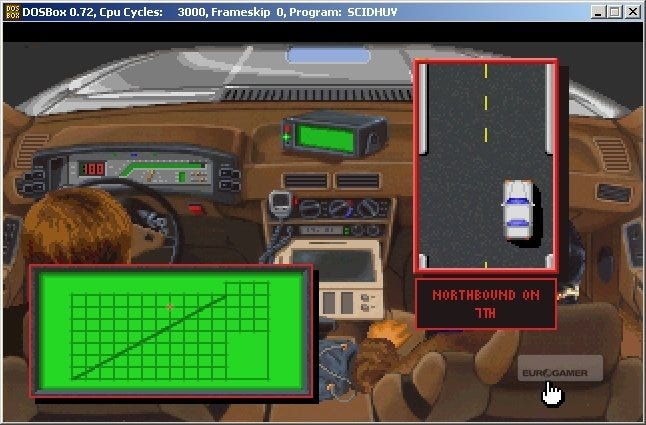
Oh, the driving. Why did they ever think it was good enough?
If you persist with ploughing up and down the highway you'll be asked to pull over a number of vehicles for various violations. Without being given any warning you must note down the time that briefly appears on screen, then speak to the driver (approaching from the near side, or you'll be run over instantly), and then apply the correct procedure for the circumstances. If he's speeding, run his licence in your car's on-board computer, then issue him a ticket. Drunk driving? Perform a roadside sobriety test, make an arrest, and take him back to the jail. Where you must correctly submit his possessions, make him take breathalyser, and then put him in the clink. SWAT 4 it is not.
However, should you steer off the highway at any point you might miss all of this. Which means you'll miss pissing off a rather unpleasant gentleman by the name Ruiz, who will later take you to court and open up all sorts of other details. Much is made of games with multiple pathways today, but gosh, Sierra was doing it way back when.
The game proper begins when Bonds' wife is near-fatally stabbed in a parking lot outside a mall, which means – magnificently strangely in a game otherwise obsessed with proper behaviour – you're put straight back into Homicide and told to find the attackers.
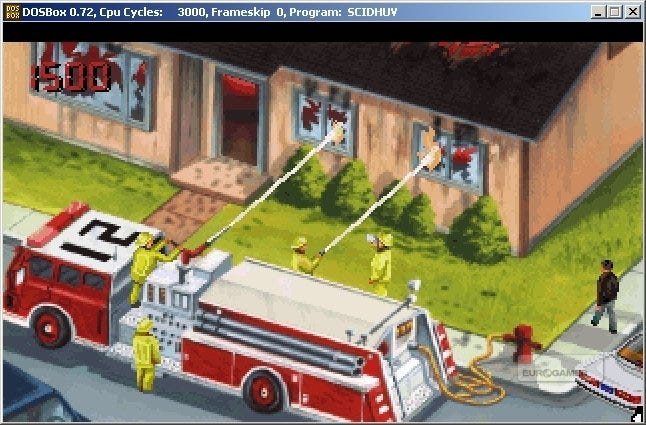
In most other adventure games the aim here would be to steal the hose.
And here's why I remember this game so fondly, despite its litany of ludicrous ways. It felt like, in a way that I wouldn't experience again until the almost completely forgotten but wonderful Spycraft: The Great Game in 1996, you were actually investigating. By examining old cases in the computer's records you discover a similar crime, and then another, and begin to piece together the actions of a serial killer.
Another murder occurs which you and your partner Morales investigate, and from this you realise the pattern that's developing. On top of that in the memory department is the graphics. They're a confusing mixture of hand-painted backgrounds, hand-drawn characters, and crudely cropped and animated photographs. But it was those photographs that had my jaw dropping back then. As ridiculous as that seems now. They were REAL PEOPLE!
And here's why I mentioned Halloween. Police Quest III was, out of nowhere, about a satanic cult. Each victim (bar your wife, who survived after the attackers were disturbed) has a pentagram carved into their torso. And later, perhaps infamously (and if you're concerned about spoilers for the 18-year-old game you'll never play, stop here), one rather enormous pentagram spelled out across the city's streets.
I mentioned Bonds' partner Morales. The first time you encounter her on traffic duty she's pissed off a pregnant woman so much that you – a superior officer – have to be called in. She's clearly trouble. So, er, she's also assigned to Homicide and you're told to work with her. So while her obvious badness isn't subtly indicated, there is a rather nice slow development of your suspicion.
Whenever you walk into the office she quickly locks her desk drawer. When the two of you arrive back at the station she'll always make an excuse to visit her car. And on a number of occasions she asks you to take her to the mall so she can make a phone call. It's on one of these occasions that you can nab the key from her purse, take it to the key cutters, and then later find out what's going on in that locked drawer.

Jim Walls may have retired, but damn, he's still flexible.
Beyond that nothing makes a blind bit of sense with her. You find stolen cocaine in her locker, report it to your Captain, and he tells you he'll call Internal Affairs and to watch your back. Then, out of nowhere, you suspect she's affiliated with this satanic cult and do absolutely nothing about it. Her eventual attempted betrayal makes no sense, her connection with the gang goes unexplained, and indeed why a bunch of satanists were running drugs and performing serial murders becomes bewildering, especially when it somehow has something to do with former nemesis Jessie Bains' brother. My poor head.
But that pentagram. This, before I replayed the game this week, was the clear memory I had. I remembered really loving the game, I remembered it being very hard, but most of all I remembered the pentagram. Each murder site, when plotted on a computer map of the city, formed four points of a five-pointed star. With this information you could then predict the location of the fifth murder and hopefully prevent it.
But of course it absolutely stinking didn't work. Plotting the star correctly so the game would acknowledge it was horrendously hard. And once again I struggled, echoing the frustration of my 13-year-old self. Until I discovered a patch – a term I wasn't even aware of in 1991. But still, ignoring that, what a cool idea.

This would be why most people laughed at the Police Quest games.
If it were a movie the cop would realise (either before or when it was too late) that it was only in discovering this fifth location that he was fulfilling its reality, and become the fifth murder victim by going there. If this is what PQ3 had in mind, it rather forgot to say so.
Instead you find a bar where the murderer attempts to shoot you, and then flees, eventually flipping his car on the highway and killing himself. So, um, what was that about it being the site of the fifth murder? But by then everything goes skewiff and you're tracing the cultists to their base and preventing their selling of drugs. It's something of a miracle they weren't dealing guns, running a prostitution ring, and smuggling sex slaves.
Clearly when I was 13 I was an idiot. There's just so much wrong with Police Quest III. But that didn't stop each new scene feeling like looking at old holiday photos. (Well, sort of. We spent more time in old castles or on the beach than in back alleys and dive bars. Oh, and there were fewer murders.) I think what the game reveals, more than anything else, is quite how much we've lost our ability to use manuals.

Sonny Bonds, the voice of assurance.
Quite reasonably I suspect, when a game fails to explain itself within itself we now criticise it. But there's something to be said for the reliance on a manual in PQ3. While the game does indeed feature some ridiculous random deaths (at one point you can literally "die of embarrassment"), an awful lot of the dead ends can be avoided simply by following procedure.
This reaches the tedious when you're putting each item of forensic equipment one by one into the case in the boot of your car before you're allowed to enter the evidence room to file your blood and hair sample (after entering the correct case numbers). But when it's about remembering to search a felon at the right time, so you don't get your neck stabbed, it feels quite sensible.
The game's story suggests lots of potential, and the writing throughout is strong. But its descent into incoherency and nonsense, and its failure to deliver anything interesting with the occult themes, means it's sadly a game that fails to conjure the charm that made other Sierra series be so fondly remembered. Police Quest III may not be that great, but it was at least interesting in how it was different.
You may also like...
-
Retrospective: Grim Fandango
-
Who Killed Rare?
-
Mobile Controller Group Test
-
The Story Behind XBLA's Biggest Game
-
Game of the Week: SoulCalibur 5
-
Why Devs Owe You Nothing
-
Face-Off: The Darkness 2
-
CD Projekt: Witcher 2 intro cinematic "the most expensive asset we ever created"
-
Gotham City Impostors Review
-
Valve admits hackers accessed Steam transaction log
-
Mass Effect 3 FemShep trailer debuts
-
Kingdoms of Amalur: Reckoning Review
-
Epic's Sweeney on graphics tech: "the limit really is in sight"
-
Double Fine Adventure passes Day of the Tentacle budget
-
Blizzard legally opposes Valve's Dota trademark application
-
EA announces starry Syndicate voice cast
-
David Braben discusses consumer Raspberry Pi release
-
King Arthur 2 Review
-
Namco Bandai to publish new Star Trek title
-
Amnesia: The Dark Descent follow-up teased
-
Diablo 3 release date narrowed
-
Skyrim gets high-res PC texture pack
-
Cheapest places to buy Kingdoms of Amalur: Reckoning
-
Five new Mass Effect 3 gameplay trailers
-
Skyrim makers create dragon riding, Kinect shouts, new skill trees


Comments (20) Latest comment 2 years ago
Comments threads automatically close after 30 days, but please feel free to continue chatting on the forum!
Comment below viewing threshold Show
...sorry guys.
Comment below viewing threshold Show
It was a time when they still wanted to do more than "just" an adventure game. Miss those times (even though I played it years after).
Comment below viewing threshold Show
This. Somehow, it never occured to me that after the first pull-over on the highway I'm supposed to _continue_ driving there. It was actually necessary to go to court with this guy to complete the game: IIRC at the very end, there's the thugs' hideout which has to have SWAT called in to bash in the door, and doing it is only possible if one has met the judge way back at the beginning of the game. I remember busting my head open over this and then I read somewhere (remember, there was no internet back then!) that I'd missed the whole highway patrol thing. Was a bit of a d'oh moment right there, even though d'oh hadn't even been invented then. Had to go back to a save towards the beginning, and redo the entire game. Still, it took me maybe an hour to complete it then.
Comment below viewing threshold Show
The style of Sierra games was completely different from Lucasarts. The latter made completely fool-proof games, in that you couldn't die and you couldn't "mess up", so you'd have to go back to an earlier save. Not so with Sierra: they loved killing the player, and yes, it was possible to miss something, or do something wrong, and only realise you'd done it wrong way later. Or, more often in my experience, not realise it EVER and get hopelessly stuck.
So, yeah, Lucasarts (Lucasfilm Games back then) is a class of its own. Look what happened with the companies, though: Sierra is defunct and Lucasarts is still around, even though they make bad games now.
The closest I remember Lucasfilm getting to making you hopelessly stuck in a game is Last Crusade where at two points throughout the game you find writings which tell you which grail to choose at the end. I never thought to write them down and had to reload a dozen times at that point and try all the grails in turn. Still, it wasn't a complete block, it simply made a puzzle a thing of trial-and-error when it could have been a simple affair.
EDIT: I still have very fond memories of Sierra games, although I probably can't recommend them now. I came too late to the party for the CGA games, so the earliest I can relate to are the EGA ones (King's Quest IV, Quest for Glory I/II and the like). Quest for Glory, by the way, is insanely good (especially part II) and I'd recommend it in a heartbeat. Which reminds me, I need to add it to my list of games to re-play when I'm retired.
Hmmm, I remember now I never completed Leisure Suit Larry 3, because my copy was faulty and crashed halfway through (on Atari ST). Of course, it wasn't an original, because we didn't have ANY original games in this country back then. I'll need to track it down and complete it; I remember enjoying it.
EDIT 75, probably: Not at my best writing ability today, it seems :/
Comment below viewing threshold Show
The only game my other half EVER liked.....surely someone must be able to point me to a remake??
Comment below viewing threshold Show
@John Walker: I love you. This was even better than the Police Quest 2 retrospective in PC Gamer a few months ago. I too had the same befuddlement when I realized you could miss the entire highway patrol section if you didn't just keep driving endlessly on the interstate to encounter BAD PEOPLE. Likewise, when Sonny excitedly blurts to the judge that he's convinced that this cult is running some kind of crack house at the final location, I was boggled. How the hell had he worked all THAT out? And that's before you have to make THREE round trips to said crack house (first alone, again with search warrant, again again with SWAT Team using a tank to smash the door in)
I'm pretty sure the guy who plays Ruiz made another appearance in obscure Sierra board-game-em-up Jones In The Fast Lane.
And did you not wonder why Sonny took his unmarked department car home with him every night? Or why he only had a two door patrol car, so all prisoners were sitting next to him in the front seat, surely within biting range? Or that the game was so obsessed with you making a 'right hand approach' on highway stops that after you mistakenly pulled over the DEA agent and then let him go, if you then failed to walk around the right of where a stopped car *should have* been, you'd still get run over in the same 'you didn't follow procedure' sequence? Only now the car very visibly swerves onto the shoulder to ensure it clips you (with accompanying girlish squeal from Sonny as his finger snaps off)
Comment below viewing threshold Show
I won't argue, because of course I don't remember the details. But how do you call the SWAT if you'd never met the judge? For me the courthouse did not appear, which means I couldn't go to meet the judge to get the paperwork done.
Comment below viewing threshold Show
Nowadays, every motel in America looks like that motel in PQ2 to me. I always expect to get shot in the stomach by a shotgun boobytrap when I open the door.
Comment below viewing threshold Show
*Green old voice*Merged with Vivendi, .... they are --hmmm?--*Green old voice*
*Cry of boy that found his real father* NOOOOooooooooo!!!*end of breath, and post*
Comment below viewing threshold Show
A few years later I bought the police quest compilation and could not get PQ3 to work because the driving was sped up.
Police Quest 1 was the probably one of the earlier games I played. The story and situations were quite fun. Things like getting ready for your shift and then driving around in your car responding to callouts, car chases and going on stakeouts.
Comment below viewing threshold Show
The hero's father was a police officer, but gets killed on duty. The killer is never caught, but his son (the hero) walked in his fathers footsteps and became a police officer, and is reasonably obsessed with finding his father's killer. Get this game if you enjoyed Police Quest, seriously.
Comment below viewing threshold Show
I didn't figure out the pentagram bit at first cos I thought a pentagram was like a pentagon. I was only 12, remember.
To this day, I walk around my car before getting in, to ensure there's no flat tires or anything else amiss