Phantasy Star Portable Review
PSP PSP.
Version tested: PSP
Our hobby is full of forgotten worlds. Cities whose streets and structures were once as familiar to us as New York to a Brooklyn cabbie, in time become as slippery to recollection as last month's dreams. Hills and valleys and forests previously understood as pieces of geography, defining landmarks en route to Rabanastre or the Imperial City, soon become no more than context-less clumps of polygon and texture. It is almost every game-world's fate to be forgotten, sunk as archaeological remains in the overburdened memory of the seasoned, universe-hopping gamer.
For many explorers, however, Phantasy Star Online, the Dreamcast's electric blue blueprint for all console-based multiplayer RPG space quests, is gone but never forgotten. The memories of fighting with friends and strangers for the first time through its purplish corridors and crimson caves remain so vivid we could retrace our virtual steps blindfolded. SEGA may have switched off the servers, but this world will always have its players, those Hunters and Rangers and Force who roam its turf by memory alone. As such it seemed certain that PSO's next-gen follow up, Phantasy Star Universe, would be a surefire hit.
Perhaps it was World of Warcraft's fault. Perhaps it was the sheer petrifying range of choice for the contemporary MMORPG player, or perhaps we mistook the fact PSO was the first and only console-based game of its sort for the illusion that it was the best. Either way, PSU failed to ignite the passions of gamers, its labyrinthine corridors walked by just a hardcore few after the first influx of prospective immigrants left unconvinced of its merits.
But Phantasy Star Universe nevertheless did a great many things well. For those players who could look past the idiotic decision to isolate its single-player and online campaigns (where progress in one had no bearing on the other) and its reliance on subscription-locked disc-shipped content, there were a clutch of neat ideas and elegant tweaks. These built upon and even improved the PSO template in some regards, especially with regard to matchmaking, the job of forming and maintaining a party of likeminded questers.
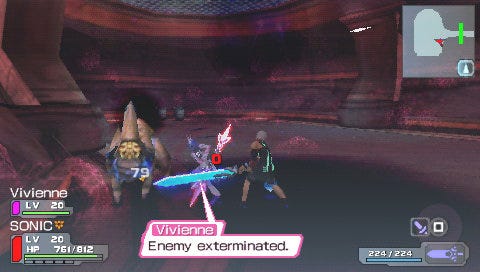
A tap of the select button will change your view to a first-person view, useful for lining up shots with the rifle, long bow, laser cannon or hand guns.
For that reason Phantasy Star Portable is still a notable release. It is essentially PSU in handheld form, a shrunken port of a forgotten world, but a game, which, in trying to fix that world's problems, has great potential. On paper, the signs are good. The game incorporates all of the PSU tweaks and amends introduced in the recent (and much overlooked) expansion, Ambition of the Illuminus, returning the player's character to the forefront of both the multiplayer and single-player experience.
The previous emphasis on item crafting is gone, refocusing play back onto the random drop system while maintaining all of the weapon and armour customisation that allows higher level players to show off to their peers. The game flow follows PSO's lead, offering a slew of Story and Free missions of varying length and complexity across a wide variety of planets, completion of which nets loot of varying degrees of usefulness. So far, so Sonic Team.
However, Phantasy Star Portable's minor victories threaten to be overshadowed by some ostentatious shortcomings from early on. Principle amongst the game's problems is the lack of online multiplayer: an oversight that, for the Western gamer at least, will seem indefensible for a game seemingly built for communal questing. The problem, as 14 million Japanese Monster Hunter fans will tell you, is a cultural one. While in Phantasy Star Portable's homeland, gamers will often gather at a location - a school hall, a bus stop, a shop corner - to play multiplayer RPGs with one another for hours, Western gamers prefer their handheld multiplayer gaming to be experienced remotely, across an internet connection.
This cultural discrepancy works doubly against Phantasy Star Portable, as the game appears on a relatively niche system in a niche genre. For many Eurogamers, the chances of finding another PSP owner who lives nearby, who enjoys multiplayer RPGs, who owns a copy of Phantasy Star Portable, who is of a similar experience level to your character and who is also free next Tuesday afternoon are so slim as to render the game's strongest selling point irrelevant.
There are two ways around the problem, neither of which are as effective as playing the game how the developer intended, with friends sat together in close proximity. Firstly, the forthcoming functionality that will allow online multiplayer games to be played via infrastructure mode through the PlayStation 3 will solve the problem (although at time of writing we were unable to test how well this works). Secondly, for the single-player it's possible to augment your team with three A.I.-controlled players, teammates who provide back up and healing to your character.
This is a welcome addition but, with atrocious path-finding (which creates real frustration when negotiating certain winding-corridor areas of the game world) and poor decision-making when it comes to healing and reviving fallen comrades, the feature falls far short of the ideal. While it's still preferable to take CPU-controlled teammates into battle with you rather than going it alone, your team is nevertheless burdensome, often at times when you have enough difficulties to contend with without their without their failings exacerbating your problems.
Other obvious concessions to the handheld format may put off PSU veterans. The world hub is now rendered as a 2D overhead map, while the NPC characters that you can interact with in these areas are now shown as static portraits, stills of the 3D models. Gone is the customisable aspect to your space station apartment, as is the item-feeding evolution system for your 'Partner Machinery' (PSU's version of MAGs), which is replaced by straightforward upgrades that customise your virtual combat pet's behaviour during battle.
But sometimes less is more and these features of the fully-fledged PSU did not make up its primary appeal. Instead, Phantasy Star Portable's reduction acts as a streamlining, reducing the amount of time it takes to explore the inter-battle world, making key NPCs quicker and easier to find, dropping load times to acceptable levels and removing much of the deadweight that clogged its immediate forebear.

On reaching level 20, CAST characters can deploy super-powerful SUV attacks while beast characters can transform into one of four creature types for different status upgrades.
What's left then is a snappy action-RPG with a huge amount of quest content, a diverse range of environments and enemy types and a selection of lead character types each with huge and engaging development trees (from Hunter to Fightmaster to Acromaster, for example): all the ingredients that made PSO such a compelling proposition and then some. This is a game for players who love to collect, who find thrill in the unpredictability of item drops, and pleasure in customising the minutiae of a character's appearance in order to show off to fellow players.
It's more accessible to Westerners than that other Japanese item collect-'em-up Monster Hunter, yet still deep and wide enough to warrant tens of hours worth of investment. The combat is fast-paced and often enjoyable, encouraging careful timing of inputs to build up powerful combo hits, and the game's solid strength in this area helps to paper over its obvious shortcomings in storytelling (which has always been a series weakness).
Judged in isolation as a PSP title, Phantasy Star Portable offers recurring glimpses of the unforgettable RPG multiplayer baby steps we first experienced with Phantasy Star Online on SEGA's Dreamcast. But today, with a wealth of multiplayer action-RPGs on the market for other systems, most of which are far easier to set up for multiplayer sessions, only committed players will have the tenacity to get the most from the game. For that reason, it's destined to remain a niche product in Europe, even if, for those who do fall for it, its depths as a handheld multiplayer RPG ensure it may never be forgotten.
7 / 10
You may also like...
-
Why Devs Owe You Nothing
-
Face-Off: The Darkness 2
-
Digital Foundry: PS3 Skyrim Lag Fixed?
-
App of the Day: Sir Benfro's Brilliant Balloon
-
Ultimate Marvel vs. Capcom 3 Vita Review
-
Sony admits "dropping the ball" with Demon's Souls
-
CD Projekt: Witcher 2 intro cinematic "the most expensive asset we ever created"
-
Skyrim patch 1.4 performance tip: make a new manual save
-
Grand Slam Tennis 2 Review
-
Who Killed Rare?
-
One Piece: Unlimited Cruise SP Review
-
Gotham City Impostors Review
-
Kingdoms of Amalur: Reckoning Review
-
Valve admits hackers accessed Steam transaction log
-
Mass Effect 3 FemShep trailer debuts
-
Epic's Sweeney on graphics tech: "the limit really is in sight"
-
The Darkness 2 Review
-
Double Fine Adventure passes Day of the Tentacle budget
-
Next Xbox has tablet-like touch-screen controller - rumour
-
Sony: The Last Guardian is making "slow progress"
-
App of the Day: Superman
-
Skyrim patch 1.4 now live for Xbox 360
-
Blizzard legally opposes Valve's Dota trademark application
-
EA announces starry Syndicate voice cast
-
David Braben discusses consumer Raspberry Pi release


Comments (22) Latest comment 3 years ago
Comments threads automatically close after 30 days, but please feel free to continue chatting on the forum!
Comment below viewing threshold Show
I mostly remember PSO because it wasn't a 'proper' PS game. Still, we got Skies of Arcadia which was a decent trade...
Comment below viewing threshold Show
/rev's up heaven punisher
Comment below viewing threshold Show
My opinion from the demo though is that it wasent very good. It had the general template down but didnt feel anything like PSO. which I loved (and played constantly, mostly in offline mode).
Which is a shame :/
Comment below viewing threshold Show
Or nothing.
Demo was allright I guess, but so was the DW:Strikeforce demo (if a little hard) and thats clearly a very similar style of game.
Hmmmmmm.
Comment below viewing threshold Show
I may give it a second chance one day because I love games that have massive character customisation & rare loot.
Comment below viewing threshold Show
Sorry Simon, but that's just a mishmash of memories and garbled thoughts you put down here, you spent more words telling what it's not and whining about cultural differences than describing what it is.
edit: Vistrix just above gave a lot more information in his comment than the whole articles does, thanks Vistrix!
Comment below viewing threshold Show
There's no in-built online multiplayer. There's a single player story mode and a local multiplayer you can play with anyone you can see. The caveat to this is that with Ad-hoc party on PS3, you can pretend that you're near someone who's actually online somewhere else, but there's no server to connect to as with online RPGs in general.
Comment below viewing threshold Show
I'm sorry you feel confused by the review. The section on the cultural differences is important because this is a game made for a Japanese market to play in a peculiarly Japanese way. We simply don't have a culture in the UK of meeting up en masse to play PSP games (something which is massively widespread in Japan thanks, in main, to Monster Hunter).
As such, its important to talk about these differences because, for the vast majority of players who will be reading this piece, they won't be able to play the game in the way it was intended. When a game's primary purpose becomes redundant due to cultural differences then you need to address that - it's more important than a survey of which button does what etc.
That said, I may have assumed too much knowledge of PSO/ PSU of some readers. If that's the case for you then hop over to the PSU review on EG for a more detailed breakdown of the game's workings.
Simon.
Comment below viewing threshold Show
Its kinda like diablo you can quest single player and in this case they have a full story worked out or you get group of friends together and then its multiplayer (MMOish). The 360 version the single player character and online character were seperate which was frustarting as you had to level a character twice (PSO let you just move the character between them).
Comment below viewing threshold Show
I imagine the fee on top of Live is what killed PSU before it ever really took off, and after this many failed relaunches I imagine that PSO is confined to the annals of time.
PSO and PSO v2 - you are gone, but as the review said, you are not forgotten. Thanks for the memories!
Comment below viewing threshold Show
Phantasy Star Zero is more of a straight sequel to PSO though, and will be more interesting for old PSO fans.
I liked PSU though, and would probably still play it, it if was free. So I've been waiting for this to fulfil my PSU needs.
@schnide: You can play PSU on a silver account, so you don't need Xbox Live for it. That said though, most people who played it online probably had Gold as well.
Comment below viewing threshold Show
Doesn't say much for Westerners, EG.
Comment below viewing threshold Show
/review was a bit lacking on details.
Comment below viewing threshold Show
Ambition of the Illuminus was ok but playing online quickly put me off as the remaining comunity was quite clicky and no one used mic's.
I picked up PSP today and so far it's quite good. Not used to all the new potions and stuff and much prefer it to the original PSU. Keen to play this in ad-hoc.
Comment below viewing threshold Show