PES 2010: Pro Evolution Soccer Review

The revolution's coming, but not yet.

Version tested: Xbox 360

For a football game that once lived or died on the pitch, it's surprising to discover that PES 2010's most dramatic changes are to be found in the menus. Or at least it would be surprising, except nowadays we live in a world where dogs and cats play together, the FIFA games are recognised for their football simulation, and Robinho may be surplus to requirements because of Craig Bellamy.

Between them, Team Style, Player Cards, and a change in the way player skills are represented on the line-up screen, sound about as exciting as Wayne Rooney's haircut. But they rip the lid off a lot of PES voodoo. Back in the old days, squeezing the most out of 11 players meant studying endless statistics and being able to decipher skills pentagons at a glance. Withdrawing the pentagons in favour of numbers may seem regressive (and it would be nice to see the former brought back as an optional extra), but it does mean you can spot tactical errors and players out of position in a split second while surveying the whole team.

Player Cards, meanwhile, let you burrow down and uncover a particular player's unique attributes, like pinpoint passing, or poaching, and you can even toggle certain behaviours, expanding your range of tactical options considerably. Team Style, for its part, lets you adjust the team as a whole, most helpfully in how much it keeps its shape and its response to common situations. For people who have played PES forever, it's a useful trio of changes, which makes it easier to perform complex surgery on your team quickly and at very little cost to the game as a whole. For inquisitive newcomers, it's a warm embrace.
1

The new penalty system comes as a shock. I have no idea what I'm doing with them. Good luck.

It's not the only welcome sign in a game that looked like it might be on its last legs this time last year. The UEFA Champions League is back, but the presentation is much more impressive (slicker than the main game's, actually), and it and the Europa League are now integrated in the Master League, which remains the superior option to FIFA's rival Manager Mode (unless they fix it, anyway). There's also a new "Community" area, where you can keep track of local games between you and your friends, rather than just bouncing off Exhibition mode all the time, although the latter is tempting anyway since it's quicker to start a match, with a much simpler interface.

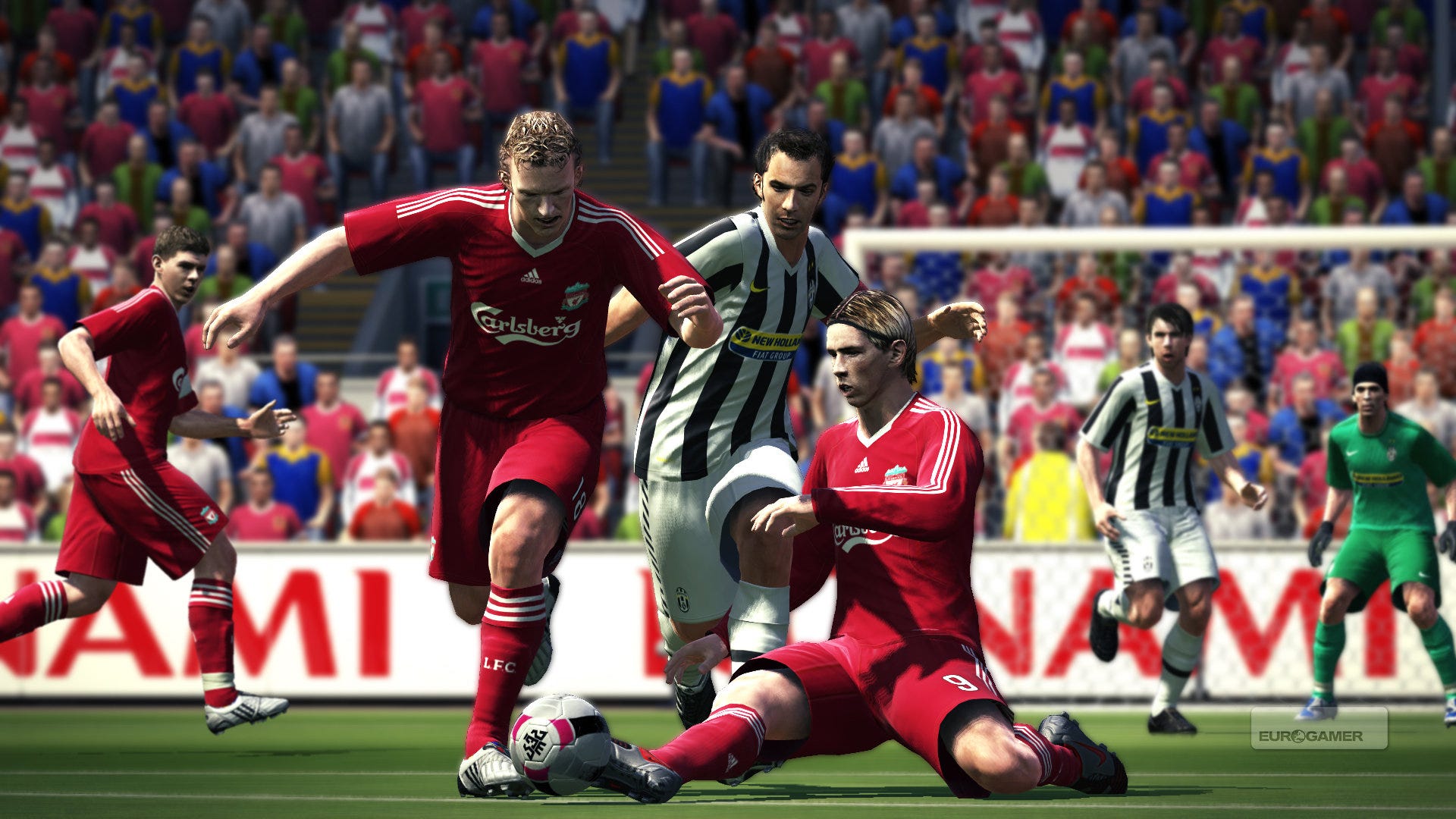
On the pitch, PES 2010 still feels like it's running on rails rather than flowing freely in any direction, but there are more rails and the degrees of separation are smaller, allowing you to run around and turn with the ball in ways that provide greater versatility, and make it less likely your opponent will simply be able to guess what you're doing. The graphics engine has received a big boost too, with much-improved player likenesses (some, like People's Hero Steven Gerrard, are now more uncanny than Uncanny Valley). Nobody would struggle to spot the common genes by staring at PES 2009 and 2010 side by side, but in many respects the transition is as night to day (although they didn't have to take that quite so literally by saturating the right-hand penalty area in glare during daytime matches).

All the same, PES 2010's improvements are bittersweet in light of the massive distance Konami still has to cover. PES is famous for the scarcity of goal-scoring opportunities, but in 2010 this is frequently becau se of a quirk of the creaking game engine rather than a design flourish: it's relatively awkward to pass the ball around and dribble over short distances (the slow and sideways dribble buttons are no excuse for proper analogue control), changing direction more than a few degrees robs you of too much momentum, and unless you're perfectly set it also takes so long to dig out the average shot that the tracking defender, who may have been behind you for the length of the pitch, will have ample time to get a block in or put you off-balance.

Even so, it's easier to score in other ways. You may not be able to do much on the deck in the penalty area, but long-range efforts and headers from crosses are surprisingly potent, and if you're playing against the AI, you may find that it passes the ball around in its own half with no sense of urgency once you take the lead. That sense of inconsistency is something of a theme: despite improvements in animation, it's a rough and clunky experience in many places, where something as simple as playing a quick pass when receiving the kick-off almost knocks Carlos Tevez on his back, and goalkeepers are achingly slow to distribute the ball. Players also regularly take the long way around to run onto passes, or defenders allow them to do so, stretching your suspension of disbelief to breaking point.

2

The licence situation is still stacked heavily against PES, despite a solid use of the Champions League. When those nights roll around in Master League, it feels special.

Next to PES 2009, it's still a big improvement all told, but next to FIFA, as it inevitably must be, it's still a poor second choice, losing out in terms of manoeuvrability, player movement and acceleration, simplicity and versatility in control, and - crucially - believability. Yes, you can do some weird things in FIFA 10 if you look them up, but that's nothing next to the baseline obscurantism of PES 2010, which still feels creaky and old-fashioned, despite its myriad improvements, which include more durable online netcode. That's before you get onto the traditional issues PES faces: that it has nowhere near as many licences, and that it's nowhere near as slickly composed or ambitious off the pitch. In the year EA expanded the Be A Pro concept to work across its entire range of modes, PES' Become A Legend feels more isolated than ever.

Long-time Eurogamer readers will know that I've no particular loyalty to either series. I spent years advocating Pro Evolution Soccer because I thought it was better, during which time I kept an eye on FIFA but rarely went near it (with one memorable, 2/10 exception). Last year though, EA Canada made it an easy switch, outgunning Konami in almost every area for the first time. That's not entirely true this year: PES 2010's team management options are a warning sign that the Japanese developer still has some tricks up its sleeve, and people for whom the transition to another football game is simply too much to countenance will buy and enjoy this, and discover it still plays a good, grass-roots game. For everyone else though, up is still down, because FIFA wins again.

7 / 10

Read the Eurogamer.net scoring policy

Comments (210)

Comments for this article are now closed, but please feel free to continue chatting on the forum!

  • Loading...hold tight!