PC Roundup • Page 3

Fantasy Wars, Simon the Sorcerer 4, City Life, Penumbra: Black Plague, Sims 2: FreeTime.

Fantasy Wars

Let's talk hexes. Not voodoo curses, or indeed well spoken old flames, but military hexagons. Fantasy Wars is a traditional hex wargame set in a rather retro-looking world of swords, sorcery, orcs, goblins and magic helmets.

As you might expect, it's a turn-based strategy affair, and it bears some deeper tactical mechanics. For example, a zone of control (or ZOC as abbreviation fans will know it) is in place here, meaning a unit's movement is halted as soon as it enters a hex next to an enemy. Archers will provide support fire for any adjacent unit that is attacked during the opposition's turn, so the positioning of your army is an important consideration.

Troops can be routed, commanders give attack bonuses to nearby units, and while all this is pretty standard wargame trappings, there are a couple of interesting nuances. Charging knights are labelled as impetuous, meaning that they'll attack the first unit they come into contact with regardless of orders, unless there's a commander around to keep them in line.

1

The art of hex.

Terrain has a huge bearing on the battles of Fantasy Wars. Crossing a river bogs a unit down completely and leaves it extremely vulnerable to attack, and knights are terrifying when thundering across the plains, but far less effective when plodding through a swamp. It's all common-sense stuff that lends the game a definite flavour of realism without getting overly technical.

And while that's commendable, Fantasy Wars still ends up feeling rather dry. The process of planning out a turn is a slow one, as units can't stack, so it's necessary to be extremely careful about who moves where and in what exact order. Then you've also got to remember which units have been upgraded to fight more effectively on certain terrain (scouts trained in forestry get big offensive and defensive bonuses when in the trees). There's quite a lot to deal with.

Unit upgrades are facilitated via experience points earned over the persistent campaign, and there's also an element of army management. New troops can be purchased using the gold plundered from captured towns, or the rewards given for achieving optional objectives, and all this adds an extra strategic layer to the game's three campaigns.

The missions are fairly varied, with some very challenging goals to achieve, meaning this really isn't one for the faint-hearted gamer. Even on normal difficulty, the scenarios quickly stack the odds up against you, and when you throw in the odd interface quibble - it's easy to mis-click troops and accidentally give out an errant order - it's clear this really is a game of conquest for the patient. Fantasy Wars will be most appreciated by those armchair generals who are thirsty for a dose of meticulous planning, not to mention those with comfy chairs, as it will be a long sitting before the day is done.

6/10

Simon the Sorcerer 4

It's been a while since we last saw Simon on the PC. It was 2002, in fact, starring in an ill-fated 3D excursion which earned itself much derision for its poor graphics, huge empty world and out-of-place action sequences that were rubbish anyway.

For this fourth outing, the series has returned to the straightforward point-and-click formula, with traditional but pleasantly vibrant pre-rendered backdrops. Simon has been summoned back to Magic World via his wardrobe, only to discover a doppelganger of himself running around plotting something. Your job is to find out exactly what, all the while dealing with idiot wizards, alcoholic wolves and a psychotic rabbit (where's a Holy Hand Grenade of Antioch when you need it)?

Simon is as nasal and irritating as ever, his only endearing quality being the sarcasm he mixes in with his whinging. The game's humour still involves a fair bit of breaking the fourth wall ("It's a moss-covered log - every good adventure game needs a moss-covered log") and it remains decidedly juvenile. Not that this stops it from being funny, as there are some amusing set-pieces and gags, but equally there are some banal attempts at humour which leave you with a deep longing to lobotomise the hero and turn him into a real simple Simon.

2

Don't eat the mushrooms. Never eat the mushrooms.

At least the puzzles won't have you ripping your hair out (or indeed Simon's head off) as they're reasonably logical in the main, and there's a helpful three-tier hint system. Every major objective is listed in a journal, complete with a help button that can be clicked three times to provide increasingly obvious clues. The game also lets you know when, for example, you're combining two compatible items, but maybe not at the right time or place. Simon even voices occasional hints himself, and this can feel like a bit too much hand-holding. However, rather that than frustration; at least you're never lost and clueless in Magic World.

Simon 4 is much more tightly designed than its predecessor, with a smaller set of locations and a streamlined interface. Naturally it's all context-sensitive, and there are no microscopic items that require painstaking cursor sweeps of the screen to locate. The only painful facet of the interface is the fact that it's not possible to scan around the screen while listening to an object's description, as the pointer turns into a fast-forward dialogue button that doesn't examine things. It would be nice to be able to continue searching a location while listening to Simon's pithy observations.

On the whole Simon 4 is a clear improvement for the series, even though it runs the risk of being overly simplistic at times. The humour can fall flat as well, but despite these issues there's no doubting fans of the earlier adventures will find it a return to form.

6/10

City Life 2008

If you examine an aerial view of Washington DC, the streets sketch out what appears to be an owl sat on top of a pyramid, allegedly. By the same token, Paris probably resembles a giant string of onions from space. And Grimsby, well, Grimsby looks like someone's taken a giant dump that got lodged in the east coast and steadfastly refused to flush into the sea. Whatever your favourite city and any striking resemblance its street map bears to anything animal, vegetable or fecal, it can be recreated in City Life 2008.

Newcomers to this latest version of City Life won't find the tutorial very helpful, as it's a series of non-interactive screens that only explain the basic principles. You can pore over it all safe in the knowledge that you'll have forgotten almost every word by the time the game proper starts. On the positive side, City Life does provide a fair bit of in-game prompting as to what you should be doing.

And what should you be doing? Throwing up residential and business buildings so people will flock to your town and turn it into a metropolis. There's also the service industry to consider, so electricity and waste management plants must be placed, along with medical facilities and shopping centres. Wherever these are lacking on the map, big icons are painted over the affected populous so it's easy enough to keep things ticking over. Video clips also pop up letting you know about any overall problems, such as a lack of jobs for a certain social strata.
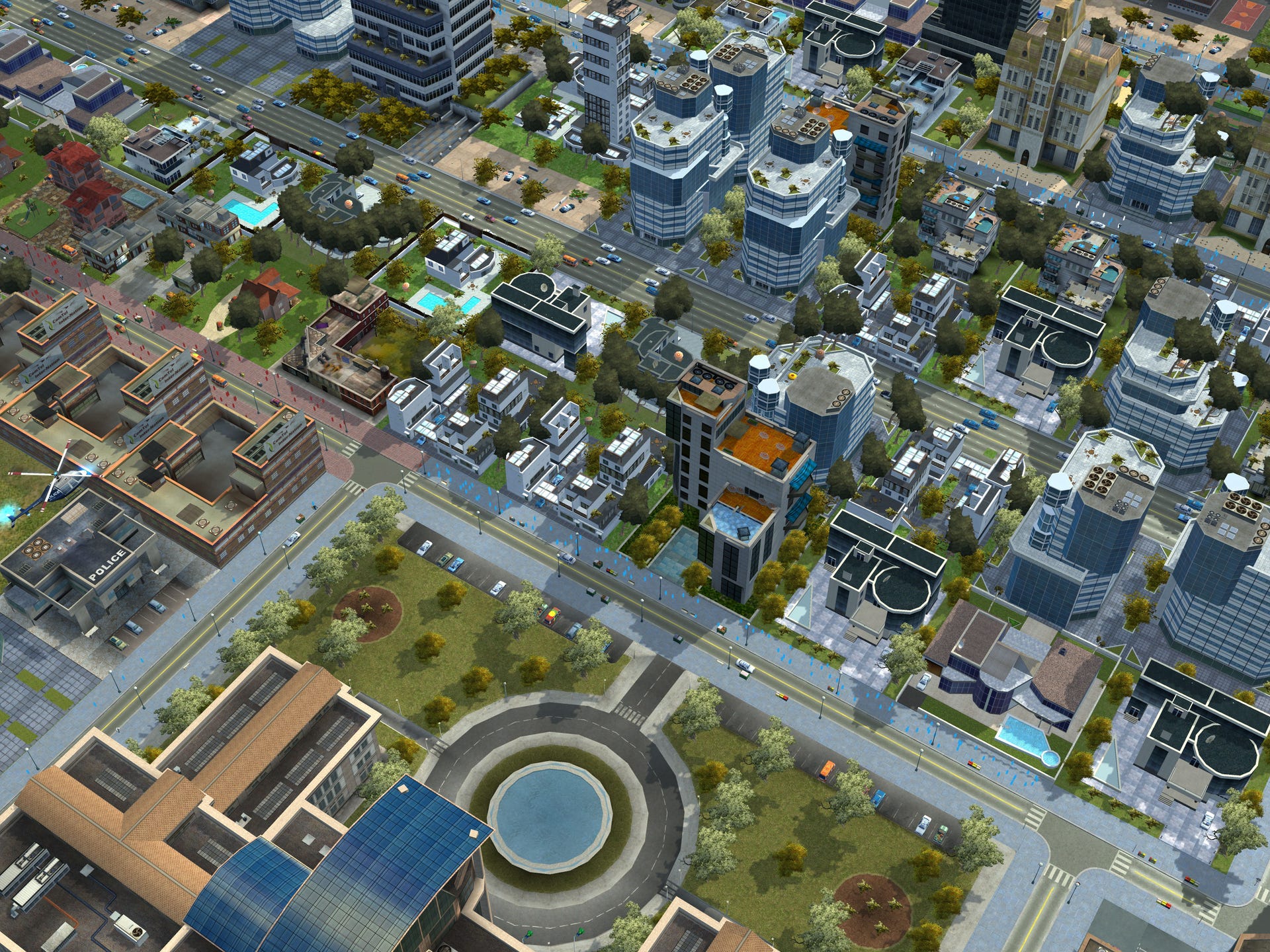
3

The pavement colours mark out the neighbourhood's dominant social caste.

The key twist to City Life is this element of social dynamics. There are six classes, and the have-nots hate the elites, the blue collar workers hate the trendies, and the goths hate everyone (or they would if they were in the game). Mix antagonistic groups together and they'll fight or worse still a riot will flare up, which is fun to watch (the 3D graphics can be zoomed in to ground level) but not good for your score.

While these social factors and different demands and reactions from the various groups are an interesting idea, the game suffers from a lack of direction. The scenarios are largely the same, with equally vague premises that basically boil down to building a big city with the odd nuance thrown in by the surrounding terrain or climate. There are graphs hidden within menus that give you more feedback on your city status and ability to plan, but the temptation is to simply plonk down buildings as and when the icons and videos tell you.

Having said that, there's nothing offensive here, and if you haven't tried City Life before it provides a reasonable if rather plodding casual city-construction experience. Those who own previous incarnations of the game won't find it a worthwhile upgrade, as it merely adds some new scenarios (which aren't much different to the old), a fresh dollop of buildings and an editor that allows for importing satellite maps. Nothing to get too excited about, really.

5/10

The Sims 2: FreeTime

Those hapless sims. Always running around cleaning up dirty plates, fixing showers, plunging toilets, mopping up spills. Between work, house maintenance and a demanding social schedule, does the average sim have any free time? Well they better make some, as EA's latest expansion pack for the juggernaut series is based around hobbies.

And there are plenty of past-times on offer, including keep-fit, playing the violin, building a model railway and playing videogames (like The Sims 3). My bohemian review sim decided she was going to get into arts and crafts in a big way, so spent many an hour daubing on canvas and spinning the old potter's wheel.

There's an impressive attention to detail here, as a painting takes quite some time to complete, with the image building slowly, piece by piece on the canvas. There are various different styles, from portraits to abstracts, and the finished results can be hung on the wall or sold for a decent amount of dosh, making a secondary income to supplement the day job.

5

Hmm... what seems to be the problem here? Aha - no wheels - that's it.

At higher hobby skill levels, sims can instruct (or indeed bore) other people in their crafts, and even join secret clubs at the top echelons. The catch is these skills decay if not used, and keeping them active alongside the everyday rounds of cleaning and socialising can be quite challenging. That's fair enough, but the rate of decline seems overly harsh when you max up a skill and then half a day later it drops back down a point.

As well as the hobbies, FreeTime introduces some extra career paths, so if you've ever wanted to be a dancer, comedian or oceanographer (erm...) now's your chance. Moreover, there's a new lifetime-aspiration meter that measures the overall success of the sim in achieving his or her life's ambitions. Filling this up earns aspiration points which can be spent on perks such as slower motive decays, or sharper business instincts to secure easier promotions, along with secondary aspirations that grant further benefits.

It's not exactly ball-busting stuff, but these are interesting additions that keep the game feeling fresher, and make the juggling act of moulding the perfect sim a little trickier. Chuck in a slew of minor additions, such as extra outfits and the ability to edit a neighbourhood's terrain after it's been created, and there's enough here to make FreeTime a worthwhile addition to any Sims fan's expansion collection.

6/10

Penumbra: Black Plague

"If you feel ill, do not proceed to sickbay. Instead, chain yourself securely to the nearest heavy object, sound the alarm, and wait for trained professionals to arrive."

I don't know about you, but if the training video for my new job contained that delightful piece of advice, I might reconsider my career path for something more preferable. Such as a lavatory attendant, or perhaps a pharmaceutical guinea pig.

Clearly, all is not well at the Shelter Research Station in Greenland. Things haven't been quite the same since they excavated an ancient dig site, and the staff became infected with some manner of virus that turns human beings into maniacal flesh-rending zombie-type things. And guess who awakens in this research base, locked in a cell with a thumping headache and some seriously vivid hallucinations for company? And soon after, an extra and not very welcome voice in the old noggin.

Penumbra is a seriously spooky first-person adventure in the horror-survival mould. Think flickering lights, blood-splattered walls and guttural noises echoing down ventilation shafts; late at night, on your own, it's all quite unsettling to say the least. Particularly when the infected are first encountered, and Penumbra takes on a stealth element as you crouch and crawl around, trying to sneak past the beasts.

This game of horror hide-and-seek can lead to some truly pant-peppering incidents. At one point, I thought I'd cleverly evaded one shambling nasty, sneaking into a side room and hiding behind a crate. The thing was still audible, muttering outside in the corridor somewhere, so I risked a peek around the side of my cover. At that instant the door to the room flew off its hinges as the monster burst in - that was a genuine jump-in-your-seat moment.

4

The infected aren't your only enemy - there's also the security systems.

The tension is well-maintained throughout, with all the trimmings such as menacing low-key music and thumping heartbeats. Even the plot is enticing, involving secret society shenanigans and weird otherworldly interludes. Penumbra also boasts a fully interactive environment, meaning you're not restricted to collecting objects in your inventory, it's also possible to fling them across the room, or drag furniture around.

Most of the game's puzzles are satisfyingly logical, although some - particularly those in the hallucinogenic realm you encounter - are rather abstract. But the only really annoying ones are those that involve object-manipulation, as the physics system can be pretty wacky. Placing a plank across a gap is a tedious exercise in fiddling around, dropping it, moving it a bit more, rotating it and so on. Even turning a vice is painful, as it only moves freely if you grab it in exactly the right place, and say the magic words, whatever they might be (four-lettered ones didn't seem to work).

The marvellously creepy atmosphere falters a touch as you get further into the game and realise the zombies might be infected but they're not particularly effective. It takes a fair few hits to kill you, and it's relatively easy to wriggle away and sprint off, losing your assailant without too much trouble and then hiding again. But the good outweighs the bad here for sure, and Penumbra's pacing, story and genuine sense of uneasiness makes for an intriguingly dark adventure tale.

7/10

Read the Eurogamer.net scoring policy

Comments (41)

Comments for this article are now closed, but please feel free to continue chatting on the forum!

  • Loading...hold tight!