A chap called Daniel Garner accidentally drives into a truck on his wife's birthday and they both die. For a game that's heavy on spearing zombies to walls through the face and giggling, it's all a bit melodramatic. Trapped in purgatory, the only way to rejoin his wife in heaven is to become an agent of various angelic and demonic creatures - one of whom has her boobs half out. His mission? To kill wave after wave of the hell creatures marauding towards him, then to move forward a bit and trigger another spawn. It's the sort of stuff that Milton would have come up with if he'd had greater access to Nuts magazine and methylated spirits.
Now developing Bulletstorm with their buddies at Epic, Polish studio People Can Fly created a rough-edged marvel with Painkiller. At the time much of the instant appeal came from the fact that the game appeared at the dawn of in-game physics and ragdolls (nobody had ever nailed a gasmask-wearing WW1 soldier in the leg and seen him dangle from the ceiling of an Underground station before) yet even six years on those simple pleasures remain. The gut-pinning, momentum-harbouring stakegun, as lovingly ripped off by BioShock 2's speargun, is still the most satisfying FPS weapon of modern times.
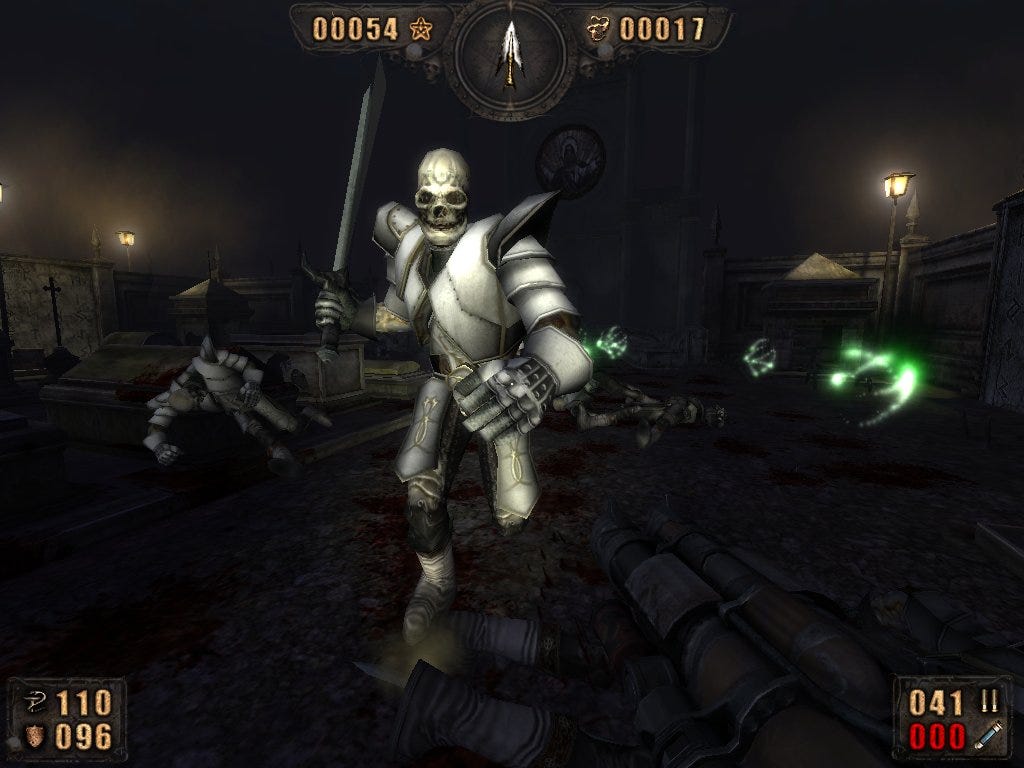
Skellingtons. Eat your heart out Harryhausen.
It's the art style that continues to impress the most though: the bad guys look gorgeous no matter which way they're flying and wherever way their legs are splayed. Cowled Jawa-esque monks armed with axes, whimpering eyeless zombies crawling on an asylum ceiling, witches darting overhead on flaming broomsticks... Painkiller's AI may have worked in a straight line, but the minds that created these monsters certainly didn't. And those enemies got big - huge even. Six years down the line facing one of Painkiller's hundred-feet high bosses is still an awesome experience.
There are few games that let you run between the legs of a goliath hellbeast and shoot him in the unmentionables, while he angrily slams the ground with a hammer the size of a bus and crumbles the physics-laden scenery. The first time you, and various pieces of ancient masonry, are thrown into the air at the moment of hammer impact is just as exhilarating now as it was six years ago.
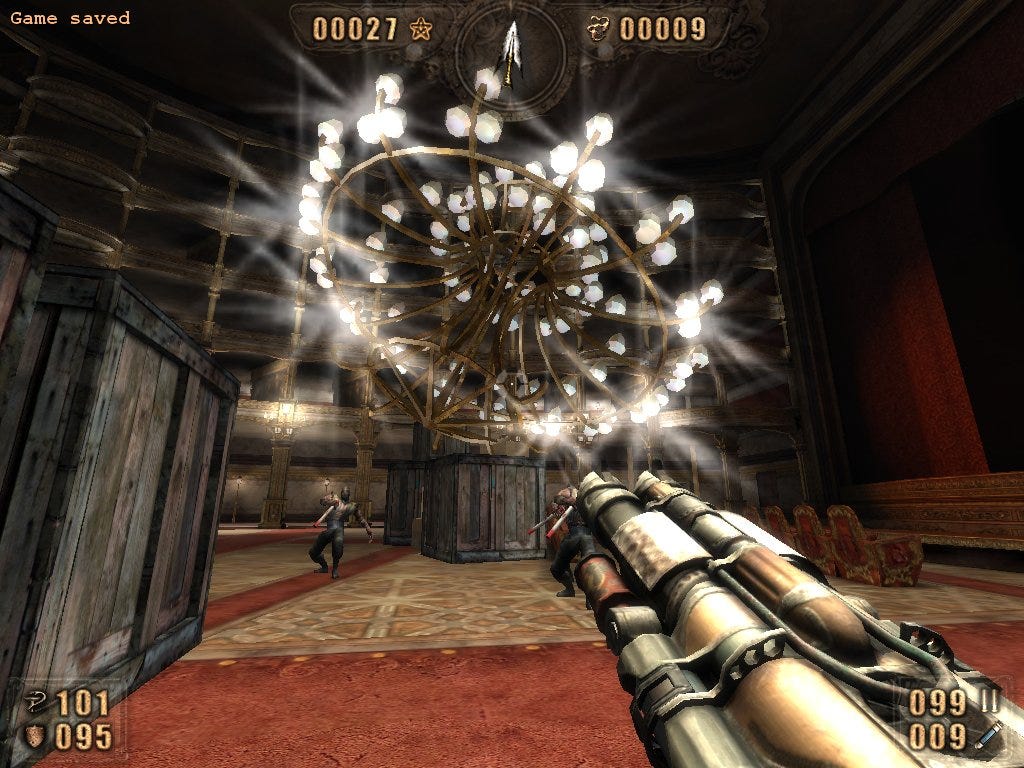
A fight at the Opera. Back in the day the collapsing chandelier was a physics marvel.
To house this towering menagerie though, you need vast and echoing levels - and this is again an area in which Painkiller summons a degree of awe. For a start, the slices of hell that People Can Fly designed were often highly imaginative - for every generic graveyard there was a beautiful opera house, for every medieval town there was a Venetian city on water or old-times train station invaded by the war dead.
These levels could often only be described as cavernous: Painkiller's high vaulted ceilings really pull out the feelings of personal-tininess that you get when walking into a real world cathedral or stadium. No shooter apart from the original Doom has ever toyed with scale to such a successful degree; and despite the primarily rush-n-hack enemies there's an awful lot of lines here that can be traced from id to the Warsaw offices of People Can Fly. The setting, the colossal bosses, the wide open spaces, the distant growls and grumbles and the multiple spawns are all very Doom-y, while the pursuit of a pure, fast and simple form of deathmatch certainly feels a lot like Quake.
Much as I'm fond of its devotion to the old-school, however, I'm not immune to the game's failings. As will no doubt be underlined in the comments thread below, when you stopped taking Painkiller in small doses it got repetitive. Beautiful as they are, levels outstay their welcome. As a relaxing 20-minute break from the daily grind Painkiller was a triumph, as a game you played in long sessions it could eventually feel a mite purgatorial itself.
Replayed in the modern day, when you're not automatically dazzled by the ragdolls and fizz-bang physics, this is an issue that's ever more of a problem. The notion that enemy corpses dissolve into flashing green souls that will eventually turn you into a monochrome-vision heat-hunting death demon is fine in theory, but it slows the game down no end while you're doing laps through the guts of the deceased to harvest them.
So why devote the Eurogamer retro section to Painkiller? Well, simply because when you replay it you can't help but think how well it bodes for Bulletstorm. Painkiller was rough, ready and old-fashioned in its outlook, but it was also book-ended by some very forward-looking traits.
Note the barbed-wire mask. Charming.
Take, for example, the Black Tarot cards that you can unlock through certain basic tasks in each level and then open up various abilities that you can swap round and take into the fray - essentially the achievement and perk model that is now central to so many shooters released today. Epic didn't just team up with People Can Fly on a whim, they're a studio with great deal of original thought and an unparalleled imagination.
Painkiller pulled off the remarkable trick of cut-and-pasting an insane creative vision out of its designers and into the game's framework. It plays like a game where anything goes, and usually does. Take for example the final level, at the very bottom of the Pit. The actual confrontation with Lucifer is a bit dodgy, yet the level that surrounds it is mind-boggling.
It's essentially a freeze-frame level of warfare through the ages - if you ignore the similarly anti-climactic ghost enemies. The frozen-in-time scenery is special, strange and haunting. At first medieval arrows hang in the air and the faint sound of ancient battle can be heard, then you're in WW1 and looking the precise moment in time that smashed bricks and mortar are exploding from sides of trenches.
Painkiller was gib-heavy in the extreme. If there was a limb: it could fly.
Later on an upended warship on an unmoving, rippled sea is captured at its most vertical moment before it slowly plunges into the water below. Finally, looming over the entire level, is a nuclear mushroom cloud frozen in time. As hellscapes go, it's an exceptional one.
So, six years on has People Can Fly abandoned Painkiller? I don't think so, not entirely. Bulletstorm takes place in on an abandoned tourist planet: a heavenly paradise gone wrong. Thematically, at least, it's on the other side of the Painkiller coin - just with more Epic-y space marines and fewer awful cut-scenes starring a recently deceased widower.
The whole set-up allows for the same wild divergences in scenery and fantastically imaginative enemy design. I'm quietly confident that Bulletstorm will be the best shooter of next year, and it's the remaining splinters from the stake that Painkiller fired through my face in 2004 that have me convinced. Roll on next February.
