Mercury Meltdown Preview
The sequel. Butter whole lot better.
Ignition's Studio Manager Edward Bradley has just come back into the room to find me crashing his new game, Mercury Meltdown. Whoops.
"The big myth of the games industry is that it's hard to be a game designer," he says, as we fill a bit of time waiting for the devkit to reboot. "It's easy to be a game designer; it's turning the ideas into products that's the hard part." And when you do make it? "There's no shortage of ideas, just a shortage of time - which is a nice situation to be in."
Unsurprisingly, the conversation's slipped off a ledge into the realms of what was left over from the last game, a UK PSP launch title. And the answer, it turns out, is rather a lot.
"We didn't have the luxury of iterative design on the first one," he says. "It was get it right first time... or die! It was on the emulator until about five months before it was released, and it was on the unfinished libraries until a month before release."
No wonder there were problems then. And there were. Mercury - a game about moving a gelatinous blob of liquid metal around mazes, flicking switches and spray-painting it to move through coloured gates, all the while trying to avoid letting too much metal slice off or fall off the edge of the level - was widely praised but also savaged in places for its punishing difficulty and dodgy camera.
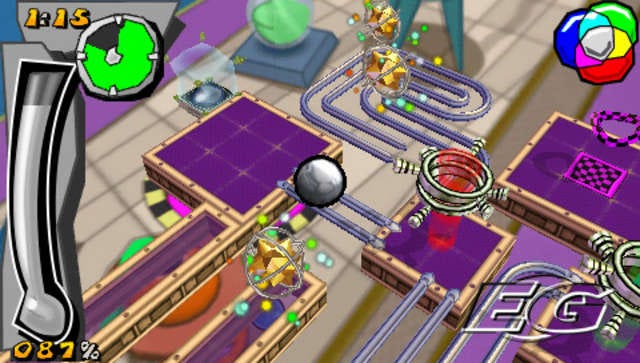
New mercury states mean Ignition can do lots of previously impossible things with the levels.
For the sequel, things are a bit better organised. There are new ideas, but most importantly Ignition Banbury (formerly Awesome Studios) has been able to sit back and take stock, and the result is a game that isn't just a sequel but, they hope, an even better game than the one the team tried to make in the first place. With it, they aim to maintain Mercury's position as a beloved plaything of the physics-toy-loving hardcore, but open it up too, with party games and more forgiving mechanics. With that, they might finally creep out of the shadow of more popular tilt-based games, like Monkey Ball.
"There's no getting away from the fact that Monkey Ball set the bar that we have to try and beat in the minds of gamers and the press, so comparisons were inevitable," says Bradley. But Mercury's more than rolling a ball around a maze - and the new game accentuates that difference, allowing for mercury that's hardened, like a ball, but also less viscous mercury that's almost a puddle. Something SEGA certainly can't do. "Yep. Let's see them melt their monkeys, eh?"
The first step in reinventing Mercury for Meltdown was to go back and assess what worked and what didn't. There were all sorts of things that needed updating. The vacuum tubes, for example, which sucked you up and spat you out elsewhere in the level. "Functionally identical to a teleporter, 53 times more difficult to QA and set up properly. They added three months to the project, those things. So many artistic and technical challenges." So they're gone.
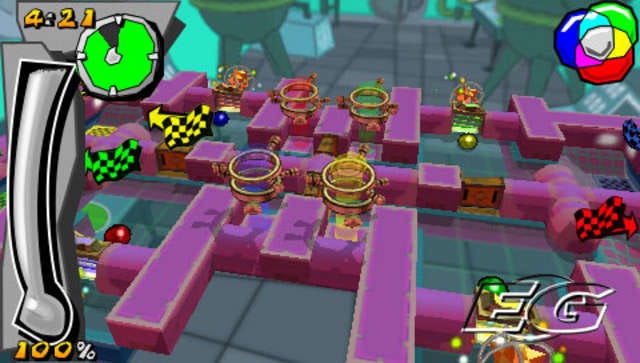
As before, you'll need to split into smaller coloured blobs to reach certain areas - something the on-screen chart (top-right) aids immensely.
The camera, meanwhile, hasn't changed dramatically - you still use the PSP face buttons to change orientation, but there's also a free-view mode now so you can scan the level to see what needs doing. Just press Select and you can zoom around with the analog nub, or use the d-pad buttons to flick between objects to see what they do. Not only that, but this time you won't automatically lose when the timer runs out, so if you don't make it in time you can still examine how the level works - and aim for other objectives. Is that going to be enough to sort out people's camera concerns though?
"There was no team on Earth that was going to code a camera that worked with all those levels," Bradley notes about the first game. That's also the key to sorting it out. The camera can't be much better - although it's been recoded so it should do a better job of handling spread-out blobs when you sheer your mercury into pieces - but the levels can be. "Basically, we've designed levels in such a way that they don't cause so many camera problems." Easy fix then.
All of this should help make the game more accessible, and that's a theme throughout- the game's structure is now a lot less punishing too. "Because the difficulty curve was all over the place, people would get stuck because of the linear structure," Bradley observes. In answer to that, you now have multiple levels available at once within each hub. The hubs are laboratories, and each level is a test-tube - you just rotate and pick another one if you get stuck.
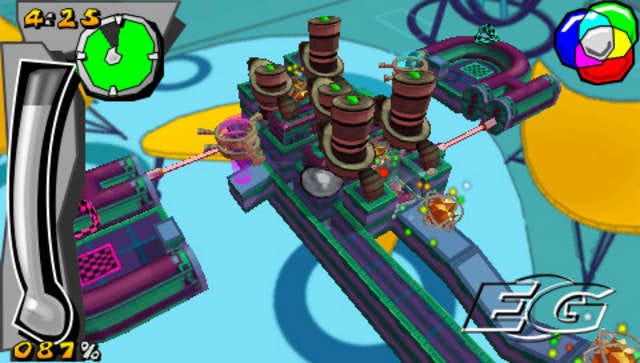
Some levels are fiendish, but the ability to use free-view to explore them will make things simpler.
As before there are eight worlds (labs), with a couple of hidden ones and bonus levels to unlock. And instead of having three distinct objectives, they intermingle - with the test-tube corked when you complete a level with 100 percent of your mercury intact, a sticker attached if you collect all the bonus stars, and a golden cork if you can do both those things and achieve a time limit. To add to the accessibility, you don't have to do them all at once. "We're not actually guaranteeing that all of them are achievable on a single run," in fact. Somewhat by accident, it's a similar approach to puzzly racing game GripShift - and that's no bad thing, given the replay value inherent to that largely unloved little game. Unlocking new labs is a question of filling up an overall mercury tube on the left side of the lab screen, and you don't need to finish all the levels to do that - there are merely bonuses if you do. Similarly there's a bonus test-tube that fills up as you collect stars, and for this you gain access to the party games, of which more later.
On the whole then, it's a game that's been expanded to fit a wider audience, and make them comfortable - there's an optional five-minute tutorial to go through the main aspects, and there's even a colour chart in the top-right of the screen so you can see how the colours mix at a glance. It might sound like a small thing, but it's symptomatic of a broader change.
Fortunately for the likes of us, that doesn't mean Mercury's been dumbed down. On the contrary, it should be more hardcore than ever, with a total of 168 levels ("exactly double, completely by accident"), a host of new elements to overcome, and - most importantly - still a place for those of us who obsessed over finding shortcuts. In fact, we're better catered to than ever. "At the end of the day it's just a physics system," says Bradley. "There's no scripted control of the gameplay at all. All we've done is make the system and let people play with it. So people are going to find 'emergent behaviour' or whatever fancy word you want to call it, but of course it's a double-edged sword, so for every instance where someone finds a cool new shortcut someone finds a bug. But no, we've definitely tried to keep that aspect in there."
"Some of the levels are designed with the shortcuts in mind. On the first game, we were getting videos back from Sony QA in Japan where their testers were doing stuff that had our jaws on the floor. They sent back high scores we were convinced were impossible and we made them send videos to back them up. So we've definitely tried to keep that in place, especially on some of the more advanced worlds." Videos will play a part here too. You can save replays (cleverly, the game simply remembers what you did with gravity, so the actual file-size of each replay is minute - it just re-enacts your best runs), and you'll be able to swap them with your friends to see how tricky routes are done. You can play through a level while someone's ghost is at work too. "We may end up making replays and ghosts available so you have things to compete against and see how particularly difficult routes are done, too," Bradley says of the game's promised downloadable content - which will also, you'll be pleased to hear, quite possibly include classic packs of some of the latter levels of the first game that you may never have reached.
And of course Meltdown has plenty of new features. Mercoids - those pesky little buzzing fellows who ate up your mercury - return in several variations; some eat certain colours of mercury, others blow you up into tiny parts. There'll be three-way painting gates that change your colour depending on which side you go through, too (handy, and also "basically gives us more colour options on a single level without cluttering it up with 55 paint shops"), plus bounce-pads, attractors and repellents (think magnetism), dice with coloured sides that need to be rolled onto corresponding switches, Mouse-Trap-style runners for your solid state and, well, that brings us onto the different states.

The graphical style's certainly new, but don't go calling it cel-shading.
Being able to vary your mercury's viscosity should add a whole new dimension to proceedings. Heaters heat your mercury and make it more runny, so it splits up much more easily, while the cooler-blocks harden it slightly so it's still gelatinous but unlikely to split up when you roll it over narrow ledges. You can also turn into a solid sphere - and thanks to some more advanced rendering techniques you can even make out the mercury rolling thanks to slight textural changes.
That in turn brings us onto the graphics, which are likely to be the most obviously different thing for fans of the original. The original's graphics were "well liked" says Bradley, but some people felt they were too cold and sterile. This is meant to be warmer, brighter. "A lot of people want to pigeonhole it as cel-shading or whatever, and it's really not the case," he says. "The engine does all the same sophisticated rendering techniques and more. The only thing that's really changed is the art style, and there's no fancy buzzword associated with it. We just went for a brighter, clearer style." Complete with a black outline, hence the cel-shading accusation. "There's divided opinion about the black line round the mercury," Bradley notes, "so the original skin is in there as well." Another nod to inclusiveness. "I've got used to the new one myself, but some people will say it makes them bleed from the nostrils or whatever so it's there." Well quite.
Perhaps spontaneous nasal eruption is a bit unlikely, but you might still fancy punching people. For all the shift towards accessibility, it's not going to be easy if you want to push it. "Yeah it still makes you swear, don't worry," Bradley jokes. I certainly swore when the game crashed just as I was about to beat a particularly tough level I'd spent half the demo session trying to conquer. You'll also be able to take your frustrations out on other people's faces, by playing ad-hoc battle mode on the same stages - and then there's two-player options for each of the party games, which we might as well move onto.

Collecting bonus items unlocks more levels. The whole thing's geared toward replay value.
Unlocked by collecting bonus stars (remember? You have been paying attention, yes?), with "the thresholds set deliberately quite low", there are five of these to play through and first impressions are promising. There's the Monkey Ball-style Race mode, obviously, but there's also Rodeo (you're a blob, you've got to hang onto a ledge while a fan bombards you with jet-bursts of air - AI or second-player-controlled), Metrix (a three-in-a-row puzzle style game where you have to try and fill a grid by creating Tetris shapes), Paint (where you try leave a trail as you move around a tray, trying to cover as much as possible in your colour while the other person does the same), and my favourite Shove ("Paint" came close, but lost out because it needs to be called "Warring Snails"). Shove is basically mercury-curling, with multipliers, slow down/speed up buttons, and the potential to be just as addictive in multiplayer as Monkey Bowling. There are as many as 30 levels for each party game, including, for example, Shove levels with dog-legs and other obscure designs.
All of which adds up to a game that could, as Ignition hopes, deliver on this ideal of a game that's hard for those who want it to be, but also simple and varied enough for people like Kristan to play without crying. There's certainly no shortage of ideas. There may be a shortage of time - a perennial problem for game developers - with the game due out in September, but having spent an afternoon in its company I don't feel guilty saying I'm glad it's due so soon. Expect more on Mercury Meltdown when we get our hands on playable code in the near future.
Mercury Meltdown is due out in Europe this September, with a US release just beforehand at the end of August. See how it looks over on Eurogamer TV.
You may also like...
-
Happy Action Theater Review
-
Call of Duty: Black Ops has best game ending ever, says Guinness World Records
-
Mass Effect 3 Demo: The First 20 Minutes
-
Why Devs Owe You Nothing
-
Tim Schafer: publishers aren't evil
-
Sony confirms PS Vita 1st Party digital only game prices
-
Halo 4 Master Chief action figure flaunts new suit design
-
Face-Off: Final Fantasy 13-2
-
ModNation Racers: Road Trip Review
-
App of the Day: Monkey Bump
-
Sony's $50m Vita marketing campaign targets PS3 owners
-
EGTV: Eurogamer playtests PlayStation Vita
-
UK Top 40: Kingdoms of Amalur: Reckoning beats Darkness 2
-
Fallout: New Vegas dev asks fans what game they would like it to Kickstart
-
Retrospective: Star Wars Episode I Racer
-
Digital Foundry: PS3 Skyrim Lag Fixed?
-
Metal Gear Solid 3D demo on eShop this week
-
Metal Gear Solid 5 expected between April 2013 and May 2014
-
DICE working on multiple Battlefield 3 fixes
-
Making FIFA Street in the FIFA engine's image
-
Activision: games are relationships, "brands in people's lives"
-
FIFA Street footage pits France vs. Germany
-
Ridge Racer Unbounded delayed by four weeks
-
No plans for Journey PlayStation Vita version
-
Gotham City Impostors Review


Comments (19) Latest comment 6 years ago
Comments threads automatically close after 30 days, but please feel free to continue chatting on the forum!
Comment below viewing threshold Show
LocoRoco taking ages to appear.. and my psp is gathering dust.
Comment below viewing threshold Show
Lumines is quite good.
If you haven't got a PS2 Katamari would be a good purchase perhaps?
Comment below viewing threshold Show
Not that i don't want Console esque games on a handheld, it's just... getting spanked by DS handheld games at the moment.
Comment below viewing threshold Show
Also, this looks like a prime suspect to be released as a downloadable demo meethinks
Comment below viewing threshold Show
I know it's supposed to be good, but it doesnt appeal.. doesnt seem like a "proper" handheld game to me.
Same goes for burnout.. which again i know is supposed to be good.
I cant see how a 3d platformer like daxter will work with 1 analog stick, I *REALLY* hate the on foot parts of liberty city as i cant control the camera... and feel like i need a 2nd stick for the job.
Mercury 2/LocoRoco look more like the sort of games i'd want to play on the psp.
Comment below viewing threshold Show
FM - deffo not!
I'm after simple fun games, with depth.. hmmm.. guess i'd best just wait for loco.
Comment below viewing threshold Show
Yay!!! Now I know we can turn off that cel-shaded shite, I can start getting excited about it again \o/
Comment below viewing threshold Show
Only reason i didnt get this game is the reviews said it's too rock hard and fiddly, not because of a black line!
Comment below viewing threshold Show
But then again, I haven't finished any of my PSP games...
But then again again, I don't go on holiday that much, so it's cool.
Comment below viewing threshold Show
@smelly: Daxter is really great. It's setup really well for handheld gaming. You can control the camera using L and R buttons and the game has been designed so that this is all you need when it counts (i.e. when fighting bugs).
When looking for hidden stuff and such you can press the up button to get a first person 'look-around-in-3d' with the analog stick, which works fine too.
Of course, it's virtual lack of load-times also helps - you die, you restart instantly. And you can save at any moment, which adds to portable bliss.
It's really an awesome game, highly tuned for portable gaming.
Also Burnout Legends being on budget and all is something which will find its way to me shortly. What I think makes it particularly suitable to portable gaming is the crash mode games, as these are very short. At least that's what I read ...
Comment below viewing threshold Show
In fact, the level design was the primary cause for most of the problems.
The camera was fine, but when you had 2-tiered platforms you couldn't see properly.
Its not to say the team did a good job, its just a sign that they didn't get enough time to design the levels.
I'm expecting that this time around they'll have had enough time to playtesting to create levels that can be beaten and then replayed to get crazy high-scores like the Japanese playtesters mentioned.
I remember the different between Super Monkey 1+2 and Katamari Damacy 1+2 and I'm sure this could improve similarly.
The only problem could be if they spend too much time on the newer stuff too refine the gameplay and level design.
And please please please let us have that original skin. Mercury just isn't the same with those black lines.
hmm... I wonder if they could recreate the Sony Bravia advert with this XD