Tom Clancy's EndWar
Kill by mouth.

"I do not know with what weapons World War III will be fought, but I do know World War IV will be fought with sticks and stones."
The words of Albert Einstein flash up during a video teaser for EndWar, silently looping on the flatscreen in a meeting room in Ubisoft's impressive studio in Shanghai, China.
Ol' big brain's mid-20th Century musing neatly establishes the geopolitical context for this near-future thriller - a new franchise in the mega-selling Tom Clancy franchise. And an ambitious, new direction, an RTS designed specifically for console that offers control over an entire nation's armed forces by voice alone, like some kind of virtual Vera Lynn.
Einstein is doubly appropriate. The FBI had assembled a 1,427-page dodgy dossier on him by the time of his death in 1955, the celebrity genius nevertheless successfully avoiding trouble, despite his political outspokenness in the US and an affair with a Russian spy. The stuff of Clancy, right there.
EndWar is set 13 years in the future. A global anti-ballistic missile shield has failed, Saudi Arabia and Iran have engaged in nuclear war, oil prices soar, America overreaches and, well, the whole bloody planet kicks off. The pledged 'end of strategic nuclear war', with rather devastating irony, merely serves to ignite World War III. Whoops.
EndWar deals with the 'Atlantic theatre' of the war: concerning the US, the European Federation and Russia. China, where the game is being made, and where we've been whisked away to for a first in-depth look at the project, is conspicuous by its absence.
China is in reality, of course, a nuclear power and an emerging superpower. It's also a notoriously thin-skinned Communist nation, with a state-controlled media. (No doubt the games industry PR community has at least some sympathy with this).
Shanghai, far more westernised than this westerner's eyes were expecting, is the financial and commercial hub of the country, with a shopping district that could frankly be Oxford Street, London on the surface.
It's only when we try to access Wikipedia (blocked), or search for local background information (most foreign Google links for general background on China are blocked), that we are abruptly reminded of the political climate.
In other words, don't expect China to start blowing the shit out of the planet in any games coming out of Ubisoft Shanghai anytime soon.
"Basically, being here we can't do anything that would portray China in a way that would be seen to be villainous, as bad guys, etc." Aussie creative director Michael de Plater tells us.
"Obviously when we get to the Pacific theatre [planned for the next instalment], we're going to have to look at who does what there."
Aside from that inconvenient truth, though, the company is free to get on with its business without intrusion, and has seized upon China's great natural resource: the vast, and largely untapped, pool of development staff.
"The Chinese games industry has actually exploded over the last few years," reveals Julian Gerighty, editorial content director and chief cheerleader for Shanghai.
"It's about that limited pool of talent worldwide and being able to tap into the best artists, the best engineers worldwide. Shanghai is one of those examples."
EndWar's development team is overwhelmingly local, overseen by key creative staff either shipped in from elsewhere in the Great Rayman Empire, or poached from afar.
But this is not, as the residents of Royston Vasey would have it, a local game for local people. It's an all-guns blazing, flag-waving Tom Clancy epic, yet one that is boldly going where no console strategy game has gone before.
"Dead end"
Consoles aren't exactly buckling under the onslaught of RTS titles. But Ubisoft believes that's not down to lack of demand, rather the wrong approach. In other words, the traditional PC approach. Stand well back.
"PC RTS has gone up a bit of a dead end," explains de Plater, a veteran of the Total War PC strategy series. "The excitement and interest of soldiers and armies clashing is really interesting and compelling. But because of the success of Warcraft, C&C and Age of Empires, everyone has gone down this other path and forgotten what original war games really were.
"People are trying to come back [...] but they're loaded with this baggage," he adds. "Take Company of Heroes - they make this fantastic tactical war game, but then they still have this hardcore economic simulation that you have to play at the same time. If they cut that loose, it would be a much better and more fun game."
At the heart of de Plater's grievances is the issue of accessibility. "With traditional PC RTS there's almost this threshold of complexity," he complains. "The really good players have to master the keyboard shortcuts, the build orders. It's almost like learning a language. Then there's a layer on top of that where it's interesting and strategic. At that level I think we're really similar. I think we've just stripped out all the housekeeping decisions."
That might put the hardcore's nose out of joint, but it's fundamental to the studio's approach. de Plater routinely cites what Bioware did for the RPG with Knights of the Old Republic as both a paradigm and aspiration. "Every single successful console game is either third- or first-person," he muses, referencing THQ's Full Spectrum Warrior and Nintendo's Pikmin as rare examples of console strategy done good.
The art of war
So the first big change is how you view the action. "Every RTS has this intro sequence of 3D, and hills going over the horizon, and huge armies clashing like a real battle. And then there's a game where you build a town hall, or a farm. There's always been this big disconnect between the promise and the experience. We basically wanted to make a game that was more like the CGI intros to other RTSs than the gameplay."
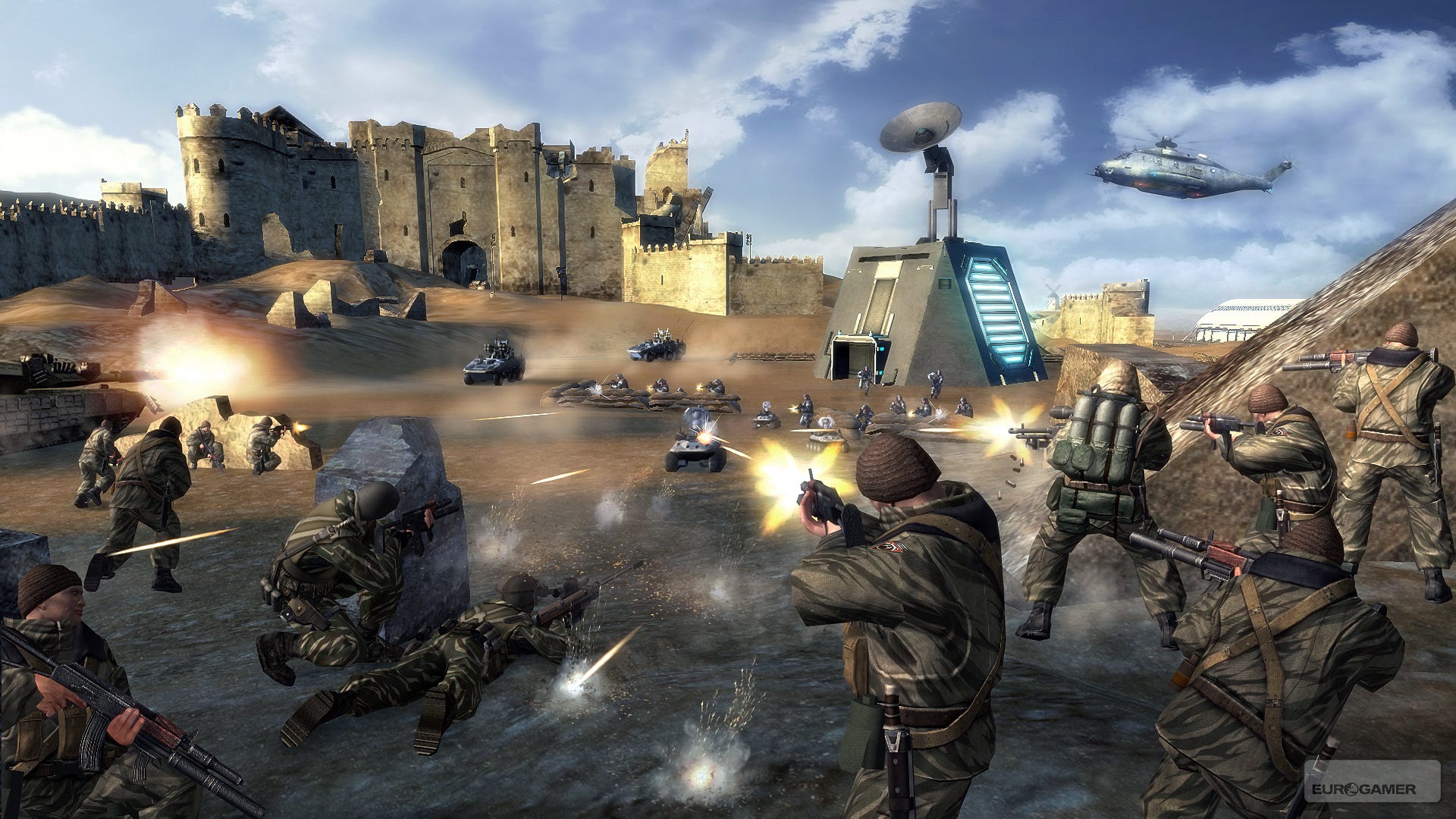
The excellent PC version of World In Conflict rolled its tanks into three-dimensional warfare earlier this year, of course. EndWar takes a slightly different route. Critically, the camera isn't free-roaming, and this may prove contentious as the game nears release. That's because "the downside of putting the camera so you can see everything, is that you can see everything," according to de Plater.
Ubi's solution to this awkward paradox - essentially its 3D implementation of fog-of-war - is line-of-sight. You should only be able to see what your units can see. So you can look around freely only from the point of view of each unit.