Overlord Review

Gangs of New Orcs.

Version tested: Xbox 360

I had to genocide the elves. I had no choice, you understand. Well, I had a choice, but that'd involve not killing the elves, so it wasn't really a choice at all. So, as the remaining elf-maids cried to the heavens, my giggling serfs dragged off an enormous pile of gold which I'd spend on an old fridge which leaks CFCs constantly or something.

Cheerio, eldest of the races. I hardly knew ya.

Overlord is about being Evil. I'm giving 'Evil' its capital, because it's not really about being evil. This isn't about being evil like in dealing crack to kids, or death camps or telling your girlfriend you're working late in the office when you're really screwing your secretary. You're evil, but not like - say - Hitler. You're Evil like Mum-Ra the Ever-Living. Your character is silent throughout, but you know if he ever laughed he'd go "Muhahahaha" and be entirely unashamed by it.

Overlord is about the Pantomine of Evil. The "you" when the children cry "HE'S BEHIND YOU!!!!" That's you.

Overlord's probably most succinctly described as Fable meets Pikmin with Dungeon Keeper's plot, with splashes of Diablo and Sacrifice. Succinctly, but almost entirely incomprehensibly. Let's break it down.

You're the Overlord. The land is in peril - the peril is you. Well... if the land realised it was, it would be. From your stronghold, you venture out into areas of the world in an attempt to initially reconstruct your home and then gain as much power as possible. This involves hunting down and killing the heroes of the land. Except, as you rapidly discover, the heroes aren't exactly Heroes. The Paladin's a pervert. The Dwarf is phenomenally greedy. And the image of the enormous bloated sac of the halfling hero rolling towards you, like Monty Python's Mr Creosote turned nasty, is terribly memorable. Don't expect wide roaming - the model for the quests is Fable, in terms of branching - because instead you've mainly got linear paths with hubs, but there's still a considerable degree of freedom, with you able to return to previously explored areas to harvest more life essences for your diabolical purposes.
1

Out of the frying pan, into the third-person action/strategy game.

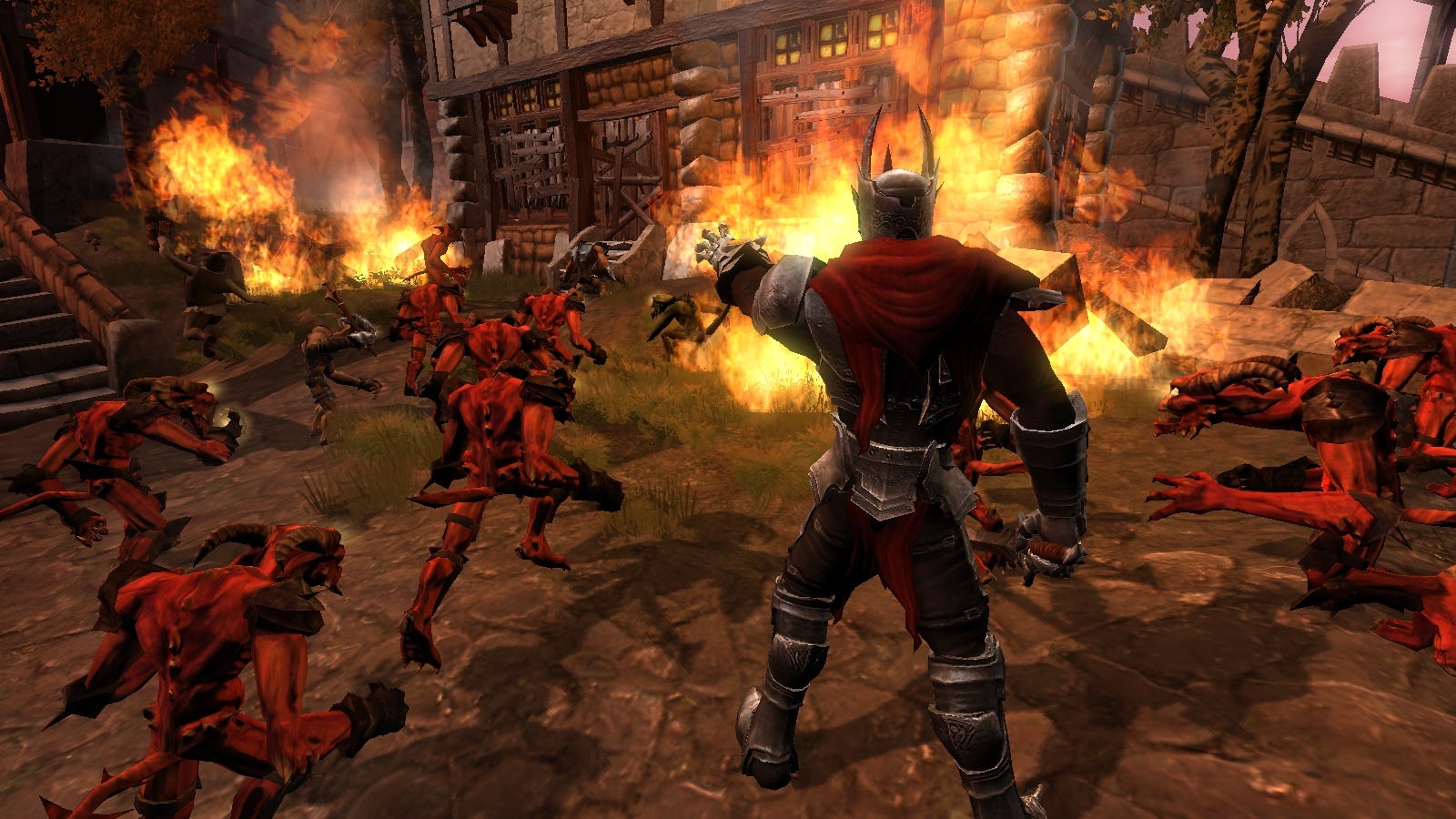
The harvesting life brings us to the Sacrifice/Pikmin aspect of the game, and its main device. While you pick up spells and improve your weapons throughout, your real killing power is derived from your minions. There's four life essences in the land, each of which allows you to summon one of the quartet of servants. Brown minions are the largest, and basic hand-to-hand bashers. Red minions lob fireballs at a range. Green minions perform vicious backstabbing attacks on opponents, if they can get into position. Blue minions are ludicrously weak but can resurrect their fallen companions if they get to them in time. In a Zelda-derived fashion, the last three are also able to unlock routes further into the game - reds can remove fire, blues can swim and greens can clear poison clouds.

The reasonable skill-set expands its appeal with the specifics utilisations. For example, you can leave groups of minions in a set position rather than trundling after you. This means you can leave Reds in a safe cliff to provide covering fire. The greens when given a station to guard will go invisible, allowing you to set traps. Between your ability to lock onto opponents and send minions charging with a trigger-press or being able to use the right thumb to move the mob through the terrain, there's a lot of control.

At which point the sober thing would be to spin off to talk about how all this enables a series of accessible yet enthralling puzzles - the minions moving where you can't get to, or whatever. But that's deceptive, because while it's true, this it's not a sober game at all. It's a happy game. When you get up to controlling thirty of the squeaky little creatures, you feel something like a teacher on a school trip with the bottom set. You kind of set them loose, and havoc results. Like every RPG ever, boxes contain items... but it's a whole lot more interesting when there's a mob of Gollum-squeaky creatures smashing up shit and bringing the best bits to you ("FOR YOU!" they yelp, offering up golden trinkets, an enormous grin on their little diseased faces).

Not that they'll settle for that - they find weapons? They'll pick them up, and use them themselves. Keep any given group alive for a long time and they'll become an increasingly heterogeneous mass. The guy with the axe - fine. But what about the one with a pumpkin on his head or brandishing a zombie's forearm? From the first second of the game proper, where you lead the first mob into bucolic fields to just slaughter defenceless fleece, it's a pleasure to be in their company. More than the script (generally witty and sharp, if occasionally undercut by an iffy voice-actor) or the graphic design (a brother to Fable's faux-fantasy charm), the constant capering of your charges is what gives the game its personality. That is, they have a lot of personality and so does the game.

2

Typical. You wait for ages, then three succubus turn up at once. Er... one here. And Succubi is the plural. Joke fails.

Problems? Well, as the intro says, anyone expecting genuine evil will be a bit disappointed. In fact, there's a number of your tasks which may as well be what a hero does (when you're collecting an uppity princess' luggage, you do wonder whether Sauron had to put up with this stuff). It even kind of becomes the joke. Especially early on, there's a fairly obvious irony in that everyone else in the world is assuming that you're this brave hero when in fact you're clearly a sociopath. The tone's set in an initial cruelty, where you raze a farmer's house and he's grateful for it. Put it like this: it's not going to join Manhunt 2 on the public enemy lists.

The real problems with the game are more mechanistic. Surprisingly, despite the fact the minion controls take over the right thumb-stick's traditional role as a manual-camera-shifter (that's the technical term, don't you know) there's only occasional problems with the camera position. What's more annoying is the occasional imprecision in the monster control. The Blues' ability proves especially useless, as they'll prioritise gathering treasure and killing over collected their fallen companions. The big-bosses lean towards the underwhelming rather than the tiresomely repetitive kill-crazy, which is the better choice of the two evils. It saves its unpunishment for elsewhere, especially as the game progresses - a twitch can lead to losing most of your horde on a fireplace if you're not paying attention. When making your way across a desert is less perilous than making your way around a kitchen, something's gone wrong. Probably its biggest failing is the lack of an in-game map function. While one comes with the manual... well, it's not 1991 any more, guys.

3

It's a good fixer-upper.

It's easy to forgive. Overlord may remind the more experienced gamer of a mass of things, but it's only so identifiable as they're conventions which relatively few games have used successfully. And when a few quick clicks send a spindly-limbed wave heading over to cause havoc, it's its own thing. As much of a monster as you are, when you see a powerful succubus flying through the air, covered by your little green guys, holding on with one hand and stabbing desperately with the other, you end up feeling... well, a little parental.

Oh, the little darlings. I'm so proud. They're not evil. It's just... high spirits.

8 / 10

Read the Eurogamer.net scoring policy

Comments (106)

Comments for this article are now closed, but please feel free to continue chatting on the forum!

  • Loading...hold tight!