"It's the usual rip-off." "F*** you Nintendo." "Worst. Update. Ever." "F*** off you rip-off bastards." "Get bent Nintendo." Not my words, of course, but the words of Eurogamer readers after discovering that they would have to pay GBP 149 or thereabouts for the Nintendo DSi, which introduces slightly bigger screens, onboard flash memory and a download store, a couple of 0.3-megapixel cameras and an SD card slot at the loss of GBA compatibility - all housed in a slinkier, matte frame.
Not only are they not my words though, but they aren't my sentiments either.
Eurogamer has banged on about Game Boy creator Gunpei Yokoi's philosophy of "the lateral thinking of withered technology" before, and it's worth repeating, not just because it infuses everything Nintendo does, but because it's even more dramatically relevant to the DSi than it has been to the DS, Lite and Wii.
The 0.3MP DSi cameras are hardly going to frighten the average mobile phone, smart or otherwise, and the limited music playback functions are unlikely to scare Apple back into R&D on a new iPod; but for now they - and the amusing photo and sound mixing software packages included in the DSi system software - are little more than proofs of concept. Like the original idea of having two screens, the stylus in addition to regular d-pad and face button controls, and a microphone built into the handheld, they are there to tempt developers in new directions. If pressed, Nintendo would explain that it only includes new features in consoles when they facilitate creators and they are cheap enough to mass-produce at a profit. This is what Yokoi was on about, although one of the virtues of leading the market is that Nintendo rarely needs to say so directly.
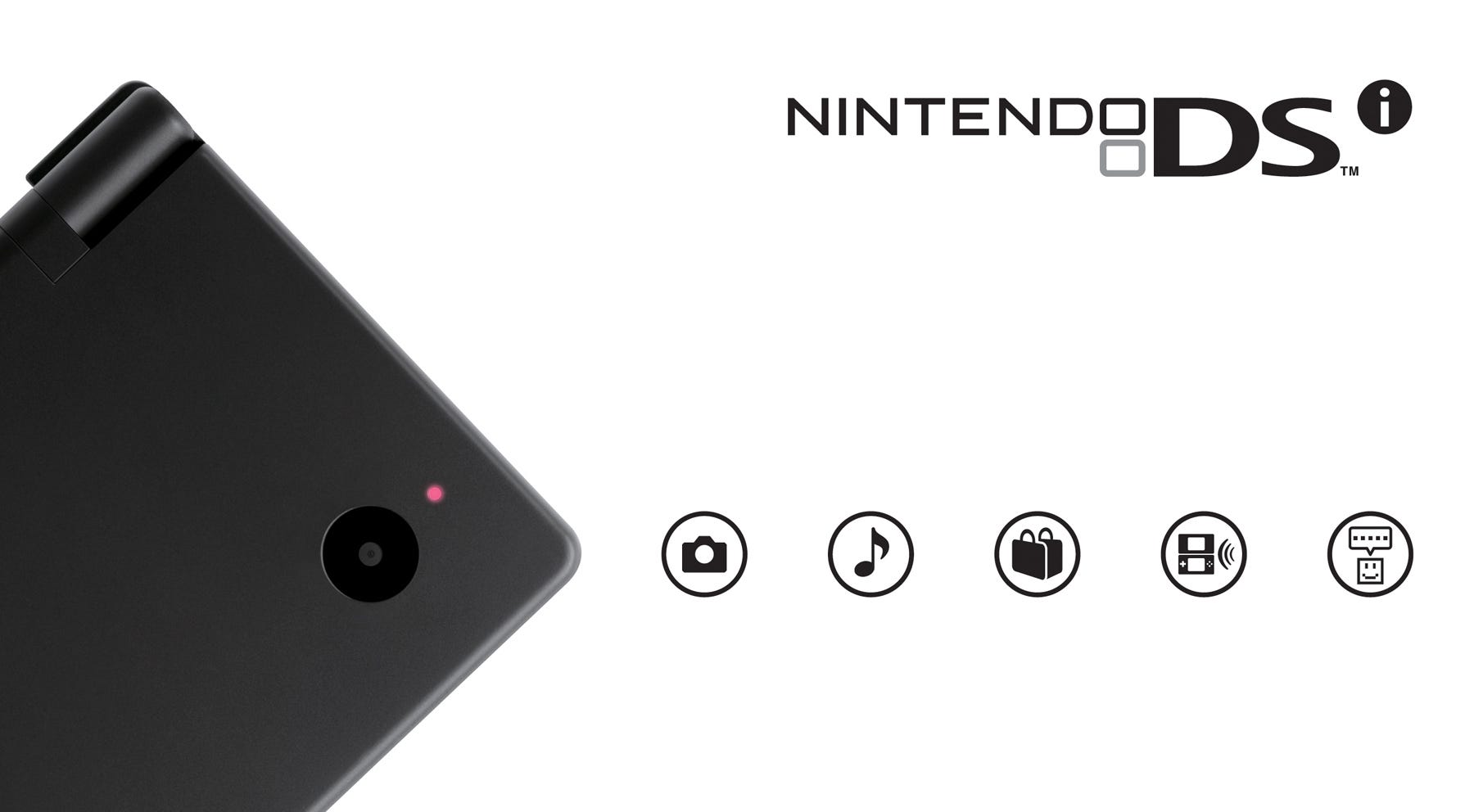
The DSi will launch in Europe in two colours: black and white.
The bottom line for the average Eurogamer reader is that the camera and its new friends are not designed to sell the system to you immediately; they are designed to appeal to developers, and to briefly entertain people who do take the plunge without delay.
It's the same story with the SD card slot and the DSi Shop, which is inaccessible to European journalists at the time of writing, but has grown from nothing to boast over 20 games - including a new WarioWare, Solitaire, Mr. Driller and Panel de Pon - and half a dozen basic applications in Japan in the five months since the system launched. On the surface of it, there is nothing there to tempt the money out of your wallet this time next month. But in the longer run it will be a tempting reason to consider upgrading, even for filthy pirates bemoaning the obsolescence of their beloved R4s - an obsolescence Nintendo will hope to sustain with rolling firmware updates that are prerequisites for Nintendo Wi-Fi Connection and DSi Shop access.
If you can see a pattern emerging, it crystallises further beneath the DSi's slender bonnet, where CPU speed doubles from 67MHz to 133MHz, there's 16MB RAM (four times as much as the DS or DS Lite), 256MB of internal flash memory for the first time, and enhanced Wi-Fi support (WPA and WPA2 security, most notably). Right now, your existing games have nothing to gain. But you can look forward to games that will benefit from it, judging by Nintendo's admission that we can expect DSi-specific releases. The tech tweaks are hardly enough to worry the PSP's bigger and faster alternatives, but it's a rather more attractive proposition taken in context of the beauty and creativity already exhibited by some of the best games in the DS' existing back catalogue.
It also goes some way to explaining the GBP 149 price - along with currency fluctuations and, most significantly, the presence of the DS Lite on the market. Nintendo isn't abandoning the DS Lite, which costs GBP 99; it's happy to continue selling it, but it wants to launch the DSi now to build up a base of early adopters, fit to encourage developers to consider it as an alternative, and presumably to get the DSi Shop out there, and start fighting back in the war against casual piracy.
When it comes to Nintendo, the old rules of console launches do not apply. There is no need to keep the more powerful and capable DSi in isolation, nurturing specific games and third-party exclusives, and then unleash them on the market in a competitive hammer-blow, not least because the main competition is the DS Lite itself. Nintendo is the first company in the history of games that can afford to launch a substantially new console with no software, expect it to sell and expect to make money off every unit sold, and not even bill it as a particularly new console.
Yet, for all of that, it's hard not to see where all the swearing's come from. Core gamers have been bred to expect things at cut prices, in huge quantities, and for anything older than today to be forgotten in the process. The market reality is artificial - the Xbox 360 may retail for GBP 129, but you don't get a hard disk, the games you actually want, or the extra controllers and add-ons you need, and Microsoft loses money for selling it to you at that price. Nintendo has to make a decision: map its behaviour to a competitive pricing strategy that is no longer relevant to its business plan and profits, or cry itself to sleep for a few weeks under a blanket of four-letter internet tirades every time it launches a new console. Evidently it's chosen the latter because, in the long run, it's a sensible compromise: you are an important part of Nintendo's plans, but you're a core gamer, so you're fickle, and when the DSi reaches the tipping point, you'll be there in a flash. This doesn't mean Nintendo hates you, or doesn't respect you.
There is one unknown quantity in all this, however, and that's the question of region-locking on DSi-specific software. Nintendo has said that this is down to a mixture of embedded communication functionality and parental controls across regions, and the company's addiction to consumer safety is well-documented (Friends codes, anyone?). But on the other hand, it's easy to understand why it adds insult to import-minded gamers who already feel injured enough by the pricing to go on the internet and tear their hair out.
The original helpful shot comparing the DS Lite to the DSi.
The only way for Nintendo to answer this to everyone's satisfaction is to localise every game instantly, and release them all simultaneously, so nobody in Europe ever has to wait months for Rhythm Tengoku, or a new Ouendan game. But of course this is impossible. Never mind the role of third parties, who may not even want to release certain Japanese or US games in Europe, localisation is far from instantaneous, and Nintendo has its own way of doing things. Take Virtual Console as proof of that: although releases roughly align, the same games in different territories are treated as separate entities, with numerous different concerns like licensing contributing to delays in some cases, if not complete absence in others.
The irony is that there's no question Nintendo is better at releasing things quickly in Europe than it used to be, but it will never be enough for everyone. The greater irony is that this is because the DSi is being pitched as an upgraded DS rather than a new console, despite its numerous revisions. But the greatest problem is that even if Nintendo were to overcome localisation delays and standardise game releases across regions, region-locking still restricts people who honestly spend time in more than one country, and want to buy their DS games wherever they are. There's no answer for them except the lifting of region coding.
All of which leaves us with one question: should you buy a DSi on 3rd April? By now you probably know the answer. I think it's a splendid handheld, and you can read more about exactly what it does that appeals in our already-extensive Japanese DSi hands-on, which covers all the specifics. But the truth for core gamers is the same now as it was then: you don't need this yet, but you will one day, and Nintendo isn't quite the ogre you were thinking.
Nintendo DSi goes on sale in Europe on 3rd April for GBP 149.
